 Tim Romero · · 4 min read
CFO of an Airbnb for meeting rooms on Japan’s fundraising and sharing economy landscape
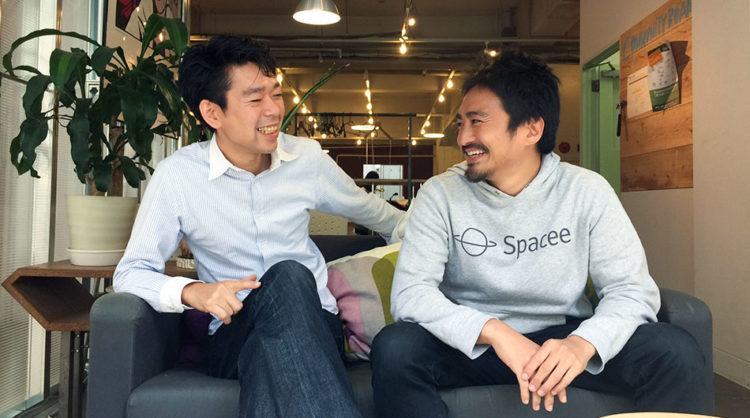
Spacee CEO Keisuke Uchida and CFO Takuya Umeda.
This article is part of Tech in Asia’s partnership with Disrupting Japan where we publish the revised transcripts from the show’s podcast interviews with Japanese entrepreneurs. This is heavily revised from the original transcripts. For the full interview, go here.
Spacee is a startup that rents out people’s unused space around Tokyo to salesman, co-workers, or those who need a quiet place to conduct business.
Here, I spoke with the company’s CFO, Takuya Umeda, on the sharing economy in Japan and some of the problems it’s facing there. He also explained why the company decided to delay taking outside investment for almost three years before finally taking an investment from 500 Startups.
Could you tell us a bit about how your startup works?
It’s really like an Airbnb of business. In Japan, whenever you have an outside meeting, the only place you go to is Starbucks or a cafe.
If there is a professional conference room, it’s really expensive. It’s probably US$44 per room, per hour. So we found that there is a gap between an expensive conference room and a Starbucks.
Who are your customers?
We’ve now run this firm for a little over three years and we found that not only do the sales guys use it but also the marketing people, as they don’t have enough meeting rooms in their office. Usually, they use the rooms for a little less than three hours.
On the supply side, it’s those people who have a little extra space. We have tutoring schools, language schools, karaoke places, and actual offices on the platform.
Are you looking to go beyond Tokyo?
I think that if we establish the concept in Tokyo and we find the core value of it, we could. Office buildings always have empty rooms and tenants are always looking for a room. But our business is 90 percent in Tokyo for now. So we should try and go out to other big cities like Osaka, and Nagoya.
Now, we’re trying out our customer model in Shinjuku, twice in Shibuya, and now inside the whole Yamanote line area. Once we do that, it’s easier to switch over to other cities, I think.
You only recently got funded. Why spend three years bootstrapping?
Our CEO, Keisuke, used to have a solar panel package information pricing company—or something like that. He sold the division of the firm, which was like the first in seed finance for Spacee.
We also had an angel investor invest in us a year ago, but we still bootstrapped for two years.
Some people wanted to invest in us beforehand, but we didn’t want to lower our market value. So, we waited. That’s one reason. We also tried to raise our value more, but it’s good to have 500 Startups as the first fundraising in Japan.
What’s your impression of the fundraising environment in Japan?
It’s not easy. As a startup, you have to have decent traction. I think it’s getting harder—you need products in traction for the next round.
What advice do you have for startup founders trying to raise money in Japan now?
Both Uber and Airbnb have had problems in Japan. What do people think of the sharing economy here?
If I gave you a magic wand and said you could change one thing about Japan, what would you change?





Stay updated on the go with our mobile app.
Get latest insights with smoother, more personalized experience through TIA mobile app.











📅 Upcoming Events
22 October 2026
Payoneer x CSPN Summit 2026