- Insights This article was written by a TIA community member. Insights pieces undergo the same rigorous editorial process that newsroom-produced articles have.
 Abhilash Kayarat · · 3 min read
How blockchain can solve issues around app store payments
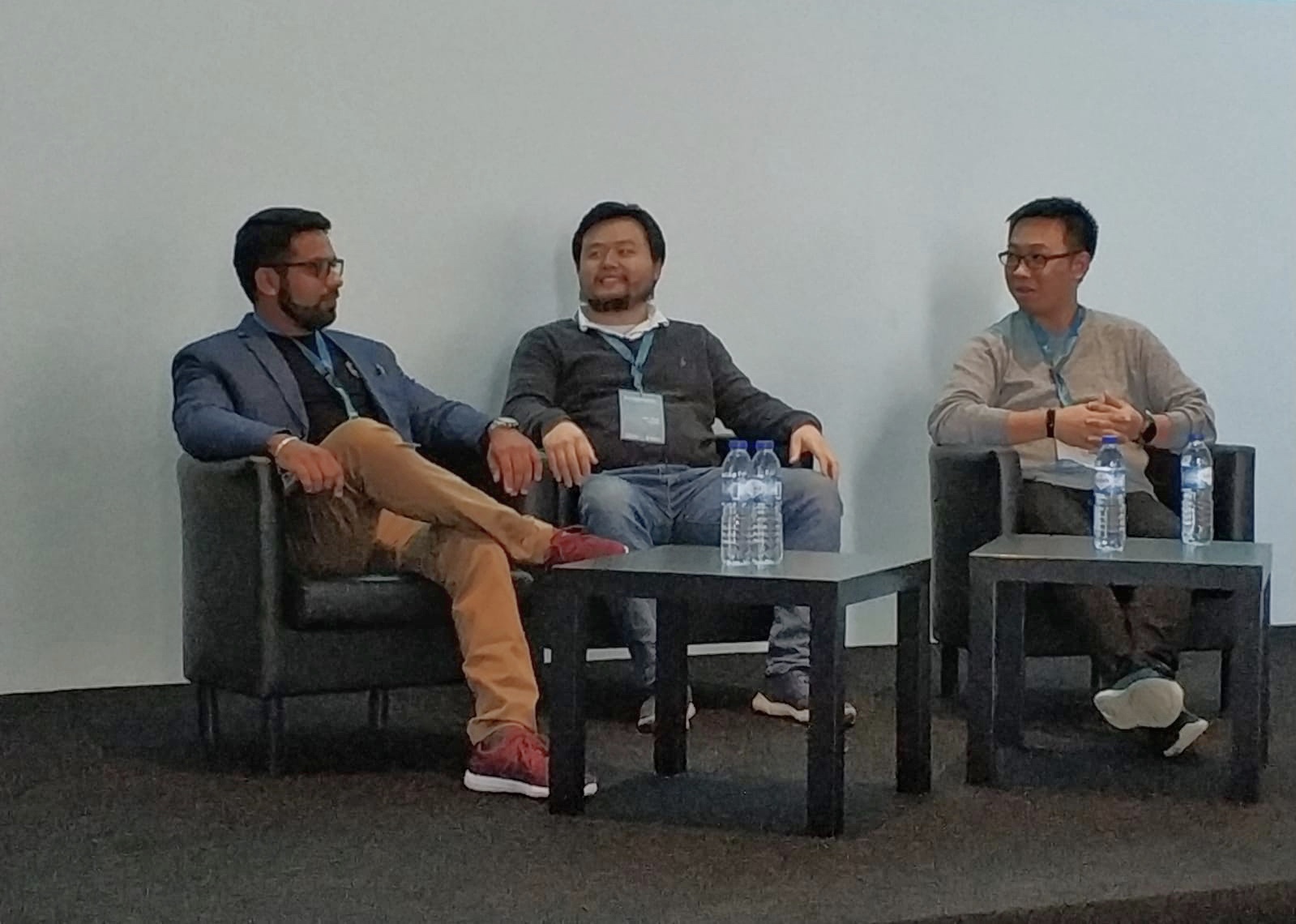
(L-R) The author, Ren Tang (VP of product for Aptoide), and Quang Tran Vinh (COO of Appota)
Disclosure: AppCoins and Aptoide are Tech in Asia clients.
Mobile applications have come so far.
Many of us can still recall when Nokia debuted its phone which allowed us to play “Snake” barely two decades ago. Today, mobile apps play an integral role in our work and personal lives.
But the app store industry faces a problem: it doesn’t have an open, standard solution for app distribution. So, I discussed this topic with Ren Tang (VP of product for Aptoide) and Tran Vinh Quang (COO of Appota) in a panel for the App Store Foundation’s event in Portugal.
Answering this problem with blockchain
During the event, it was announced that the App Store Foundation has been incorporated to promote AppCoins (an open and distributed protocol for app stores). Aptoide, a marketplace for mobile apps and a founding member, will be the first to implement the protocol, but more will follow.
AppCoins aims to efficiently manage incentives between developers, users, and app stores. A part of the protocol is composed of smart contracts that enable developers to create and store advertising campaigns on the blockchain.
This will allow developers to see an overview of active campaigns, validate proofs of attention (PoAs), and reward users for giving attention to apps. This means that once users are verified to have spent two minutes of attention in an app, they will be rewarded with bounty.
Pros and cons of this approach
AppCoins was built to solve the industry’s problem (i.e. not having a single APK that works for multiple app stores). According to Tang, the protocol allows for lower acquisition costs, trust and transparency, and easy developer integration.
But he also mentioned some challenges it faces:
- Consumer adoption: The crypto community is still a very small fraction of the world’s population. So, Aptoide users may not have AppCoins or Ether to make payments. As a workaround, the project can detect whether a user has any of the above cryptocurrencies. If not, they can make payments through credit cards. In this option, the money is debited from the credit card to the back end, and the payment is made to app developers in AppCoins.
- Speed: Ethereum transactions are slow, and users may not be ready to wait this long to pay in-app. To solve this issue, payments can be done through a side chain and processed immediately. The purchase will then be instantly downloaded for the user, and the transaction can be written in the blockchain afterward.
How blockchain is making a real-world impact
To illustrate blockchain’s real-world impact, let’s take a look at Vietnam.
In the country, most phones are illegally unlocked from their carriers. So, people don’t usually pay for apps. But at the same time, the mobile games market in the country has grown phenomenally, making up a third of the whole market in Southeast Asia.
Appota (a mobile app service provider in Vietnam) created an advertising platform that drives installs for apps and helps developers make money from their traffic. The company also has a marketing rewards app, a payment solution, which provides a cost-effective payment gateway for its partners, and an e-wallet for its users.





Stay updated on the go with our mobile app.
Get latest insights with smoother, more personalized experience through TIA mobile app.