- Insights This article was written by a TIA community member. Insights pieces undergo the same rigorous editorial process that newsroom-produced articles have.
 Seyi Fabode · · 3 min read
Why big companies won’t acquire your startup

Photo credit: Rawpixel
The founder of an early-stage company, which was still trying to figure out product-market fit, asked me questions about getting acquired. He reached out because of some suggestions I made in my newsletter that big companies (BigCo) are slow, hold the bulk of the cash in their industry, and are consequently stifling innovation. He wanted to know how he might get the attention of BigCo to get his company acquired.
It would have been laughable if he wasn’t so serious.
I realized that the acquisition question is one a lot of founders (nowadays) think about as an avenue out of their startup woes.
It’s you, not BigCo
I quickly corrected the assumption he’d made about BigCo holding the purse strings and reminded him that it is the customers that hold the money. I also shared with him that there are basically three reasons why a startup gets acquired:
- Your product is truly game-changing, and BigCo needs to prevent you from eating their lunch.
- Your product provides a new and growing revenue stream or market segment that adds life to BigCo’s already mature business model.
- Your product fills a hole that the company has in its business model or product roadmap.
After reviewing these examples and highlighting that his idea did not fall into any of these buckets, I shared with him some thoughts on why he should settle in for a long journey.
It’s not you, it’s BigCo
In the early days of a startup, the founders and the early team are in search of a business model that works (product-market fit). While the model might be fluid and uncertain in these times, one thing they’re setting is the culture of the organization or their system (the business).
Paradigms, culture, and goals are the highest “points of leverage” (see image below) in any company, and this is where the bulk of this startup’s time goes–even though the team does not realize it.
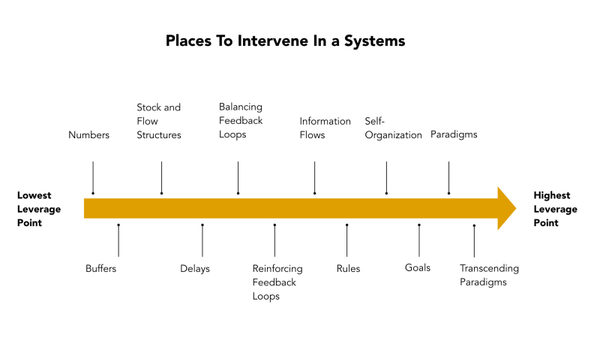
BigCo’s case is the opposite. Numbers and structures are the lowest leverage points within a system/company. It is at these lowest points of leverage that the majority of the employees at BigCo operate in.
Competition and disruption impact the paradigms and goals (higher points of leverage), but the true information about how much is going on with competition/disruption never reaches the executives. This information gets filtered and sanitized within the company, and the size of that company determines how much filtering goes on.
Executive decisions are made from these sanitized pieces of information. An example: employees get a directive to grow X percent this year. To avoid their bosses getting pissed, they make up numbers. When the numbers come in below projections, everyone wonders how it happened.
Settle in, young buck





Stay updated on the go with our mobile app.
Get latest insights with smoother, more personalized experience through TIA mobile app.









📅 Upcoming Events
22 October 2026
Payoneer x CSPN Summit 2026