Connie Chan · · 14 min read
When one app rules them all: The case of WeChat and mobile in China
This post is all about WeChat, but it’s also about more than just WeChat. While seemingly just a messaging app, WeChat is actually more of a portal, a platform, and even a mobile operating system depending on how you look at it.
Much has been written about WeChat in the context of messaging app trends, but few outside of China really understand how it works — and how it can pull off what for many companies (and countries) is still a far-off vision of a world managed entirely through our smartphones. Many of WeChat’s most interesting features — such as access to city services — are not even visible to users outside China. So why should people outside of China even care about WeChat? The first and most obvious reason is that it points to where Facebook and other messaging apps could head. Second, WeChat indicateswhere the future of mobile commerce may lie. Third, WeChat shows what it’s like to be both a platform and a mobile portal (what Yahoo could have been).
Ultimately, however, WeChat should matter to all of us because it shows what’s possible when an entire country — which currently has a smartphone penetration of 62% (that’s almost 1/3 of its population) — “leapfrogs” over the PC era directly to mobile. WeChat was not a product that started as a website and then was adapted for mobile, it was (to paraphrase a certain movie) born into it, molded by it.
Most notable, however, for anyone in the tech business is WeChat’s average revenue per user or ARPU, which is estimated to be at least $7 USD — that’s 7X the ARPU of WhatsApp, the largest messaging platform in the world. How did WeChat do it?
But first, some background: What is WeChat?
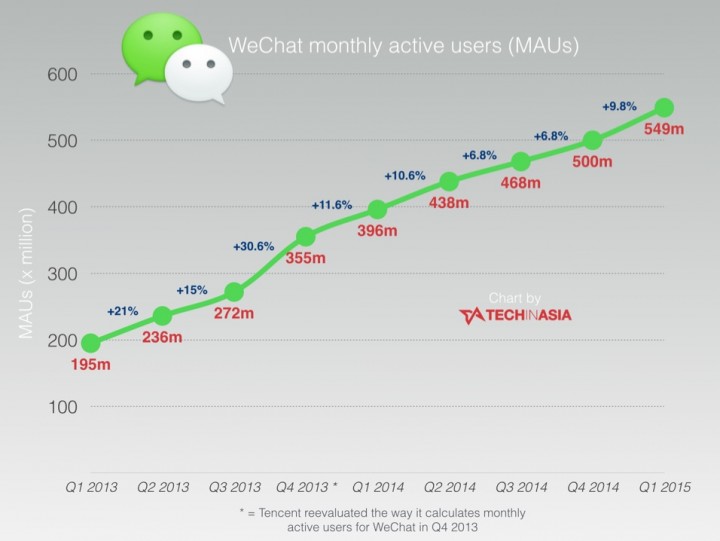
Known in Chinese as Weixin (微信) — “micro letter” — WeChat is first and foremost a messaging app for sending text, voice, and photos to friends and family. It was launched just 4 years ago by Chinese investment holding company Tencent, one of the largest internet companies in the world. As of earlier this year, WeChat had 549 millionmonthly active users (MAUs) among over one billion registered users, almost all of them in Asia. To put that in context: That’s only 150M MAUs fewer than Facebook Messenger, almost 3x the MAUs of Japan’s Line, and 10x the MAUs of Korea’s Kakao (which Tencent is also an investor in). [Tencent is also a strategic investor in a number of U.S. startups, including some of ours.]
Downloading the app is free, and WeChat has only just begun to experiment withadvertising revenue, so where then does its ARPU magic lie? (Especially when one remembers the difficulty of monetizing other universal, utilitarian services like email.) The short answer is that it offers more functionality. Along with its basic communication features, WeChat users in China can access services to hail a taxi, order food delivery, buy movie tickets, play casual games, check in for a flight, send money to friends, access fitness tracker data, book a doctor appointment, get banking statements, pay the water bill, find geo-targeted coupons, recognize music, search for a book at the local library, meet strangers around you, follow celebrity news, read magazine articles, and even donate to charity … all in a single, integrated app.
In WeChat’s case, chat — not other content streams or a search box — is the “universal”UI. (And while this post is not focusing on design, it is worth noting that Chinese apps tend to combine as many features as possible into one application. This is in stark contrast to Western apps, which lean towards “app constellations”.)
How WeChat works #1: The app-within-an-app model — changes everything we think we know about ‘web vs. mobile’
Philosophically, while Facebook and WhatsApp measure growth by the number of daily and monthly active users on their networks, WeChat cares more about how relevant and central WeChat is in addressing the daily, even hourly needs of its users. Instead of focusing on building the largest social network in the world, WeChat has focused on building a mobile lifestyle — its goal is to address every aspect of its users’ lives, including non-social ones.
The way it achieves this goal is through one of the most unsurfaced aspects of WeChat: the pioneering model of “apps within an app”. Millions (note, not just thousands) of lightweight apps live inside WeChat, much like webpages live on the internet.
This makes WeChat more like a browser for mobile websites, or, arguably, a mobile operating system — complete with its own proprietary app store. Not what we’d expect from a messaging app.
The lightweight apps on WeChat are called “official accounts”. Approved by WeChat after a brief application process, there are well over 10 million of these official accounts on the platform — ranging from celebrities, banks, media outlets, and fashion brands to hospitals, drug stores, car manufacturers, internet startups, personal blogs, and more. It’s important to emphasize that these official accounts are nothing like verified accounts on U.S. social networks, where being “official” is mainly a badge of authenticity or identity verification. On WeChat, official accounts are approved to access exclusive APIs for payments, location, direct messages, voice messages, user IDs, and more. (Not every official account uses these APIs, but there are still millions of them that indeed are app-like.)





Stay updated on the go with our mobile app.
Get latest insights with smoother, more personalized experience through TIA mobile app.