
Photo credit: bimdeedee / 123RF Stock Photo.
Let’s consider these for a moment:
Fact #1: Recruiters have giant piles of resumes to go through each day. Given this large amount, they normally spend less than a minute to look at each to decide whether they’re worth pursuing or not.
Fact #2: It is impossible for recruiters to be fully aware of all the skills required for every role in their organization. As a result, they must rely mainly on keywords, and that never gives a complete view of a candidate.
Fact #3: Recruiters and hiring managers may have biases towards candidates without having the benefit of a 360-degree view. This may lead to unobjective decisions that are not best suited for the organization.
What if there was a data-driven approach that could address these problems, process resumes automatically, and give recruiters more time to examine promising candidates?
Enter machine learning and natural language processing
Data-driven HR is the latest trend. Done successfully, it will change the department’s outdated role and turn it into a pro-active and strategic business resource. By leveraging cutting-edge technology in machine learning (ML) and natural language processing (NLP), many companies have already demonstrated how data-driven HR can significantly improve the quality and speed of the recruiting process.
With so much data available, information flooding is another reason why recruiters often ignore candidates that don’t explicitly apply for a position. Having the right tools to objectively judge and rank candidates could help HR find the best match and process more potential candidates.
The goal is to get a complete picture of a candidate’s fit to a specific job position. Thus, the recruiter needs to combine multiple dimensions of information such as skills, education, work experience, location, and others. Using ML and NLP, it is possible to build a pipeline that first extracts all the relevant information from resumes and provides them for review in a structured way.
More mature search and match
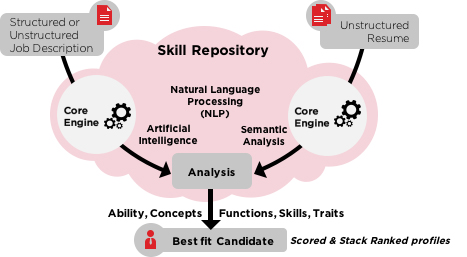
NLP structures resumes and job descriptions to find the candidate with the best fit.
Let’s look at a common scenario. Say a recruiter requires a skill such as “Java.” A tool powered by NLP is able to find its contextual relation with other skills – like Struts and Hibernate. In short, it infers that a person who knows Java has a high probability of knowing these other skills. This helps find candidates who are the best fit for the role.
This is possible when the tool’s core engine runs on the NLP algorithm, which consumes both structured and unstructured data. It helps break down job descriptions and resumes into different abilities, concepts, functions, skills, and traits.
While analyzing, the tool is further able to understand the contextual relevancy of skills and can infer missing ones via an intelligent skill repository (a network of connected skills). Using this enriched analysis of a job description, it searches for the most relevant candidate in the pile of profiles, which are scored and ranked.
Betting on NLP to drive business outcomes





Stay updated on the go with our mobile app.
Get latest insights with smoother, more personalized experience through TIA mobile app.