Dannie Li · · 12 min read
Opinion: Why Airbnb’s China expansion is stumbling
“This is how you kill a successful foreign brand fast: start with a stupid Chinese name.” This was a comment on LinkedIn regarding Airbnb’s latest rebranding in China and is just one of many examples of how the Chinese have responded to the company’s new local name.
At a press event last month, Airbnb attempted to woo the Chinese market by unveiling its new Chinese name “Aibiying.” According to the company, the intended meaning of the name was “to welcome each other with love.” However, Chinese users aren’t buying it. They claim the name is awkward to pronounce and uses weird character combinations.
However, despite this stumble, the company’s latest plans show great ambition for the market. Besides the new name, it also introduced its Trips and Experiences products for Shanghai residents and announced it would double down on investment and scaling the team in China. Compared with the sluggishness of the past three years, it seems Airbnb is this year gearing up to play hardball with the Chinese market.
In this piece, we recap Airbnb’s past efforts for this hard-to-crack market and explain why it’s still not time for it to flourish in China.
A look at Airbnb over the past three years
Though Airbnb officially announced its debut in the Chinese market in 2015, it has behaved slowly and discreetly with regard to its strategic planning. This stands in stark contrast to its more aggressive expansion in markets outside of China, with its usual approach of investments, acquisitions, and new product releases.
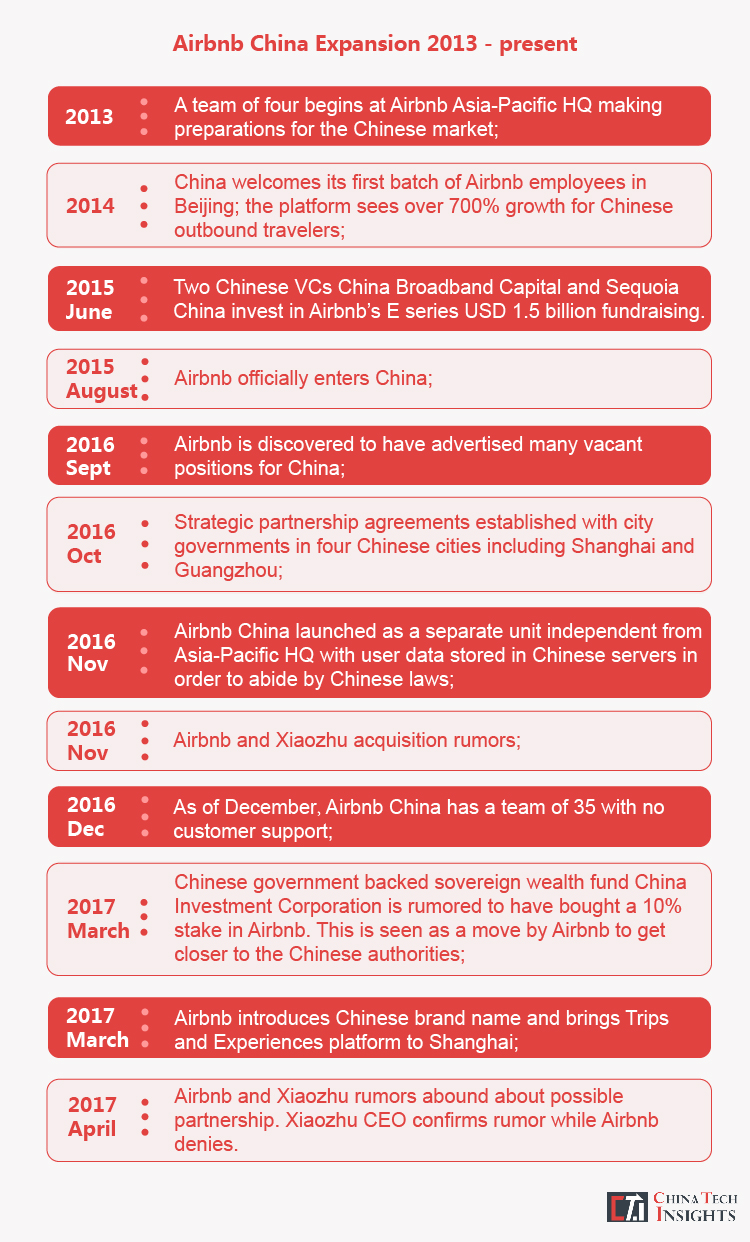
Judging from the steps Airbnb has been taking in China, it has put some effort into providing customized services, adapting products, wooing Chinese regulators, and seeking support from leading VCs.
How does the scorecard look at present? This question can be answered in two parts: a look at outbound Chinese travelers and then a closer look at Chinese inbound tourism. As an established brand, Airbnb appeals to Chinese outbound tourists. The company saw over 700 percent growth in outbound travelers from the country for 2014, with more than 5.3 million reservations by Chinese for the company’s worldwide listings as of last October.
As for the inbound tourism market, tech blog 36Kr wrote, “In the past, Airbnb mainly wanted to attract outbound Chinese travelers to use its app when traveling overseas, but from this year on, it has begun to eye landlords within China.” Despite it being the second strategic focus for Airbnb China, the company currently only has around 80,000 listings in the country, compared with its approximate three million global listings.
For a company who has been on the ground in the country for two years, these achievements aren’t exactly impressive.
Airbnb chooses a slow pace in China
According to Glenn Solomon, managing partner at GGV Capital, one of Airbnb’s investors, “Based on the work we’ve been doing with them, Airbnb stands alone among Silicon Valley companies as really, really understanding that China is different.”
“I’m not here to teach about China. I’m here to learn how to do business in China,” Airbnb CEO Brian Chesky said in a speech made at Fudan University, Shanghai last month.
With a deep understanding of the differences and difficulties of operating in China, a market where many of its predecessors have failed, Airbnb executives have been discreet and modest toward cracking the market.
This explains Airbnb’s slow pace, which is their own choice—to some extent.
Obstacles to establishing a foothold in China
The wait ahead for Airbnb will be long and arduous





Stay updated on the go with our mobile app.
Get latest insights with smoother, more personalized experience through TIA mobile app.