 Samuel Agbede · · 6 min read
My 4-month journey to pass Google’s Associate Android Developer certification
On March 4, 2017, I got an email from Andela, a platform that connects African software developers with global companies. Here’s what it said:
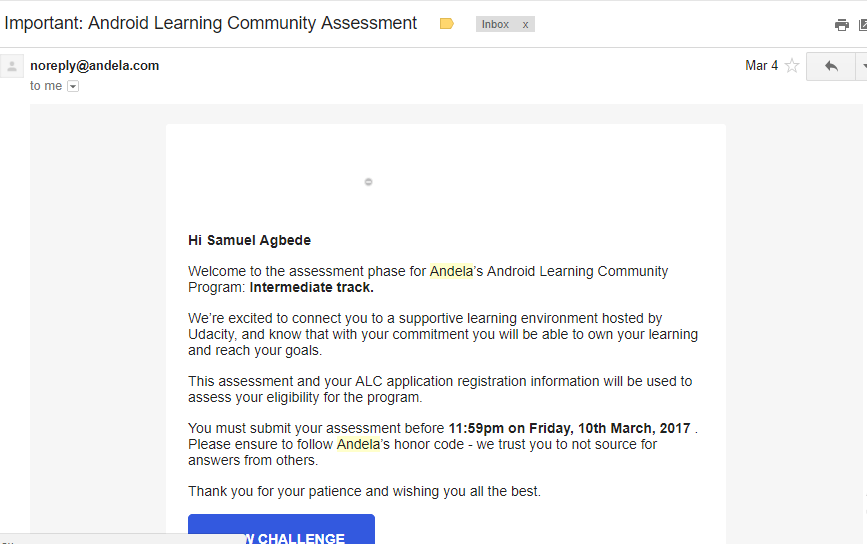
Andela was starting something called Andela Learning Community (ALC), an initiative to train people in Android development. I had previously applied to be a part of it.
I started developing android apps officially in April 2015, when I interned at ITVessel and learned Android application development with guidance from Mr. Tope, a programmer who worked for the company.
After I left ITVessel, I needed to rev up my Android developer life. I started working on projects but did not complete them. I read and watched videos on different Android development concepts but could not put them to much practical use. For instance, I did not understand and even doubted the necessity of UI testing. RxJava was an interesting topic, but I did not achieve much with it too. I at some point, I even started reading about Kotlin (many months before it became officially supported by Google). I seriously needed some structure to understand the different concepts I had accumulated. I was perhaps “information obese” and with incomplete information at that.
So, I was excited to read the email from Andela and decided to apply.
The application
I was required to make a relatively simple application that retrieved top Nigerian GitHub users and displayed them in a list. The app needed to have a share functionality and be able to show user details when an item on the list is clicked. I started the project, completed it after a few days, and submitted it. It wasn’t so difficult.
On March 21, 2017, I received an email congratulating me. I was to join about 119 others who were picked to begin this program. Andela (in partnership with Udacity) sponsored our training in Udacity’s course preparation for the Associate Android Developer Exam.
The Associate Android Developer (AAD) certification is an entry-level examination by Google. It costs US$149 and is divided into two parts: the project and the exit interview. For the first stage, you are given an incomplete project. You need to add features, debug errors, and test it for UI. The exit interview, on the other hand, is to confirm whether you did the project yourself or not and to assess your understanding of fundamental principles in Android application development.
The program
The program structure involved grouping the 120 participants into 20 groups. Each group was responsible for the success of all its members, as each group was graded based on the number of video tutorials completed every week. My teammates were (and are) phenomenally awesome. We were a motley team—a combination of students, an NYSC guy (me), a full-time worker, and a person who was to start NYSC soon. We also had a good team leader and we fired away, pushing ourselves. It did not take long before we were one of the top three groups.
I was working in a university in Makurdi, Nigeria so I had to balance work with spending hours on the tutorials. They were intensive and very efficient. It also packed three projects in between the videos. Professional reviewers went through my code and shared insights into how I could write better Android apps. After a while, the projects started coming in.
The first one (popular movies app part 1) tested my knowledge and rocked the foundation of my Android life. I failed it twice. Thankfully, my reviewer was kind enough to point out the areas where I made mistakes, and I eventually passed the stage. I then did part two of the popular movies app and passed that too. By the time I started working on the final project (the baking app), I understood the basics of what to do. I wrote the required project app, passed, and had to accomplish the exams.
During this time, we also had the chance to attend hangouts with professionals.
Attempting the AAD certification
By the time I attempted the AAD certification, an ALC colleague, Philip Okonkwo, had already taken the exams and passed. I registered for the exam at 12 am on Saturday. (The weekend was perfect for me, as I did not have to go to work.) By 5 am that same day, I had finished adding a few features. By Sunday night, I had two bugs I couldn’t fix, but I couldn’t give up. I was tense at this time. But thanks to God, I finished the project and did my tests. They ran perfectly and, after a few minutes past 11 am, I submitted the project.
Lessons learned





Stay updated on the go with our mobile app.
Get latest insights with smoother, more personalized experience through TIA mobile app.








📅 Upcoming Events
22 October 2026
Payoneer x CSPN Summit 2026