- Insights This article was written by a TIA community member. Insights pieces undergo the same rigorous editorial process that newsroom-produced articles have.
 Alex Gershon · · 6 min read
How did 2016 treat the Korean startup industry?

Photo credit: prakobkit / 123RF Stock Photo.
This time of the year is a good moment to reflect on what has occurred over the past 365 days. With this article, I want to do just that and look back at the year in Korean tech to see just what we have to celebrate and grimace about.
To accomplish this effectively, I want to look at the major investments made, the state of incubators and co-working spaces, and how diversity within startups has evolved.
A few major investments
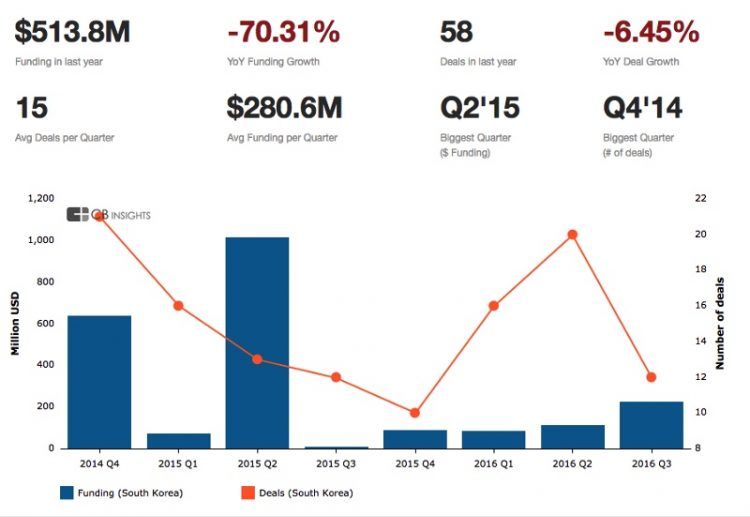
Investments in Korea. Photo credit: CB Insights.
In Q1 to Q3 of 2016, Korean startups raised a grand total of US$513.8 million spread across 58 deals. This is 70 percent less than the previous year, but that’s expected when you have Coupang raising a US$1 billion round in the second quarter of 2015.
Instead of going through each and every one of these deals, I wanted to point out a few major ones that have occurred in 2016.
- Korean Unicorn Yello Mobile, a holding company for some 60 or more startups, raised an additional US$55 million led by Partners for Growth and Macquarie Capital.
- Not to be outdone, Memebox, a global distributor of cheap Korean beauty products, raised a US$125.95 million Series C round led by Goodwater Capital and Formation Group.
- Bringing in a massive US$107 million venture round was Podotree, which provides multilingual education-based platforms and content for smartphones and tablets. This round was led by Anchor Equity Partners.
- Woowa Brother Corp., the creators behind Korea’s favorite delivery service application Baedal Minjok, continued their meteoric rise with a grand total of US$70.3 million raised from Hillhouse Capital and Goldman Sachs.
What’s important about these is that many of the firms involved are US-based venture capital firms. The more of these large, later-stage deals that Korea can close, the better it will be as these will attract foreign investors that are currently skittish on backing any early stage investments in Korea.
That being said, attracting attention would be for naught if there won’t be a consistent influx of strong, early-stage companies with long-term potential. This year has shown major improvements on this front as shown by the attention given to Korean startups from overseas incubators and accelerators.
Global incubator investments
500 Startups — one of the top incubation programs in the world — started their own South Korea fund (aptly named the “Kimchi Fund”) in 2015. This provides much-needed early stage liquidity as well as foreign expertise on how to manage a startup during its growth phase.
While no Korean startup made it into their US-incubation program in 2016, they did take part in the Seed Round for Haemukja, a personalized food and recipe recommendation platform, and Dano, which provides full stack service and products for health, body, and wellness for women. They also backed WaHome’s Seed Round.
The country sent two startups to Y Combinator (widely accepted as the top incubation program in the world) last year as well. A member of the Spring 2016 Class was Miso which is a direct competitor to WaHome. There was also SendBird, a member of the Winter 2016 batch which provides an in-game messaging platform.
Getting placed in any worthwhile US-based incubation program is astronomically difficult especially if you are not an American company, so this is a great step for Korea.
Domestic co-working spaces + incubators
Startup diversity
What to look for in 2017





Stay updated on the go with our mobile app.
Get latest insights with smoother, more personalized experience through TIA mobile app.