- Insights This article was written by a TIA community member. Insights pieces undergo the same rigorous editorial process that newsroom-produced articles have.
 Tim Romero · · 5 min read
How underestimating small things made hardware extra hard for this founder
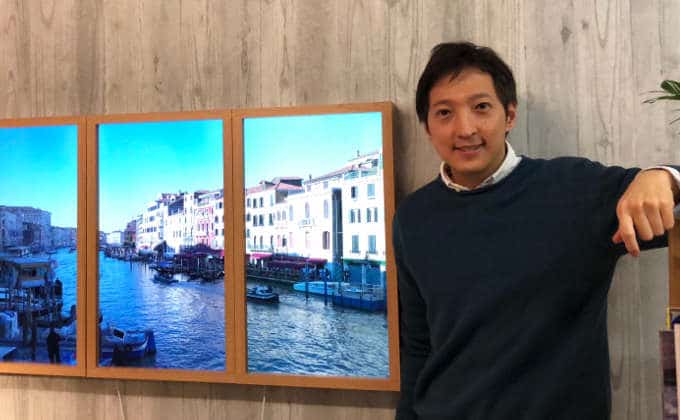
Kyohi Kang, co-founder of Atmoph
This article is part of Tech in Asia’s partnership with Disrupting Japan where we publish the revised transcripts from the show’s podcast interviews with Japanese entrepreneurs. This is heavily revised from the original transcripts. For the full interview, go here.
I sat down at a cafe with Kyohi Kang, the founder of AtMoph, a hardware startup that creates 27-inch “digital windows.”
Kang talks about how their product works, their successful crowdfunding campaigns, and the challenges they faced before shipping their product.
Tell us about what AtMoph is.
We call our product digital window but the concept is very simple. It’s a 27-inch monitor that you can hang on your wall and lets you see you the world. Every content is filmed by us in 4K, so you can view sights in Iceland, France, Germany, Hawaii, Japan, etc. The Atmoph Window has one speaker inside so you can also hear the sounds of the waves, birds, etc.
Tell us about your customers.
We started shipping last year, and we’ve seen that 70 percent are individual consumers, while the rest are restaurants, bars, clinics, and offices.
About 70 to 80 percent of our customers are from Japan.
In 2015, you launched a successful Kickstarter campaign. What were the challenges you faced?
It was really challenging because doing a Kickstarter campaign in Japan was very rare. It was also our first crowdfunding project, so everything was tough.
The reason we needed to do crowdfunding was that we didn’t have enough money to manufacture the product. Also, many people were saying that nobody would want a digital window. So, I needed to prove that at least some customers would buy.
We raised about US$160,000 on Kickstarter, but we needed more money. Things like making injection molding cost a lot. We also had to reduce the price since it’s a crowdfunded and a pre-sale project.
So, how did you manage to deliver the products?
We did another crowdfunding in Japan on Makuake. It was OK, but we still needed to collect more money. So, we asked a government bank for a startup loan and, one year later, raised VC funding of approximately US$1 million.
What turned out to be a difficult part in the process?
We underestimated too many things. First, it was our first time doing production, so we needed to find good manufacturers, which was very hard. Each time we approached one, they said, “We can’t do this in small batches.”
We did the manufacturing in Japan, but we have about a total of five manufacturers coordinating with each other. The assembly happens in Nara, then Kyoto. The board production is in Osaka, and some of the plastic parts and cables are manufactured near Shanghai.
Why did you decide to have your manufacturing in Japan even though you knew the costs would be higher?
It’s because we didn’t have enough money. To do manufacturing in China, we needed to travel often to negotiate or see the actual production. We needed to save our money.
If you had the chance to do it again, what would you do differently?
Did you have trouble keeping the momentum going after crowdfunding?
What are your future plans?
Do you see your future as a hardware company or a software company?





Stay updated on the go with our mobile app.
Get latest insights with smoother, more personalized experience through TIA mobile app.