 Osman Husain · · 4 min read
Khailee Ng: ‘I don’t give a f*ck about a funding slowdown’
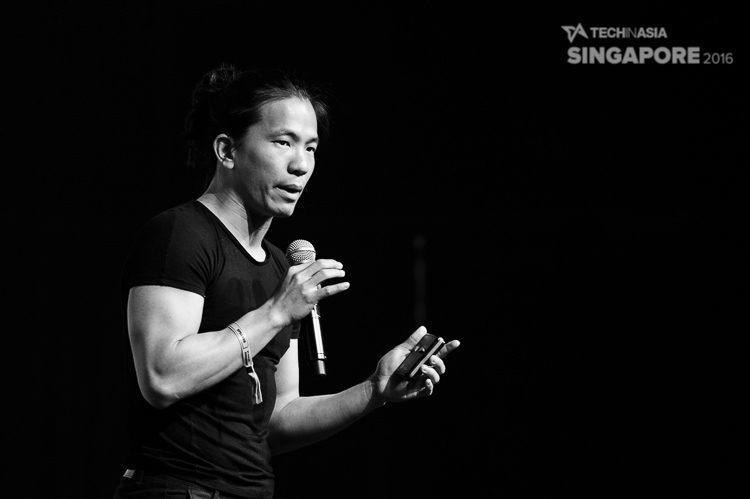
Khailee Ng, managing partner at 500 Startups, is known for saying it like it is. His no-holds-barred style is refreshing, engaging, and makes for some pretty interesting anecdotes. Speaking yesterday at Tech in Asia Singapore 2016, Khailee didn’t disappoint, with a number of profanity-laced reminders about why he thinks the world is fundamentally fucked up.
The topic of Khailee’s talk, “Southeast Asia funding in 2016: What founders need to know,” centered around the possibility of an impending tech bubble and resulting credit crunch. As VCs advise startups to hunker down, stay lean, and prepare for winter, Khailee applied these arguments to a Southeast Asian perspective.
Will nervousness in the US trickle down to Asia? Will VCs find it harder to raise cash for their funds? Will there be an overall slowdown in 2016?
New funds dedicated to Southeast Asia have doubled in the past year.
As no one really knows the definitive answer to these questions, he used data to bring some clarity. According to his first point of reference, the Tech in Asia database, VC funding in Asia doubled from US$8.9 billion to US$17.2 billion in the past 12 months.
Southeast Asia, which is still only at half the level of India, grew at an even more impressive rate to record an overall funding tally of US$478 million in the first three months of the year.
Seed investments in Southeast Asia alone grew 12 percent, from US$51 million in 2014 to US$57 million in 2015.
Giving the big picture, Khailee pointed out that new funds dedicated to Southeast Asia alone have doubled in the past year – increasing from an impressive US$680 million in 2015 to a gargantuan US$1.35 billion in 2016, with Sequioa, Rakuten, and B Capital all acquiring muscle.
With all the data clearly showing that there’s no lack of cash available for founders, who still thinks winter is coming, he asked the audience.
No fucks given
But Khailee did mention a caveat. VC firms start sniffing around for their funds well in advance, and when they’ve locked in the cash, their investors are legally obliged to hand over all of it. Hence, there might be a bit of lag, he said, for nervous investor sentiment in the US to reach the shores of Asia. It could be that tech firms find it more difficult in the future to keep upping the ante and outdoing their past exploits.
And his response to all this speculation? “I don’t give a fuck,” he retorted.

“I’ve looked at my role as a VC and we don’t go to a market and wait for things to happen. If you wait, you’re too slow. I believe in market making, in shaping it,” he explained. “By being more bullish, we can change stuff, plant seeds, make larger companies. That’s what VCs can do to help grow the ecosystem.”
Coming back to advice for entrepreneurs who might be nervously looking over their shoulders, Khailee recalled his personal journey.
Investors can be wrong too
In the mid-2000s he was approached by a venture capitalist seeking advice for possible investment in the ecommerce markets of China and Southeast Asia. Khailee recalled that the investor in question wasn’t convinced of the potential due to poor logistics, a lack of high-speed broadband, and inefficient payment mechanisms, to name but three concerns.
Nine percent of today’s tech unicorns were founded in the dotcom crash – including Alibaba.
Khailee didn’t agree with this view. He took the example of Air Asia’s Tony Fernandes, and his decision to start an online-only travel business out of Malaysia in 1996.
“Investors told him he was crazy, they said have you seen the lack of credit cards and internet connections? He replied by saying they had valid arguments but that he knew the exception. And that was if you make the product cheap enough, they’ll do anything to go and get it.”
Today, Air Asia is worth billions.
The point Khailee was trying to drive home was that the investor, in hindsight, got it completely wrong. Online shopping is now ingrained in daily life in China. Ecommerce companies in Southeast Asia are booming. They’re doing so well right now that they’re being gobbled up by Alibaba. If you shape your sentiment and build your business solely on what investors might be saying in the press, then you won’t do very well.
“I don’t know if there’s a funding slowdown. I don’t give a shit,” reiterated Khailee.
“I’m not here to invest in people who are affected by universal laws. I’m here to invest in exceptions. The businesses these founders build defy what people are thinking. If you focus on being the exception, it’s easy for you to stand out and be noticed.”
Khailee reminded the audience that nine percent of today’s tech unicorns were founded in the dotcom crash – including Alibaba. He added that his fund is looking to invest in 200 to 300 companies in the next three years, and that goal will certainly not be rescinded.
“I’m betting that the middle class will continue to grow and that there’s still plenty of startups waiting to be built. My argument is Southeast Asia can be an exception to all markets. I’m committing to do my job to fund you. You go in and build those companies for me. I do my part and you do yours,” he exclaimed.
Stay updated on the go with our mobile app.
Get latest insights with smoother, more personalized experience through TIA mobile app.
Recommended reads
 VCs 2.0: Code + cash 🚀
 Meet the 25 top-funded startups and tech companies in Malaysia
 For our loved ones who are never mentioned in our pitch decks
 Rising sun, raising funds
 Unicorns out, zebras in
 These are the most active investors in Thailand’s startups
 20 largest exits in Korea
 Profit now (and later) for BillEase
 Here comes a new (rental property marketplace) challenger
 50 shades of the VC world




Editing by Steven Millward and Nadine Freischlad
(And yes, we’re serious about ethics and transparency. More information here.)




📅 Upcoming Events
22 October 2026
Payoneer x CSPN Summit 2026