- Premium Content It takes our newsroom weeks - if not months - to investigate and produce stories for our premium content. You can’t find them anywhere else.
 Simon Huang · · 7 min read
Grocery tech firm Ocado’s SEA entry could shake up the scene
Picture this: Robots on wheels whizz across a grid that looks like a giant chessboard, racing to collect items that customers have ordered online. With no humans in sight, it all seems rather utopian – or dystopian, depending on your perspective.
This is the scene in a logistics warehouse developed by the Ocado Group, a UK-based online grocery company listed on the London Stock Exchange.
The firm was founded in 2000 as an online supermarket. However, it later pivoted to a technology-first enterprise model, providing software and robots to traditional grocers to help them compete with online rivals much like itself.
It is with this enterprise model that the firm is now planning a Southeast Asian expansion, said Ocado chief executive Tim Steiner in a Financial Times report. In the region, ecommerce platforms and traditional supermarkets alike are dialing up e-grocery offerings amid a surge in demand.
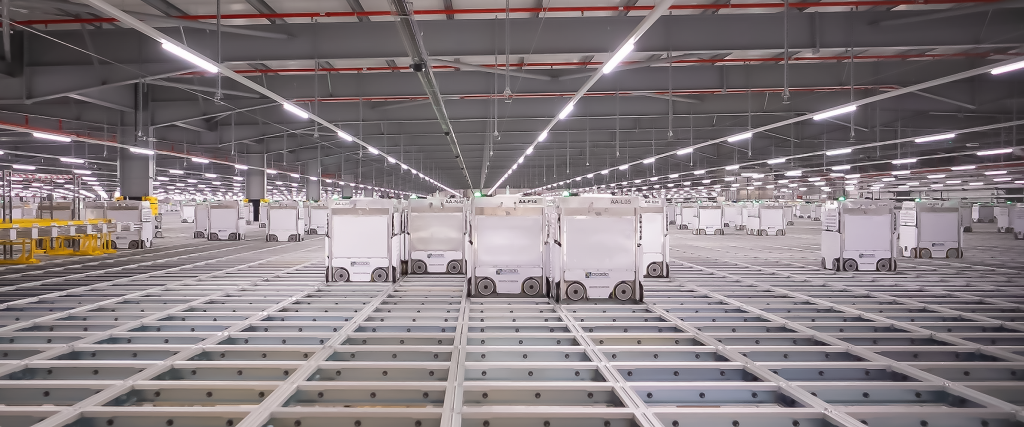
Inside an Ocado Customer Fulfillment Center / Photo credit: Ocado
Ocado’s plans for Southeast Asia come as the company announced a partnership with Lotte Shopping last month. Lotte Shopping is part of the Lotte Group, one of South Korea’s largest conglomerates. With annual revenue of 15.6 trillion won (US$12 billion), Lotte operates more than 1,000 department stores, hypermarkets, and supermarkets in the country.
Lotte is also present in several countries in Southeast Asia, including Thailand, Vietnam, and Indonesia, though its partnership with Ocado is only for South Korea for now.
News of the Lotte partnership sent Ocado’s shares soaring by 34% the day it was announced. However, like other loss-making tech companies (although Ocado is generating positive EBITDA), the business has been a part of the tech rout this past year, with its shares down by 55% year to date as of December 9, 2022.
Is the model viable in countries with low labor costs?
Southeast Asia’s online grocery sector is fertile ground. The segment currently has a gross merchandise value of US$18 billion, which is expected to reach US$31 billion by 2025, according to the latest e-Conomy SEA 2022 report by Google, Temasek, and Bain and Company (the SEA report). This implies a compound annual growth rate (CAGR) of 19% for the next three years, which outpaces non-grocery ecommerce (expected to have a CAGR of 17%).
There is significant room for growth. The SEA report estimates that the adoption rate for e-grocery services in the region is only at 49% for the average urban dweller. In the suburbs, penetration falls to 4% owing to limited product range and delivery options.
In his interview with the Financial Times, Ocado CEO Steiner did not specify which Southeast Asian markets he had in mind for the firm’s expansion effort. The decision is likely to come down to local labor costs and whether traditional grocery players have the need and scale to pay for Ocado’s technology.
The crux of the company’s offerings is its Customer Fulfillment Centers (CFCs), “highly-automated” warehouses that leverage robotics, AI, big data, and digital twins to facilitate the picking and packing of online grocery orders. As part of the Lotte deal, Ocado will help the grocery giant build six CFCs in South Korea by 2028.
Given the scale of CFCs and the state-of-the-art tech involved, building out the infrastructure to support a traditional grocery chain involves long lead times and high capital costs. For example, Ocado’s partnership with Australian grocery chain Coles for two CFCs was signed in March 2019. But the CFCs are expected to open four years later in 2023 at a total cost of around A$130 million to A$150 million (US$88 million to US$101 million).
The upside for these chains is a higher level of automation and lower labor costs, which makes these businesses more competitive in the long run. However, this value proposition may make more sense for grocery chains in countries with relatively high wages.
Prefers exclusive relationships
Impact on the local tech scene
Stay ahead in Asia’s tech landscape
This is premium content. Subscribe to read the full story.
Ocado, which helps set up grocery chains with their own online operations, is eyeing a slice of Southeast Asia’s fast-growing online grocery market.
We know this is not ideal. ⌛ Sign up in 20 seconds. Cancel anytime.
Our subscriber community includes professionals from these companies:





Stay updated on the go with our mobile app.
Get latest insights with smoother, more personalized experience through TIA mobile app.









📅 Upcoming Events
22 October 2026
Payoneer x CSPN Summit 2026