 Mary-Anne Lee · · 5 min read
SUTD’s Game Innovation Programme pairs students with industry experts
Schools can contribute to the budding video game industry in Asia by offering relevant courses, such as those in game design, programming, and computer science. But they can also go one step further, just like the Singapore University of Tech and Design (SUTD).
This is the second year SUTD has run its Game Innovation Programme (GIP). In it, product advisors from participating companies partner with teams of tertiary-level students to create products that help serve a purpose. This purpose is set by the product advisor, in order to replicate an industry environment for the students.
(See: Games invade school in Visual Math’s grade-school math app)
Product advisors and their backing companies have no commitments, financial or otherwise, save for an obligation to connect with their mentees once a week during the 14 week program. If the product advisor decides to license the created IP for use after the program ends, teams are approached to see if they want to continue as a startup. SUTD foots the stipends of all participants for the duration of the Game Innovation Programme, though this financial support ceases at its close, and mentor companies are expected to provide funding for their would-be startups. If no teams are interested, the present SUTD GIP student cohort is offered the chance before it is given to SUTD GIP alumni.
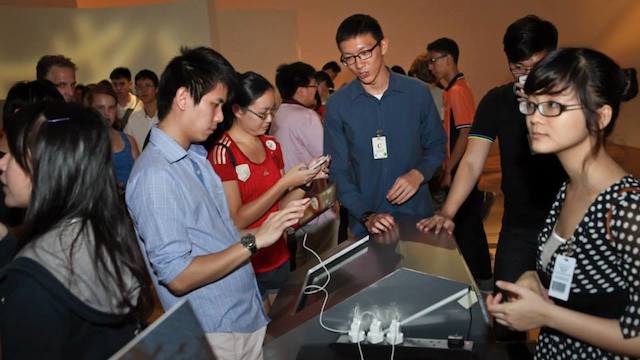
SUTD GIP 2014 industry day!
Tan Chee Ming, representing the SUTD Game Lab, shared that the university chose to host such a program in order to “breed a new generation of game innovators and technopreneurs.” Doing so also encourages employability and entrepreneurship. “It’s very important for the students to collaborate and communicate and it’s part and parcel of dealing with things [in the working world],” Tan shared.
SUTD has worked with Marshall Cavendish, Daylight Studios, Landshark Games, Pioneer Junior College, and National Instruments for 2013’s program, and with Razer, Lambdamu Games, Health Visuals, SG Engables, and Opportunity Lab for 2014.
(See: Razer CEO reveals secret to his company’s success: hyper focus)
For 2014’s program, SUTD had Ubisoft in as a main overall mentor for the cohort; specifically, QA manager Robert Watson helped with the project. The game innovation participants were also mentored by the program’s game directors Ian Gregory Tan from Witching Hour Studios, and Danien Chee from Cabal Entertainment Software, were onboard to share their commercial and entrepreneurial experiences.
Here are the games the program produced this year.
Rocketblade
[fve]http://youtu.be/91r0hsJ4sRM[/fve]
The team behind Rocketblade was mentored by Lambdamu Games, developer of the once wildly-popular Pixel People. Lambdamu wanted to see a Dynasty Warriors type game on the mobile platform that made full use of the touchscreen, as opposed to one that utilized a virtual D-pad. Rocketblade makes use of your standard touchscreen swipes and taps to give you an experience not unlike that of its Dynasty Warriors inspiration.
What we think: Great concept, with the potential to be an addictive casual game. With some thought, it could even hit midcore level!





Stay updated on the go with our mobile app.
Get latest insights with smoother, more personalized experience through TIA mobile app.








📅 Upcoming Events
22 October 2026
Payoneer x CSPN Summit 2026