 Samantha Cheh · · 6 min read
These startups are scaling successfully with Huawei’s help

Liu Yang, co-founder of Singapore-based cybersecurity solutions provider Scantist, knew that his firm had a commercially competitive product that was backed by cutting-edge data from Nanyang Technological University’s (NTU) security research lab.
And yet, his startup was struggling to put together a viable business model.
“We didn’t just have to meet customer expectations and attract timely investments. We also had to focus on making everything work well while also focusing on maintaining our cash flow,” says Yang. “It was a big transition for me as a researcher moving into the business space.”
Narin Khurana, founder and CEO of Thailand-based school management platform Schoolbright, faced similar issues when he was first getting his company off the ground.
“We talked to many schools, trying to convince a first-tier school to try us out,” he recalls. Without early adopters, Khurana knew Schoolbright would struggle.
Startups’ uphill battle
The reality is that most startups face an uphill battle to success. Though both Scantist and Schoolbright had strong value propositions, their ability to expand was hindered by limited resources, talent, and networks.
These limitations pose a particular challenge as startups look to scale beyond the seed stage, says Leo Jiang, Huawei’s chief digital officer for Asia Pacific.
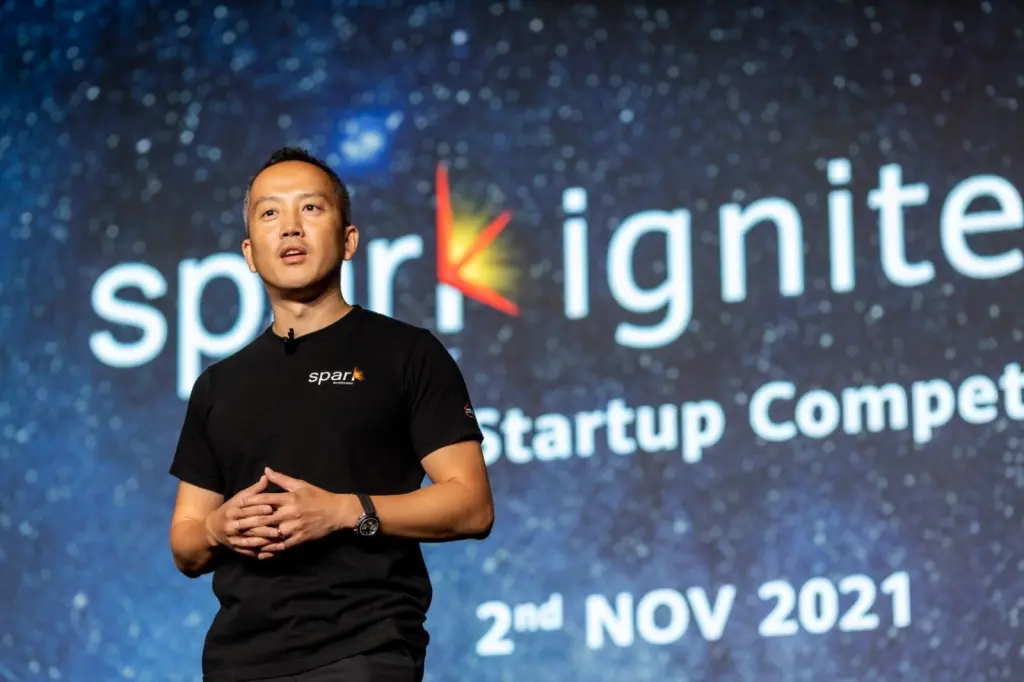
Leo Jiang, Huawei’s chief digital officer for Asia Pacific / Photo credit: Huawei
“It’s especially hard in Southeast Asia because of the non-homogenous nature of the market,” he adds.
Since 2020, Huawei has sought to mitigate these challenges for Southeast Asian startups with its Spark Ignite program, a competition-style accelerator focused on helping growth-stage firms scale up. Participants can win up to US$125,000 worth of credits to leverage Huawei’s cloud computing infrastructure. In addition, startups can also connect with the tech firm’s extensive network.
These perks were a big help for Scantist and Schoolbright, which both participated in Spark Ignite’s competition last year.
From research to reality
Prior to launching Scantist in 2016, Yang led a research team at NTU focusing on cybersecurity. He and his team saw their research’s potential to inject cybersecurity into the DNA of any application and the commercialization opportunities of its solution, especially in a region that faces a high amount of cyberattacks.
“We’re passionate about application security and want to help our customers minimize risks without the need for security expertise,” he says.
The result was Scantist’s open-source risk management solution, an automated platform that continuously monitors any application’s source code for security vulnerabilities.
However, Yang says that translating the team’s innovation into actual sales was an entirely different challenge.
“As a new brand and startup, we had to figure out how to properly prioritize resources and translate new research into systems that customers could understand,” he recalls. “We needed to find a new growth strategy to expand sales.”

Liu Yang, co-founder of Scantist / Photo credit: Scantist
Scantist began experimenting with a cloud-based version of its solution, which put them on Huawei’s radar. When the latter’s Spark Ignite competition launched in 2021, Yang saw it as an opportunity to get some help with scaling his firm. Scantist finished third among a pool of over 500 participants, which gave it access to additional product and commercialization support.
“It was an extremely exciting experience for us,” he says. “Huawei Spark’s team of strategic experts and experienced builders helped us focus more on the business.”
Huawei helped Scantist reposition itself as a software-as-a-service provider, allowing it to reach developers around the world as well as become faster and more agile innovators. Participation in the competition also introduced the startup to potential investors and clients.
“Scantist has been able to achieve a far bigger global reach, and we’ll continue to partner with Huawei Cloud on in-depth research that will benefit the entire industry,” adds Yang.
Building Thailand’s largest edtech firm
Meanwhile, Schoolbright’s goal is to make communication and coordination easier for both parents and teachers through a single portal.
It began operating as Jabjai – the Thai word for “cash payments” – a school-focused digital financial solution. However, after feedback from teachers and parents, the company decided to pivot to school management. Once it rebranded as Schoolbright, it added a gamut of new services like attendance-taking, information broadcasts, and a communications function. The platform is currently used by around 500 schools across Thailand.
At first, the startup struggled to convince school management of its benefits. Unlike the ecommerce sector, the education segment is slower to digitalize and more skeptical and resistant toward change, says Khurana.
“Startup people are always telling you to scale, scale, scale, but it’s not easy in education,” he adds. “Convincing schools to try new technology requires a lot more hand-holding and assurance.”
Schoolbright’s ability to scale was also limited by the industry’s famously long sales cycle, where agreements may take place at the beginning of one school year but only close in the next. As a result, the startup struggled with managing cash flow, impeding its ability to grow.
Through a connection with a friend at Huawei, Khurana signed Schoolbright up to participate in the 2021 Spark Ignite competition and it eventually finished in the top three.

Narin Khurana, founder and CEO of Schoolbright / Photo credit: Schoolbright
“The Huawei team was very responsive and helpful in terms of having access to cloud infrastructure and gaining knowledge on how to use it, which was really important for us during Covid-19,” he shares.
In one example, Huawei’s team supported Schoolbright in facilitating online exams for 100,000 students across the country. Khurana says having the back-end infrastructure support from Huawei has been key for the startup, which has since become Thailand’s largest edtech company.
After the competition, Khurana shares that Huawei continues to connect Schoolbright to global venture capitalists in a potential bid to expand regionally.
Optimism despite an uncertain future
Scaling a startup has never been easy, and Jiang says the challenges entrepreneurs face will only grow in number and complexity, especially as venture capital becomes scarcer and more conservative. Huawei aims to address these issues by moving down the value chain with a new incubator program to extend its offerings to startups in the pre-seed and seed stages.
“The market is less bullish now,” he muses, noting that factors like the US-China conflict, disrupted supply chains, and inflationary pressures are further complicating matters. “Yet I am also very optimistic about the future. When you look at history, most unicorns emerged out of the worst times because the circumstances gave them an opportunity to think differently.”
For Huawei, the continued goal of its Spark Ignite program is to contribute to each country’s social and economic prosperity, bolstering startups’ foundations through a combination of services and expertise.
“It’s a truly global program,” Jiang says. “We’ve spent millions already, but if you look at the returns to each country, the impact is huge.”
As part of its overarching efforts to support the region’s tech startups, Huawei holds its annual Spark Founders Summit, which aims to connect startup founders with policymakers, enterprises, and investors as well as to share the latest thought leadership insights and best practices.
The 2022 edition will be held in Bangkok, Thailand on September 20 and 21. Find out more about the Summit and how to participate on its website.
This content was produced by Tech in Asia Studios, which connects brands with Asia’s tech community. Learn more about partnering with Tech in Asia Studios.
Stay updated on the go with our mobile app.
Get latest insights with smoother, more personalized experience through TIA mobile app.
Recommended reads
 ‘A thirty second job’: how AI replaces the family office analyst
 Ex-Facebook engineers’ machine learning firm secures $2.3m
 How East Ventures is investing in a more sustainable and inclusive future
 Can AI replace the VC analyst?
 How Europe wins the AI race in SAP CEO’s view
 Edtech accelerator EduSpaze names 9 startups in 5th cohort
 Hatch’s new playbook for rapid innovation with cutting-edge tech
 How a brush with a human trafficker sparked a healthtech startup
 An AI co-pilot for scientists designing new biomaterials
 Carousell co-founder backs $1m round of SG edtech firm





Editing by Winston Zhang, Stefanie Yeo, and Lorenzo Kyle Subido
(And yes, we’re serious about ethics and transparency. More information here.)




📅 Upcoming Events
22 October 2026
Payoneer x CSPN Summit 2026