 C. Custer · · 4 min read
Why one of China’s most successful founders isn’t afraid to be a copycat

Wang Xing, the founder of Chinese daily deals site Meituan, could be called many things, but original isn’t one of them. He’s one of China’s most successful entrepreneurs, having founded three startups in three different internet sectors right before those sectors blew up in China. He did it all by imitating the success of American companies. And he told Caijing that he doesn’t regret a thing.
A career of copies
In 2003, Wang Xing saw the rise of social networking in the United States, and figured China needed something similar. His first attempt, a copycat version of Friendster, was a failure. But the site he founded in 2005, which was called Xiaonei, blew up. It also, perhaps not coincidentally, looked virtually identical to Facebook. At the time, the two were competitors – Facebook wasn’t blocked in China until 2009 – but it was the challenger that prevailed in the Middle Kingdom. Quickly, Xiaonei became the default social network in China, but Wang Xing was forced to sell it because he didn’t have the money to support the site’s massive server costs after its population exploded. It eventually rebranded as Renren, and remains one of China’s top internet companies.
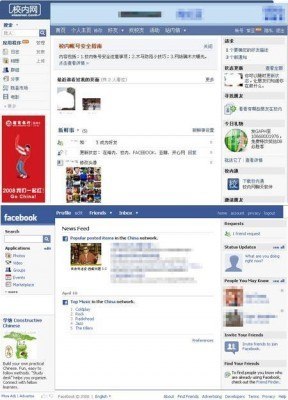
Xiaonei (top) and Facebook (bottom) compared
Wang Xing’s next venture was similarly unoriginal in its inspiration: he created the microblogging service Fanfou, which resembled Twitter right down to the baby-blue color branding. Fanfou was China’s first big microblogging site, but again, Wang Xing wasn’t entirely prepared for the scale – as it built buzz it got caught up in politics, and was shut down by the government. It was eventually permitted to reopen, but not before Sina and Tencent Weibo had been long-since launched and run away with the microblogging market.
So Wang Xing moved on to yet another “copycat” service, this time parroting the success of Groupon with his daily deals site Meituan. It was with this site that Wang Xing finally hit the jackpot – five years later he’s still at the helm, the government hasn’t shut him down, and his company is one of the most-funded startups in China and the leader of the independent daily deals marketplace.
Of course, Wang Xing’s approach to entrepreneurship isn’t very popular with the American companies he’s copied. In fact, it isn’t wholly embraced even in China’s tech circles. Qihoo 360 CEO Zhou Hongyi once said that Wang Xing ‘only knows how to copy.’ He is, at least to some, the posterboy for the lazy copy-to-China startup model.
The importance of choice
But Wang Xing doesn’t mind the criticism. “Disruptive innovation is admittedly important, but having choices is also important,” he told Caijing. It’s the latter that Wang is focused on. He’s not trying to reinvent the wheel, he’s trying to perfect it. In daily deals while other companies were expanding wildly, spending boatloads of cash on splashy offline ads, and bidding for exclusive rights to specific sellers, Wang Xing says he was buried in the IT backend, making sure he was offering the best experience for vendors, creating one of the earlier daily deals mobile apps, and crunching data to figure out where to invest.
That approach ultimately put his company at the top of an industry that, at its peak, had more than 5,000 startups trying to compete. It also allowed Meituan to weather the storm that followed when that bubble popped and thousands of those startups failed.
Wang Xing’s approach isn’t the sexy kind of entrepreneurship that we normally aspire to. And especially in the early days, his copying was so blatant that he was probably even skirting the edge of legality (and perhaps occasionally stepping over it). But being innovative isn’t always necessary for success. Knowing what to copy, when to copy it, and how to execute can be just as effective, and Wang Xing has proven several times now that he has the skills to copy better than almost anyone else in the business.
Look down on him if you want. He doesn’t mind that, he says. And why should he? He’s founded several of China’s most successful startups, and offered China’s consumers compelling local alternatives to big global sites better than almost anyone else can. Who is any of us to look down on that?





Stay updated on the go with our mobile app.
Get latest insights with smoother, more personalized experience through TIA mobile app.










📅 Upcoming Events
22 October 2026
Payoneer x CSPN Summit 2026