 Jonathan Chew · · 6 min read
These startups took the next big step in their growth with the help of Petronas Ventures

Nature versus nurture – which do you believe matters more?
It’s an age-old question, though generally speaking, you can’t rely on raw talent alone. No matter how naturally skilled someone is, all entrepreneurs need the right guidance to help them – and their company – reach their full potential.
“We were a bunch of engineers, and my two partners had Ph.D.s in computer engineering and electrical engineering,” says Ammar Zolkipli, co-founder of AI vision startup Itxotic. “But we didn’t know how to run a business.”
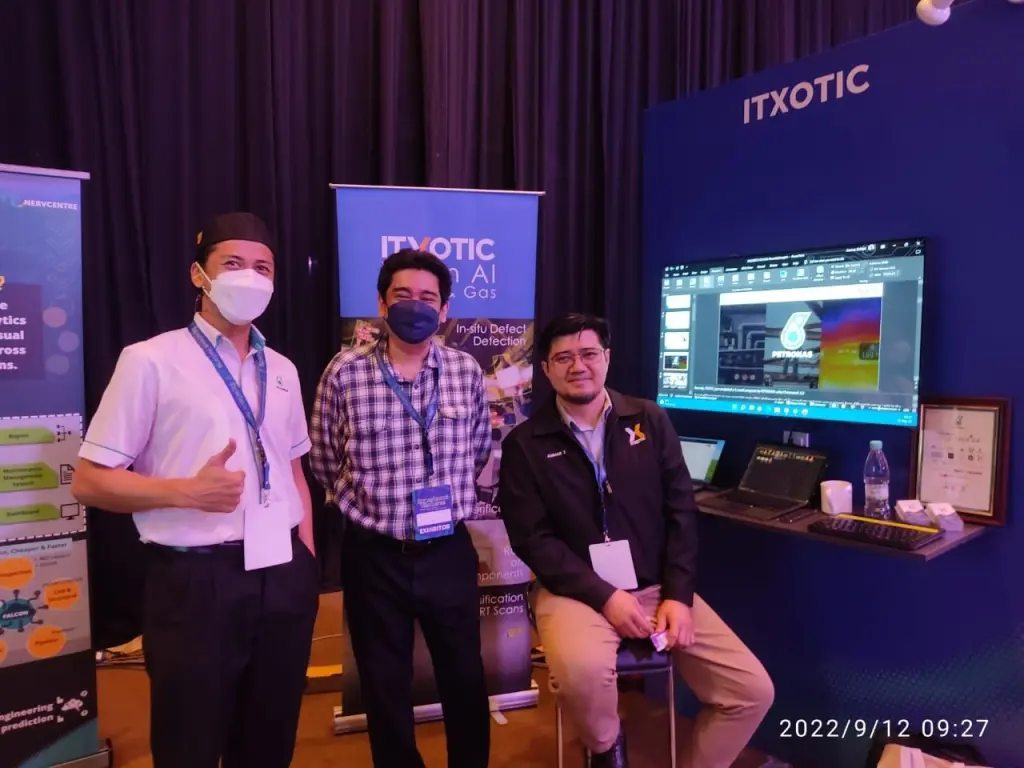
Ammar Zolkipli (right), co-founder of Itxotic / Photo credit: Itxotic
This is where startup accelerator programs like FutureTech come in. First launched in 2019, the program is the brainchild of Petronas Ventures, the corporate venture capital arm of energy firm Petronas. It offers master classes as well as mentorship and coaching from program partners, mentors, and industry experts.
The program’s agenda covers five focus areas: future of industry and works, future of energy and mobility, future of chemicals and materials, frontier technology, and sustainability. It aims to nurture the regional startup ecosystem by providing participants with the opportunity and support to scale their ventures and meet the challenges of the energy transition.
Since its inception, FutureTech has gone through two cohorts consisting of a total of 40 startups. Here’s a closer look at three of these companies.
1. EV Connection
When Lee Yuen How founded EV Connection – an electric vehicle charging service provider – in 2016, his life revolved so much around it that he felt like he was “married” to the company.
“From the time I woke up to the time I went to sleep, I was thinking about it,” he says.
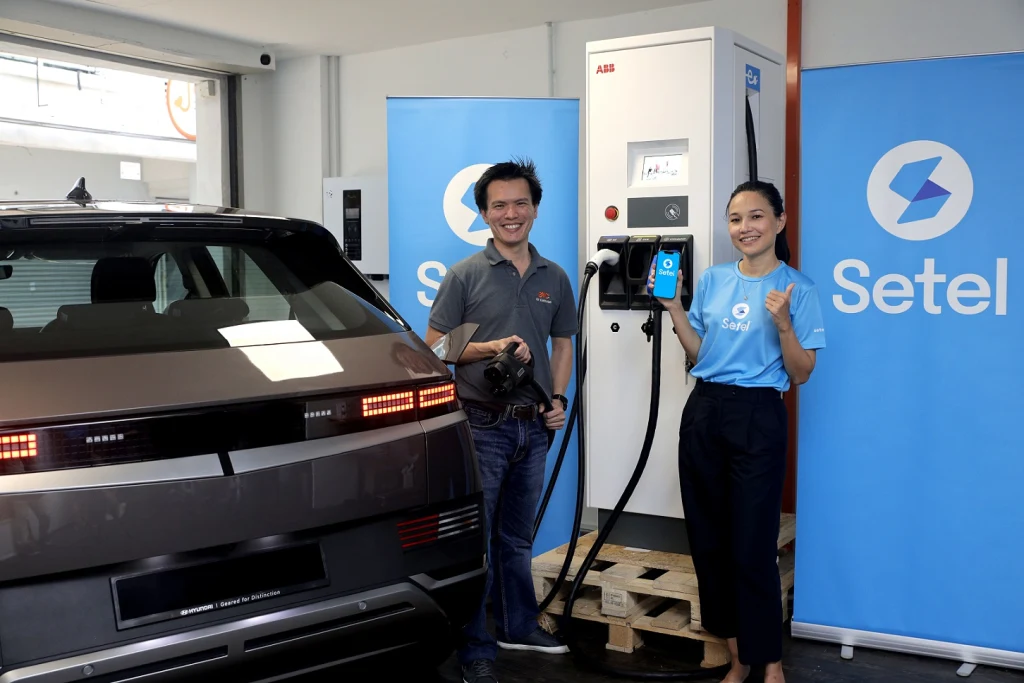
Lee Yuen How (left), founder of EV Connection / Photo credit: EV Connection
The early days of the company weren’t easy-going. The firm rented a shared office space that was rather “messy,” as Lee describes. Some potential hires even turned down job offers as the space didn’t look professional enough, he adds.
Things took a turn for the better in 2017 when EV Connection secured its first big client – an original equipment manufacturer. This acted as a springboard that gave other major auto manufacturers as well as oil and gas companies confidence in EV Connection’s capabilities.
That said, the company was still too focused on maintaining its trajectory instead of seeing the bigger picture, says Lee.
“When you’re too into the ‘conducting business’ aspect, you don’t see the opportunities available to you,” he explains.
Joining FutureTech’s first cohort in 2019 proved to be a big boost as it helped Lee and his team think globally and learn how to scale the company even further.
Since finishing the program, EV Connection has gone on to white label its Jom app – which helps users locate and activate EV charging stations – to overseas firms. Last year, it launched a strategic partnership with a Singapore-based EV charging service provider.
Now that EV Connection’s horizon has opened up, Lee says that it’s hoping to expand to other countries in the region such as the Philippines, Indonesia, Thailand, and Vietnam.
“These are some of the areas we really want to have a foothold in,” he adds.
2. Itxotic
There are many sayings out there espousing the importance of focusing on one’s character instead of their reputation.
However, Itxotic’s Ammar quickly realized that for businesses, both aspects are equally critical as starting out with little recognition made for a difficult time.
“As a startup with no reputation, we had a bit of a culture shock,” Ammar says. “We had to get our feet wet and prove ourselves to the market by prototyping things.”

This was exacerbated by the fact that when Itxotic was founded in 2018, many companies in Malaysia were unfamiliar with deeptech concepts such as computer vision and AI. As such, not only did Ammar and his team have to build custom solutions to pitch to potential partners, there was also a lot of education involved in trying to get them on board.
Additionally, Itxotic’s three co-founders had little experience in running a business, with areas like finance management and fundraising being foreign to the trio.
In 2021, the startup participated in the second cohort of FutureTech. Through the program, Ammar was able to learn about topics such as managing investor relationships, pitching to VCs, and hiring employees.
“To have a mentor clearly define those aspects for us was a great experience, especially since they could give us the data and reasoning behind making certain decisions,” he says.
Additionally, the program helped solve Itxotic’s biggest challenge by elevating it to the same stage as major corporations and giving the company exposure and credibility.
“We went from one new lead a month to two to three new leads each week. Our sales funnel, which are leads that we qualify as opportunities or potential opportunities, increased threefold,” Ammar shares.
3. Aerodyne Group
Nothing seems to describe growth better than Aerodyne Group’s trajectory since it was founded in 2014. What started out as a dronetech company with three people is now a 1,000-person-strong firm with a global presence and involvement in sectors such as agriculture and telecommunications.
Getting to that point took a lot of hard work.
“We’re a B2B firm and many of our target clients are Fortune 500 or similarly large companies. We faced a challenge with breaking into these big organizations to strike up partnerships,” says Kamarul Muhamed, founder and group CEO of Aerodyne Group. “These large organizations typically have their own processes and systems and are resistant to new tech.”
What Aerodyne Group needed to do was to show a clear value proposition – and joining the second cohort of FutureTech in 2021 helped with that.
Kamarul got to work closely with Petronas through the program, and following its conclusion, the two firms signed a memorandum of collaboration in 2022. This helped Aerodyne Group pioneer new innovations.
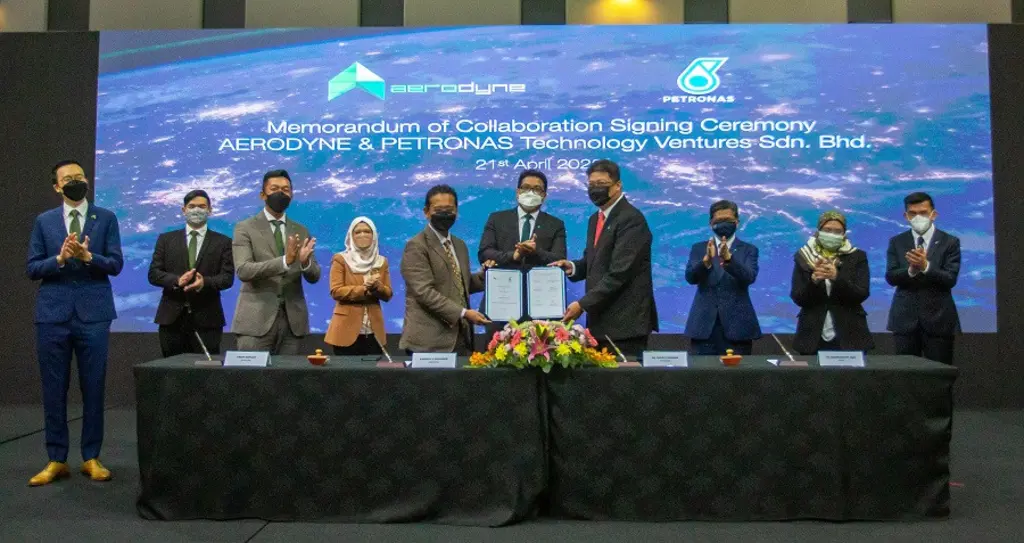
Kamarul Muhamed, founder and group CEO of Aerodyne Group (fifth from left), at the signing of the memorandum of collaboration between his firm and Petronas Ventures / Photo credit: Aerodyne Group
Since then, the company has developed a solution that helps Petronas monitor and manage gas pipelines, delivering on a proof of concept in which the former’s drones could be flown for 100 kilometers at an altitude of 100 meters to achieve this task.
“After FutureTech, we were able to push through with developing more cutting-edge solutions – with Petronas’ endorsement, too,” Kamarul points out. “This created awareness and gave potential customers lots of clarity into the kinds of improvements they could get.”
Aerodyne Group has since been on a roll. According to Kamarul, it’s sitting on around US$800 million of new opportunities since it completed the accelerator program.
“If Petronas believes in us, it gets a lot of other people excited about us too,” he adds.
Petronas Ventures is the corporate venture capital arm of Petronas and aspires to be a growth accelerator partner for startups in Malaysia. Its goal is to invest in visionary entrepreneurs with breakthrough technologies and innovative business models. Its accelerator program, Petronas FutureTech, is now opening applications to startups in Malaysia and Asia Pacific for its third cohort.
Sounds like a great opportunity for your startup? Applications close April 10 – sign up now to take your firm to the next level.

This content was produced by Tech in Asia Studios, which connects brands with Asia’s tech community. Learn more about partnering with Tech in Asia Studios.
Stay updated on the go with our mobile app.
Get latest insights with smoother, more personalized experience through TIA mobile app.
Recommended reads
 Flipkart’s costly late push into quick commerce and food delivery
 Inside Singapore’s government team that kills its own products
 Once an IPO hopeful, SCI Ecommerce nears collapse
 Who’s betting big on ChatGPT ads? Not Asian brands
 VC tracker: Granite Asia launches US$50 million fund
 GCash trims IPO ambitions to meet market realities
 Igloo CEO eyes global M&A: ‘We have an appetite to grow more’
 Why SBI paid a premium for Ajaib amid a tough market
 OpenAI warns building for today will cause technical debt





Editing by Winston Zhang, Stefanie Yeo, and Lorenzo Kyle Subido
(And yes, we’re serious about ethics and transparency. More information here.)




📅 Upcoming Events
22 October 2026
Payoneer x CSPN Summit 2026