Adinda Pryanka · · 3 min read
This startup’s AI refuses to answer legal questions without proof
This article is a part of Startup Spotlight, a series that features young, up-and-coming startups.

Image credit: Arsal Ysfin
As an engineer, Marcus Ng built AI systems where being mostly right was acceptable. But when he trained to become a disputes lawyer, he found that the standard was dangerous.
He saw how modern legal AI fails by answering confidently but incorrectly, forcing lawyers to waste time re-verifying everything and creating professional risk. This led him to build Veracia, a startup focused on verification, not just generation.
😟 Problem
Litigation and arbitration teams face pressure to work faster. Yet, current legal AI often produces plausible but unverifiable answers, sometimes with fabricated citations. This turns AI into an extra burden, as lawyers must manually check everything, absorbing billable hours and risking court sanctions for errors.
According to Bloomberg Law, attorneys work around 48 hours weekly but bill only around 36, losing time to non-billable tasks like verification. This is a key adoption blocker. A Thomson Reuters study found that accuracy and reliability are the top reasons that 40% of professionals are wary of using generative AI in their daily work.
💡 Solution
Veracia’s AI operates on a “prove it or abstain” principle. It only provides answers that it can trace to specific passages in user-uploaded documents, creating an audit trail. If it cannot find direct support, it refuses to answer, preventing hallucinations.
Its core features include:
- Pinpoint citation verification: For each claim, it outputs the claim, the exact source passage, and a support verdict, flagging unsupported claims.
- Zero fabricated citations: The system only cites from uploaded documents and locks them to a specific version.
- Chronology builder: It organizes pleadings and evidence into a timeline and flags inconsistencies between sources.
- Audit trails: It produces exportable reports that managers can review or compliance teams can file.
- On-premise deployment: The software can run within a firm’s own environment to meet data security requirements.
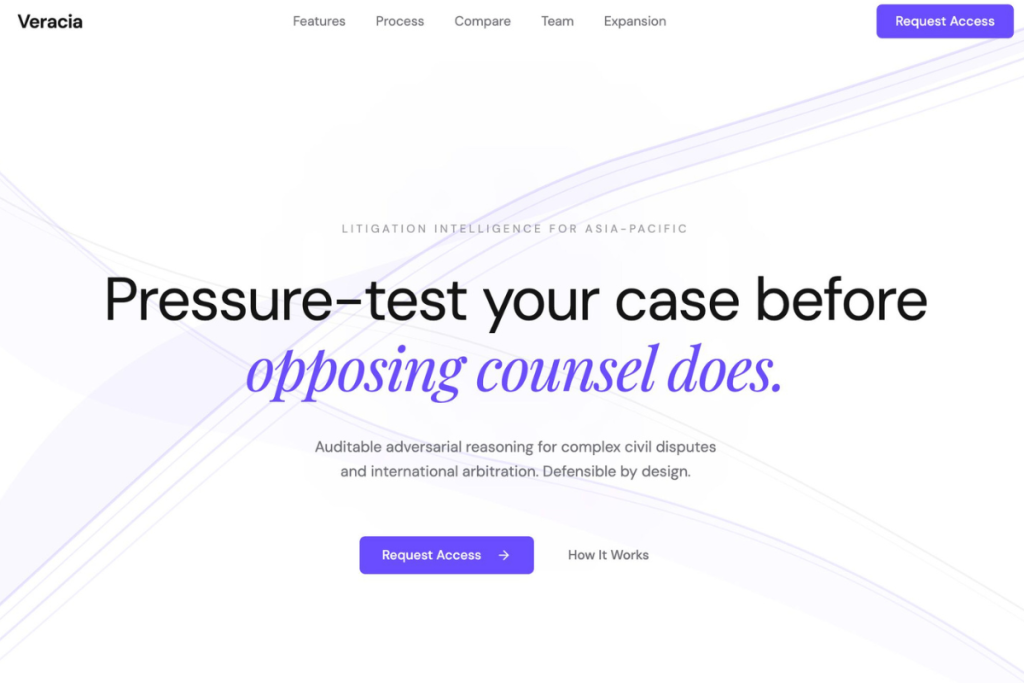
Photo credit: Veracia
📊 Market size
Veracia is targeting high-stakes legal teams in Asia-Pacific. In Singapore alone, there are over 1,000 law practices, with a focus on medium to large dispute firms. Hong Kong offers another dense market with 923 local law firms.
The company is also co-designing its product with partners in Vietnam, a market with nearly 21,000 practicing lawyers, and over 6,000 law firms and legal organizations. The business model is based on annual contracts, targeting what the firm sees as a six-figure problem for each client.
🤝 Team
- Marcus Ng. Co-founder and CEO. Engineer turned disputes-law trainee. Builds verification-first legal AI for contentious work.
- Darren Teng. Co-founder and head of legal. Litigation-trained in law and technology. Translates disputes practice into filing-grade product requirements.
- Phiem Tu Hoang. Founding CTO. Previously worked at FPT IS and NEC Vietnam. Focused on on-prem reliability and enterprise deployment.
🚀 Traction
🏆 Competition
💰 Financials





Stay updated on the go with our mobile app.
Get latest insights with smoother, more personalized experience through TIA mobile app.