Eva Xiao · · 5 min read
Fed up with her computer science education, she built a startup to teach coding

Photo credit: 1KE.
When Liu Yi first learned how to code, she was taught via blackboard. Her middle school teacher would scribble lines of BASIC in chalk, and students would follow suit.
“Our programming classes were a bit strange,” says Liu Yi, CTO of 1KE, a coding education startup based in Shanghai. “You’d have to write the steps on the board, as if you were coding on the blackboard.”
Liu Yi teaches web development at 1KE, which offers online coding classes to students all over China. The startup targets university students, as well as professionals who want to pivot towards a more technical career, whether it’s digital marketing for a tech company or writing code for Chinese tech giants like Alibaba. The guiding ethos behind 1KE’s teaching method is practice, not theory.
“When we design classes, we try to show you a visual [of] the result you can achieve,” explains Liu Yi. “And then you practice the technique.” For example, students learning HTML and CSS might dive into the source code of an existing web page, before making their own website from scratch. There’s no need to memorize every single concept, she explains.
“You shouldn’t have to […] buy a thick textbook, or look at lectures over and over again, only to realize that you just need to absorb a tiny fraction of it,” Liu Yi says, referring to traditional teaching methods at Chinese universities. “[That’s] a force-feeding way of teaching.”
Currently, 1KE offers classes in frontend web development, Java web development, PHP, digital marketing, and product management. Similar to coding programs in the US such as General Assembly, 1KE students follow a two to three-month-long curriculum, learning through various hands-on projects, such as using Bootstrap to build a commercial website. At the end of the course, 1KE students have the chance to connect with employers through 1KE’s network.
“The goal of […] 1KE is helping you get a better job,” says Nick Han, CEO of 1KE. “We want to make sure you can apply the skills on the first day of your job.”
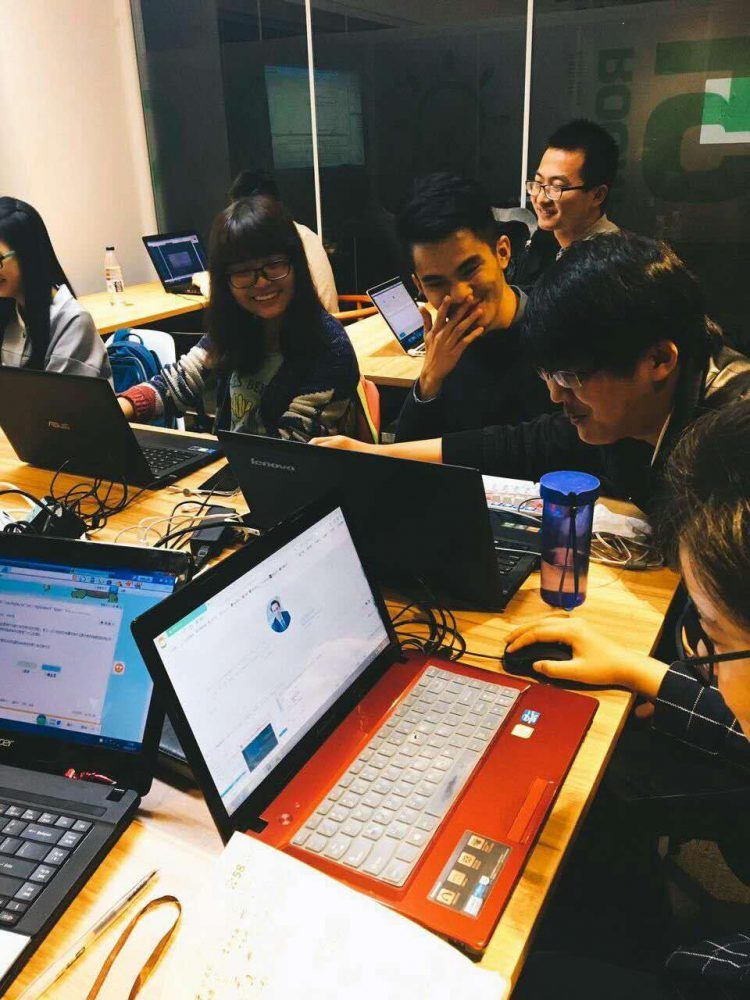
1KE students in one of the startup’s offline campuses in Xi’an. Photo credit: 1KE.
Learn by doing
In many ways, 1KE’s teaching methodology stems from Liu Yi’s own personal experience. Though she majored in computer science at Shanxi University of Science and Technology, most of her technical knowledge is self-taught.
“My college education was actually pretty disappointing,” she says. Classes were theory-laden lectures, and students weren’t expected to actually implement anything. She recalls one class in particular, where students learned about operating systems, threading, and microcode. She loved it at first, excited by the prospect of building her own operating system.
“In the end, when the course was almost over, I realized that the teacher wasn’t going to let us write an operating system,” she says. “I didn’t have any motivation to continue learning.”
Instead, Liu Yi satisfied her curiosity at the university’s internet cafe. Unlike Chinese internet cafes today, which focus almost exclusively on gaming, internet cafes served a broader purpose in the early 2000s, because fewer people had internet access. Still, they had a seedy reputation – something that the industry hasn’t shaken off today.





Stay updated on the go with our mobile app.
Get latest insights with smoother, more personalized experience through TIA mobile app.