Paul A. Christensen · · 3 min read
This startup turns idle data center batteries into revenue
This article is a part of Startup Spotlight, a series that features young, up-and-coming startups.
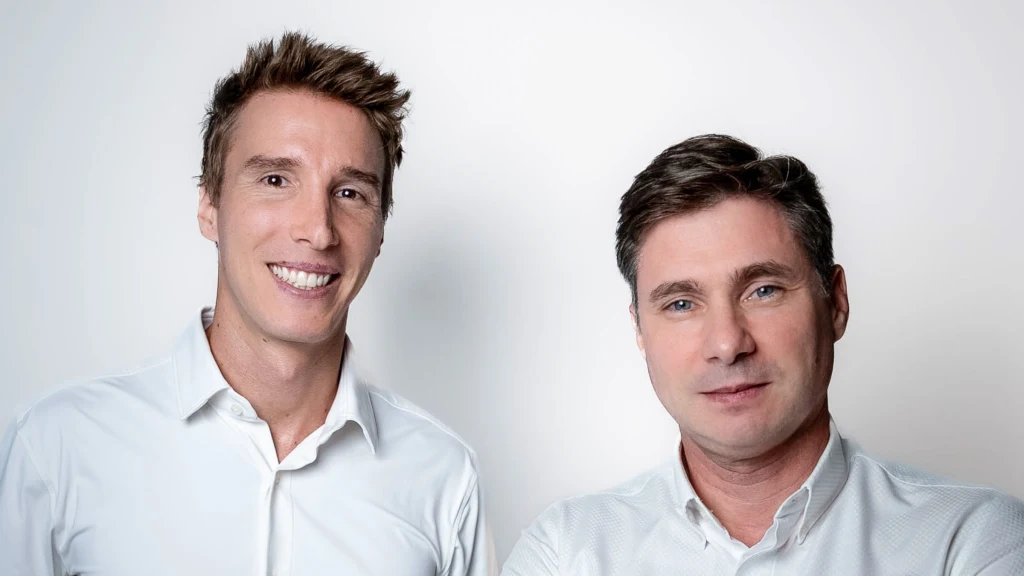
Stéphane Leyo (left) and Gabriel Schiano, co-founders of Amplicity. / Photo credit: Amplicity
During a visit to a Singapore industrial facility, Stéphane Leyo found a room filled with unused battery packs. They held more than 1 megawatt-hour (MWh) of capacity but were kept permanently on standby.
Facility managers replaced this expensive hardware every three to four years without ever putting it to work. Leyo teamed up with Gabriel Schiano to launch Amplicity to put these dormant assets to use.
😟 Problem
Data centers and factories buy massive backup battery systems to prevent power loss. These batteries sit fully charged, waiting for outages that rarely happen. Facilities leave them idle because operators fear triggering an outage by touching the systems.
Singapore’s data centers alone hold an estimated 160 MWh of backup capacity. Meanwhile, data centers already consume about 7% of Singapore’s electricity. Natural gas generates 95% of this power, tying rising electricity bills to volatile global fuel prices.
💡 Solution
Amplicity uses a site’s spare battery capacity to lower electricity bills without compromising emergency reserves. The startup maps potential value through its assessment software, which performs functions including:
- Risk management with on-site controllers enforcing backup reserve limits locally without requiring an internet connection.
- Peak shaving, meaning the system discharges stored energy during high-cost demand spikes to reduce electricity bills.
- Amplicity allows sites to earn wholesale market revenue by supporting the broader power grid.
- Optimization, as the software charges hardware when power is cheap and draws from it when prices surge.
Photo credit: Shutterstock
📊 Market size
The company estimates 740 MWh of backup battery capacity sits across data centers in the Asia-Pacific region. Australia’s data center capacity is forecast to grow from 1.6 gigawatts (GW) to 3.9 GW by 2030.
Singapore currently operates more than 1.6 GW of data center capacity. The country plans to add at least 300 MW of new capacity soon.
🤝 Team
- Stéphane Leyo. Co-founder and CEO. Held roles at Shell, BCG, and GE and previously founded a digital grids team at GE to lead energy storage projects across the Asia-Pacific region.
- Gabriel Schiano. Co-founder and COO. An engineer and entrepreneur with 20 years of experience in telecommunications and energy. He previously served as a partner at data strategy consulting firm Veltys.
🚀 Traction
- Engaged with more than 20 prospective customer sites across data centers and industrial facilities in the Asia-Pacific region.
- Modeled a Singapore data center case demonstrating S$256,000 (US$199,691) in potential annual value on a 1 MWh battery system.
- Won the Pioneers in Sustainability award at the 2026 France-Singapore Business Awards.
- Participated in the ENGIE Factory incubator and Swinburne University’s Climate 4.0 Hub.
🏆 Competition
💰 Financials
🚩 Risks





Stay updated on the go with our mobile app.
Get latest insights with smoother, more personalized experience through TIA mobile app.