 Celia Chen · · 7 min read
Why these Chinese cities are attracting top tech talent in search of a better life
This article is co-written by Zen Soo.
Two years ago, 33-year old Liu Lei gave up a comfortable career managing investments in a clean energy company in Shanghai to move back to her hometown of Chengdu, the capital city of China’s southwestern Sichuan province.
Unlike Shanghai, a global financial center and home to China’s biggest stock market, Chengdu was not a bustling finance hub. But Liu did not mind. She had moved back to Chengdu to start her own company, Luccroi, a platform providing AI, big data, and blockchain solutions for the financial industry.
“The quality of life in Chengdu is much better, and living expenses are cheaper,” said Liu, whose career previously had allowed her to live and work in countries like the US and Germany. “Furthermore, the government has very good policies to support young entrepreneurs and startups.”
Luccroi’s office is based in Chengdu’s Pidu district, about an hour’s drive from the city center. The office space was provided free of charge by the Chengdu government, Liu said, as part of an initiative to encourage entrepreneurs to start companies in the city.
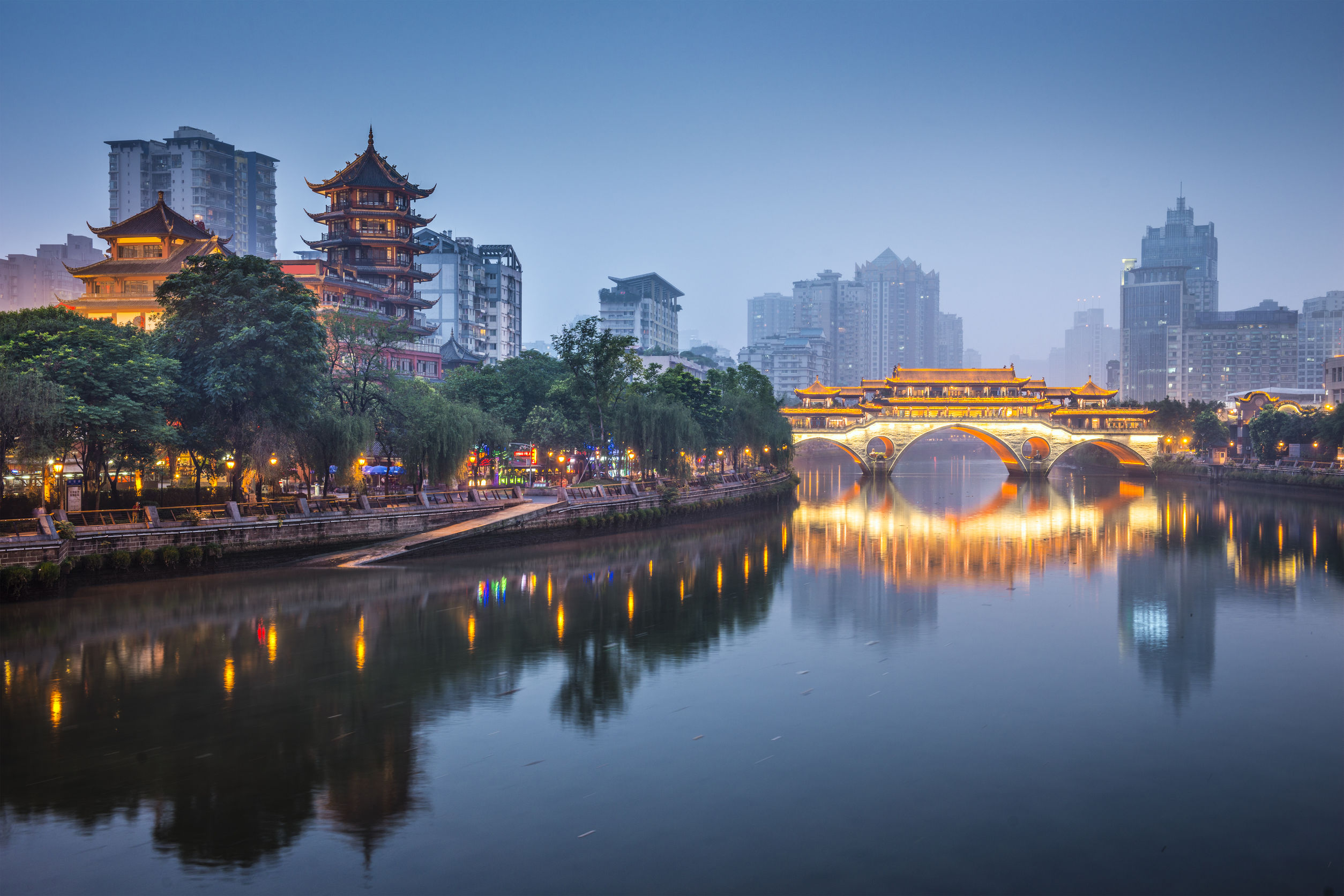
Chengdu, Sichuan, China at Anshun Bridge / Photo credit: Sean Pavone
Liu is among a growing number of entrepreneurs who have taken advantage of local government policies aimed at boosting the technology industry in cities across China.
Local governments in cities like Wuhan, the capital of central Hubei province, and Chengdu are eager to boost innovation and cultivate the next big technology unicorns. As such, they have pledged millions to build high-technology parks and offered preferential policies and tax exemptions to big companies that are willing to open up offices and bring talent to the cities.
Cities across China have been investing heavily in technology, innovation, and startups amid a broader push by the central government to strengthen the tech sector and build an innovation-driven economy. As of 2016, China’s over 7,500 incubators and makerspaces had fostered over 223,000 businesses, according to the Torch High Technology Industry Development Center led by China’s Ministry of Science and Technology.
Chengdu, for example, is well-known for its Tianfu Software Park – Asia’s largest business IT park that also houses an incubator that provides startups with funding, office spaces, and connections to investors.
Similarly, earlier this year, the Wuhan East Lake High-tech Development Zone pledged US$14.9 million to bring in top global talent in industries such as optical technology, biomedicine, high-end equipment manufacturing, and integrated circuits.
Both cities are also home to over 200 Fortune 500 companies. Firms like IBM, Intel, and Dell have set up bases in Chengdu, while Wuhan is home to smartphone maker Xiaomi and livestreaming game platform Douyu. Popular Shanghai-based social commerce app Xiaohongshu last year also opened up a second headquarters in Wuhan.
Many big tech firms are still based in traditional tech hubs though. Bytedance, Didi, Meituan, Baidu, and JD.com are all based in Beijing, while Huawei Technologies, Tencent Holdings, and drone maker DJI are headquartered in Shenzhen. Hangzhou is home to Alibaba Group Holding, while Shanghai has Ctrip and Pinduoduo.
Miranda Qu, Xiaohongshu’s co-founder who was born in Wuhan, said the headquarters in her hometown would house 5,000 employees by 2020. Xiaomi’s new headquarters in Wuhan – which doubles as a research and development center for AI, cloud computing, and big data – will hire up to 10,000 people, according to the company. Yuan Gang, the vice president of newly US-listed Douyu, said he hoped his company would help bring greater prosperity to Wuhan’s startup culture.





Stay updated on the go with our mobile app.
Get latest insights with smoother, more personalized experience through TIA mobile app.








📅 Upcoming Events
22 October 2026
Payoneer x CSPN Summit 2026