Malavika Velayanikal · · 4 min read
This startup fills a gap that Uber, Ola, and other new age taxi services ignore
App-connected taxi services in India have got a lot of attention recently with the likes of Uber, Ola, and TaxiForSure expanding to city after city. But it’s not only within urban areas that taxi services are disorganized in India. A plethora of intercity taxi operators have created a chaotic scene for customers: fragmented taxi suppliers, a lack of reliability, unclean cabs, inconsistent quality of drivers, and uncertainty over whether a taxi will come pick you up even after you’ve booked it. And then there are the usurious rates that are not calculated in a transparent way.
But one taxi aggregator is shaking all that up. Named Savaari (which means ‘vehicle’ in Hindi), it emulates the likes of Uber and Ola, but takes the concept of web and app-based taxi services out of city limits with chauffeured cab rentals and airport transfers. Droves of small operators as well as individual drivers running tourist taxis with cross-country permits have been signing up with Savaari. In contrast, the drivers hooked up with Uber and other city taxi services are licensed to operate only within a certain radius in urban centers.
Bangalore-headquartered Savaari launched in 2006 with seed capital of a mere INR 55,000 (US$895). It now services 60 cities across India with an aggregated network of 170 vendors operating 7,000 cars in three segments – luxury, mid-range, and economy. It boasts of over 20 million trip kilometers so far. “We want to bring standardization in an industry that is ruled by fluctuating fares and service standards,” says Gaurav Aggarwal, co-founder and CEO of Savaari. “So a customer hiring a car in Patna, Varanasi, Bangalore, or Mumbai experiences the same quality experience at competitive rates.”
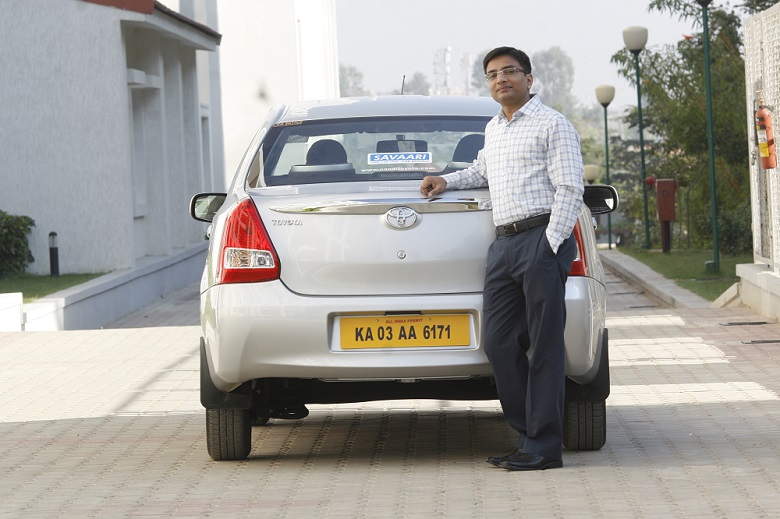
Gaurav Aggarwal, co-founder of Savaari
Algorithms for competitive pricing
All said and done, India is a price-sensitive market. Delivering quality alone isn’t enough to make it big here. Not surprisingly, there is a price war going on between Uber, the international player with deep pockets, and homegrown Ola, which is backed by Softbank and Sequoia Capital, TaxiForSure, and Meru cabs.
Like Uber, Ola, and TaxiForSure, Savaari too relies on technology to bring down operational costs and passes on the savings to customers. Though not as “cheap as an auto” – that’s a line UberX and Ola have been using after they slashed prices recently – Savaari offers cabs at prices that compete with the ones offered by local rental car providers. It has complex algorithms and other tech to optimize each of its cars.
“A lot of the time, taxis go empty for long distances,” says Samir Kumar, managing director of Inventus Capital, one of the VC firms backing Savaari. “For example, if you want to be picked up at the airport, the taxi usually goes empty to the airport, waits for you, brings you back, and maybe again goes empty to the airport. There’s a lot of inefficiency in that process. Savaari is trying to address that inefficiency with technology, allocation engines, strong algorithms on positioning, predictions, dynamic pricing engines, and so on, so that dry kilometers are minimised as much as possible.”
So in case you ask Savaari for a pick-up from the airport, it takes a passenger on the way to the airport as well. “Earning one rupee is better than the taxi going empty. Two rupees is better than one, and ten is better than two. The algorithms in the backend reduces the dry kilometres as much as possible which automatically leads to profitability at lower rates,” Kumar adds.
The airport pickups and drops have in fact become another differentiator for Savaari. “Say you have an early morning flight to catch. The last thing you want to do is to wake up even earlier and try to find a cab in your neighborhood. With Savaari, you can book in advance and sleep peacefully before your travel,” says Aggarwal.
Savaari’s pan-India business also creates opportunities for efficiencies. “Our customer care is completely centralised in Dehradun [in the foothills of the Himalayas]. This brings down our operations and salary costs significantly,” the CEO adds. “Our working model with our drivers is also very different [from the city-based taxi services]. We pay them a fixed monthly salary, including diesel expenses and allowances. The idea is to have the driver only worry about providing customers with exceptional services and leave the worry of business to Savaari.”
Tech moorings
Before turning entrepreneur, Aggarwal used to work as a technologist in California’s Bay Area. He holds a Masters in Computer Science from Georgia Tech. The trigger to start Savaari came in 2006 when he came to India and wanted to make a trip from Mumbai to Delhi. He struggled to find a reliable taxi service.
There were hardly any nationwide firms in the car rental industry then. Aggarwal’s parents, who ran a transportation business, spotted an opportunity. Aggarwal designed and built the tech backend for Savaari from scratch.





Stay updated on the go with our mobile app.
Get latest insights with smoother, more personalized experience through TIA mobile app.