Malavika Velayanikal · · 4 min read
How likely is your startup to fail within a year? Here’s the bitter pill

Photo credit: Wikipedia.
Here’s a sobering thought: an analysis of failed startups in India shows that their average lifespan is 11.5 months. That is, they die in less than a year on average.
Some of these are attention-grabbing flameouts. Like that of Intelligent Interfaces, launched with much fanfare last year by Rahul Yadav after he was sacked from Housing – a startup that he had founded. His new startup promised to use AI, AR, and VR to transform user interfaces and even got backing from Flipkart co-founders Binny Bansal and Sachin Bansal. But he wound it up within six months, and posted this on Facebook: “Thinking of giving up on entrepreneurship and doing a job.”
Some of the failed startups – like TalentPad and Fashionara – had millions of dollars in VC funding. Many others fizzled out before reaching series A. On average, they’re dying within a year of being founded, shows an analysis by startup data cruncher Xeler8.
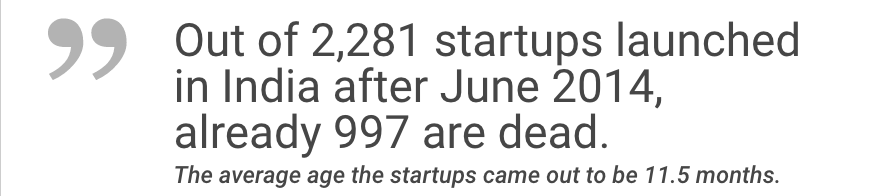
A survey of 2,281 startups launched in India after June 2014 showed that nearly half of them – 997 to be exact – are dead already, within two years. Extrapolating, at least two-thirds of them will die in another year.
The average age of the failed ventures came out to be eleven-and-a-half months. The average age of the failed founders was 27 years 4 months.
Failures in numbers

And here’s another interesting stat. The majority of the failed entrepreneurs – more than three-quarters – took up a job after their failure. So it wasn’t only Rahul Yadav who thought of giving up on entrepreneurship and doing a job.
Some joined other startups, while others returned or went to the corporate world. Only around 23 percent of them ventured to start up again. Of course, it doesn’t mean that some of those who took up jobs will not turn entrepreneurs again after finding some stability in their lives.
Logistics, ecommerce, and food tech accounted for the highest shares of failures – 21 percent, 20 percent, and 19 percent respectively. Analytics came next with 11 percent. These were also the sectors which saw a plethora of startups coming up in the past two years, so it’s only logical that they had the most failures too.
Too many copycats, not enough differentiation, a shift in the market, drying up of funding – the reasons for failure are many. Although the Xeler8 analysis did not go into the specifics of why these startups failed, the inability to raise funding was the cause of most of the early deaths.
The good, the bad, and the unlucky
As VC funding gets more cautious this year, one would expect the trend to deepen. Unfortunately, it means many good ideas too might get squashed simply because they don’t fit the current venture capital or market dynamics.





Stay updated on the go with our mobile app.
Get latest insights with smoother, more personalized experience through TIA mobile app.