- Insights This article was written by a TIA community member. Insights pieces undergo the same rigorous editorial process that newsroom-produced articles have.
 Tim Romero · · 4 min read
The startup looking to clean up space junk
This article is from an episode on Disrupting Japan. This is heavily revised from the original show transcript. For the full episode, go here.
Nobu Okada is the founder of Astroscale, a startup aiming to solve the problem of space debris.
Different entities are putting more and more satellites into orbit every year. Some of those end up becoming zombie satellites, while others collide and become space debris, zipping around at thousands of miles per hour.
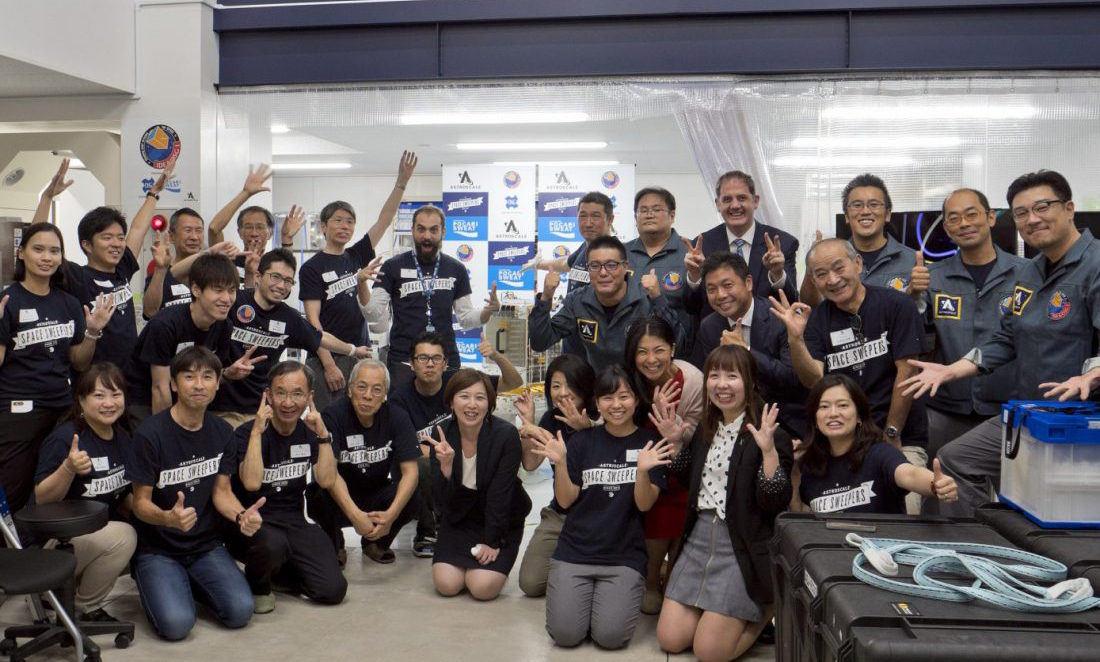
The Astroscale team / Photo credit: Astroscale
Okada and his team want to do something about this by de-orbiting the scrap metal. And since its launch in 2013, Astroscale has been gaining international recognition.
Can you walk us through the problem?
There are a variety of debris sizes in space. If we count those that are larger than 10 centimeters, there are more than 23,000 pieces. And the bigger ones are between 8 meters to 10 meters – that’s like a double-decker bus.
Smaller ones would be around 1mm or less, so it is a wide range.
These pieces typically fly around at 7 kilometers per second to 8 kilometers per second – 40 times faster than a bullet – making them powerful enough to blow up other objects in space.
The density of such debris has reached a certain threshold where there’s now a chain reaction of collisions. So there’s a consensus currently in the space industry that we should remove larger objects now before they get smaller and harder to retrieve.
You founded Astroscale without a background in aerospace. What attracted you to this problem?
When I was 15 years old, I went to NASA in the US. There was a space camp program where they trained us to become junior astronauts.
It was fun, and I met real astronauts and NASA engineers, which ignited my passion. But what I found out was that there was no actual astronaut’s job. NASA usually takes people with a particular specialty and then trains them to become an astronaut.
So, I had to major and specialize somewhere else.





Stay updated on the go with our mobile app.
Get latest insights with smoother, more personalized experience through TIA mobile app.









📅 Upcoming Events
22 October 2026
Payoneer x CSPN Summit 2026