- Premium Content It takes our newsroom weeks - if not months - to investigate and produce stories for our premium content. You can’t find them anywhere else.
 Scott Shuey · · 5 min read
Cerebras builds gigantic AI chips. Can SEA get its hands on them?
Cerebras has the type of problem that most companies would kill for.
The Silicon Valley-based semiconductor firm, which went public in May and raised US$5.5 billion in the largest US tech IPO since Uber in 2019, has one of the most technically advanced AI chips on the market.
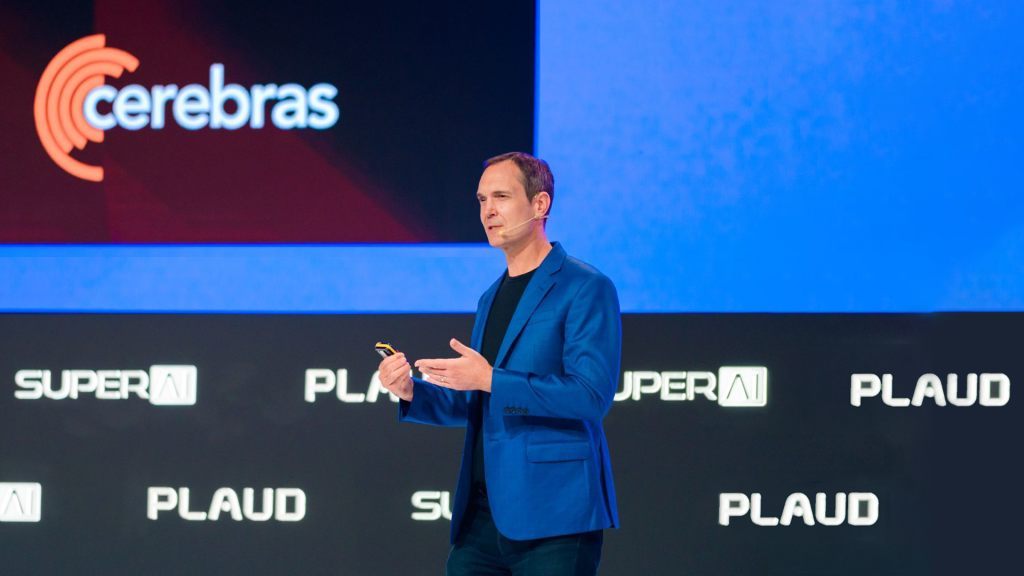
Cerebras chief strategy officer Andy Hock on stage at the SuperAI conference in Singapore last week. / Photo credit: SuperAI
Cerebras’ Wafer-Scale Engines (WSE) can run inference – the “thinking portion” of AI – “up to 15 times faster” than other high-end graphics processing units (GPUs), says chief strategy officer Andy Hock, who spoke to Tech in Asia last week at the SuperAI conference in Singapore.
But while Cerebras is ready with its chips, convincing an industry that has spent the last four years catering to the firm’s main rival, Nvidia, is a different matter.
Nvidia chips have dominated the GPU markets since the explosive growth of GPT architecture over the last four years, with an estimated 80% to 95% market share.
So how does Hock plan on pushing the adoption of WSE? By showing that unlike GPUs, which were originally designed to process graphics, Cerebras chips are specially built to handle AI.
For instance, one of WSE’s core features is its ability to transmit data through the chip at a rate of 21 petabytes per second. For reference, it would take over 800 years to stream 21 petabytes of HD video.
In comparison, Nvidia’s H-200 has a transfer speed of 4.8 terabytes per second.
This increase in memory comes from Cerebras integrating the DRAM – a computer’s working memory – directly onto WSE. In contrast, Nvidia chips require a separate DRAM chip.
Cerebras’ inclusion of on-chip memory also directly addresses the AI industry’s current memory chip shortage, which has caused a global spike in prices.
See also: SEA’s AI buildout is caught in a global memory squeeze
Historically, having better technology does not guarantee a company the top position in the market, but Hock is convinced that the memory ability of Cerebras’ chip will ensure the technology’s uptake.
“I think that gives us a really good shot at being the durable – non Betamax – long-lived solution for AI,” he said, referring to how Sony’s superior video tape format famously lost out to JVC’s cheaper and more accessible VHS cassette in the 1980s.
Stopped at the border
Breaking Nvidia’s hold?
Stay ahead in Asia’s tech landscape
This is premium content. Subscribe to read the full story.
Cerebras has built a chip it claims is made for AI but says the path to getting those chips to SEA runs through export rules and, for now, the cloud.
We know this is not ideal. ⌛ Sign up in 20 seconds. Cancel anytime.
Our subscriber community includes professionals from these companies:





Stay updated on the go with our mobile app.
Get latest insights with smoother, more personalized experience through TIA mobile app.