Paloma Ganguly · · 3 min read
Zomato’s predicament proves food and sex don’t go together
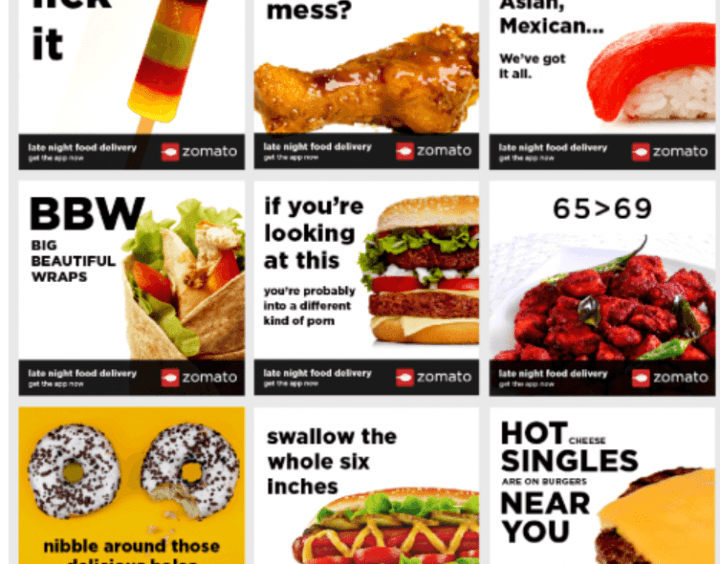
Porn sites work. They get the eyeballs. They excite people. They deliver the goods. And when they carry cheeky ads that say “Big Beautiful Wraps” and “Hot Sticky Mess,” sales are bound to look up. But then, sales are not everything.
That is what food tech giant Zomato has learned the hard way in India, after its advertisements on porn sites threatened to give its image a royal battering.
The country’s foodtech sector is in a bit of a soup. Many startups have closed shop or seen layoffs and had to scale down. Zomato, a restaurant search and food delivery firm, has left no stone unturned to stay in business.
Just last week Tech in Asia reported how the startup added an in-app chat feature to help customers talk to the Zomato team. And there was another thing. Zomato started advertising on porn sites – with great success!
But barely a week into its campaign, the company, which is backed by investors like InfoEdge and Sequoia Capital, has had to back down. “As of yesterday, we have discontinued the ads on porn sites,” a company official told Tech in Asia today.
This is what CEO Deepinder Goyal had to say on Zomato’s highly popular blog: “… we’re killing the porn site campaign, because we sense we crossed the fine line between marketing irreverence and cultural insensitivity. If we did, and ended up offending or disrespecting anyone in any way at all, we are sorry.”
Being naughty
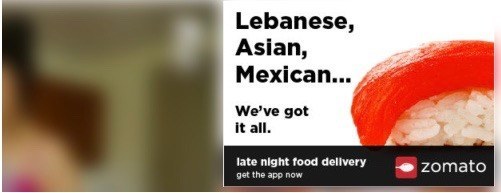
“Nibble around those delicious holes,” said one ad. “Lebanese, Asian, Mexican… we’ve got it all,” said another. “Swallow the whole six inches,” said yet another. Zomato was talking burgers, wraps and other edibles, of course!
Rolling out provocative ads on porn sites seemed like a great idea for a while. Within days of kicking off the campaign, there was a clear spike in interest from places like Delhi and Bangalore.
“The ads got us lots of eyeballs, millions of clicks, a bump up in online orders, and all at a ridiculously low cost,” Deepinder pointed out in the blog.
The ads “appeared between 11 pm and 4 am – when late-night delivery restaurants are at their busiest (we have a fair idea what people who order food that late at night have been doing to work up an appetite),” Pramod Rao wrote on the blog earlier this week. According to LinkedIn, Pramod is the company’s director of international operations.
The blog stated that people in Delhi-NCR clicked on these banners the most on desktops, at an average click-through rate (CTR) of 0.12 percent while Bangalore came a close second with an average CTR of 0.11 percent. “The campaign average CTR so far is at 0.22 percent,” Pramod noted. But that was two days ago.
Zomato does some ‘growing up’





Stay updated on the go with our mobile app.
Get latest insights with smoother, more personalized experience through TIA mobile app.