- Insights This article was written by a TIA community member. Insights pieces undergo the same rigorous editorial process that newsroom-produced articles have.
 Lilach Baumer · · 4 min read
This serial founder wants to challenge Visa through a ‘global currency’ for the future
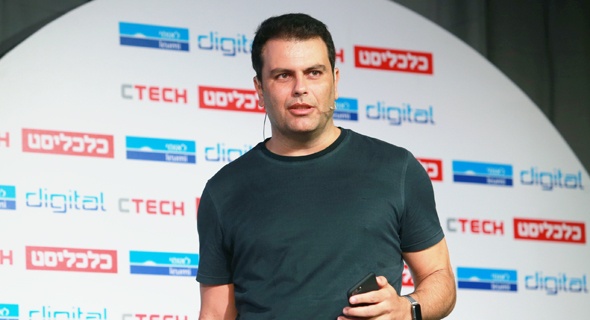
Initiative Q founder Saar Wilf / Photo credit: Orel Cohen
This article was co-authored by Orr Hirschauge.
Serial entrepreneur, investor, and semi-pro poker player Saar Wilf wants to overhaul the global payment system. He’s banking on a digital currency called Q that you can get by simply registering as a user with your name and email—no charge.
Israeli-born Wilf, 44, has a track record when it comes to changing how online payments work. An alumnus of the Israeli military’s Unit 8200, he co-founded Fraud Sciences Corp., a Tel Aviv company that utilized profiling methods to identify fraudulent transactions. In 2008, PayPal bought Fraud Sciences, making it the backbone of its current anti-fraud systems. He has since become an active investor.
Wilf also plays poker semi-professionally. In 2011, he came in sixth and collected US$208,000 at the European poker tournament in Barcelona.
Initiative Q
With his newest venture, Initiative Q, Wilf wants to create a payment network to solve many of the hassles of payments—like invoices stating a name of a business that people have never heard of or the fact that they can’t communicate with the recipient.
Wilf is quick to note that the payment system he envisions is still not in existence, and there is no guarantee that the initiative will garner a large enough user base to justify actual development.
“I can develop an amazing payment system—which is what I did in 1997 and which was just right for the time—and still no one will come,” Wilf said in an interview with Calcalist earlier this month.
In the late 1990s, it was far from obvious that credit cards were going to become the default payment system for the internet, he said.
“No one thought credit cards will win. They just copied the method of phone payments to the internet: you fill a form and enter your card information. It seems insane that millions upon millions of dollars are just transferred like that.”
“You can create a much cheaper payment system if you enlist enough people,” Wilf added. “Better technology has existed for decades.”
So, how do digital coins fit into this scheme? According to Wilf, while Bitcoin, Ethereum, and others of their ilk have not made a real impact as a payment method, they have started a public debate about the deficiencies of existing payment methods.
“The only thing of relevance about crypto is that people realized that what makes money valuable is not necessarily related to governments,” he said.
How it works
Wilf is looking to link the monetary system to the payment system using Q, a token named after the quantity theory of money, which states that the general price level of goods and services has a direct relationship with the quantity of money in circulation. It is also an allusion to the way the letter is pronounced—queue—hinting at the possibility of people lining up to receive the coin.
Feedback and future





Stay updated on the go with our mobile app.
Get latest insights with smoother, more personalized experience through TIA mobile app.