Osman Husain · · 5 min read
Too lazy to go get your own food in Bangladesh? HungryNaki will bring it to your doorstep
In early 2013, a group of five entrepreneurs based in Dhaka, Bangladesh, found themselves brainstorming ideas for a viable, scalable online business. They were determined to take advantage of the burgeoning online population in the country, but were stuck on the idea itself. As most of them had prior exposure to the textile and fashion industry, their first instinct was to set up an ecommerce store selling clothes and accessories.
However, one problem that constantly irritated them during these sessions was the unavailability of food. Curiously, restaurants in Dhaka rarely had dedicated teams that delivered food to homes and offices. Hence, these meetings, which often went on for several hours, had to be interrupted so that someone could go fetch dinner. They grew to understand that their pain was undoubtedly experienced by other consumers in the city, and therefore HungryNaki, an online food delivery service akin to Rocket Internet’s Foodpanda, was born.
“Food is, in essence, the biggest industry in Dhaka,” says Tauseef Ahmed, HungryNaki’s co-founder. “People prefer socializing and catching up with friends and family over a hearty meal.”
The site launched in October 2013, initially concentrating only on one Dhaka neighborhood rather than the entire city itself. Amit Ahmed, digital strategist for HungryNaki, explains this decision was due to a higher propensity for consumers in that area to order and transact online. Plus, they wanted to validate the idea and build some traction around their product before scaling to other localities.
In the first month, HungryNaki managed to get 200 orders. Today, it claims double that every day. Rocket Internet, every local startup’s nemesis, entered the Bangladeshi online food delivery market in December 2013 through Foodpanda, forcing the startup to dig its heels if it wanted to survive. Amit says one of the reasons they were able to compete was a clear focus on customer service. “We didn’t rely on marketing. It was all about service. We wanted to set standards, timely deliveries, compensation for any issues faced. We aimed to win hearts.”
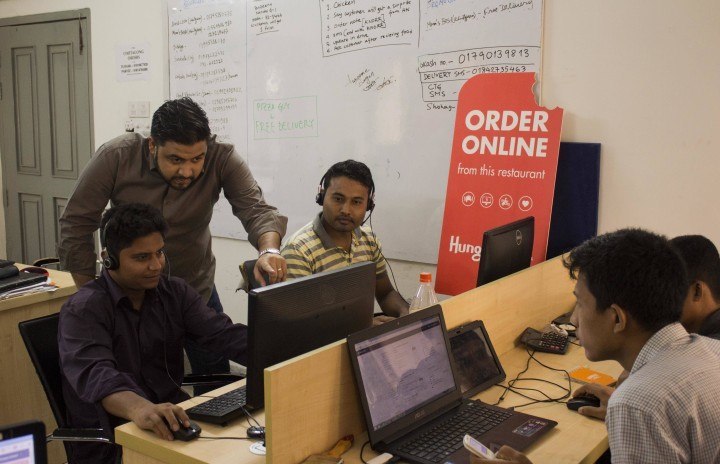
HungryNaki’s Tauseef with his team
Talking to restaurants
The biggest challenge HungryNaki faced was convincing restaurant owners that their model would work and resonate with customers. Restaurants in Bangladesh – the startup claims – are mainly family-owned businesses and used to doing things old-school. The team had to explain to them that payments would not be made instantly, nor in cash, but ultimately they would benefit as their products would reach more customers across Dhaka.
To partly overcome the problem, the founders tapped into their personal networks and convinced a number of premium restaurants to come onboard with them. As others in the industry saw these businesses come online, they were more amenable to follow suit. This resulted in a snowball effect, and soon traditional ways of conducting business were disrupted.
Customer acquisition was also not very easy. People had no prior experience of ordering or transacting online so the startup had to build awareness and create demand. But as consumers noticed the ease and convenience of ordering food online, they rapidly caught on.
As a bootstrapped startup, HungryNaki didn’t have a lot of marketing cash to burn on online advertisements, so it focused on organic growth and the reach of their Facebook page instead. They relied on content marketing efforts and utilized memes and jokes based on political events in the country to attract more users. Amit explains that at the time Facebook’s algorithm was better-suited to organic reach and virality, which helped them expand and scale.
There were efforts to understand and cater to customers in order to stand out from the competition. Amit says customers were happy with their service and glad to support them due to their homegrown status. As a result they’ve managed to keep pace with Foodpanda and haven’t been crowded out by its massive marketing spend.
A unique, hands-on approach has helped. As the startup does its own deliveries, unexpected surges in demand sometimes led to a shortage of delivery guys. Unwilling to compromise on service levels, the founders would sometimes drive their personal vehicles to deliver food. This fact wasn’t lost on their customers who noticed the startup’s commitment and perseverance. As a result there were plenty of repeat customers and new users due to word of mouth.
Bootstrapping to success





Stay updated on the go with our mobile app.
Get latest insights with smoother, more personalized experience through TIA mobile app.