A Chinese-led international research team has created a “tree” that can generate clean drinking water.
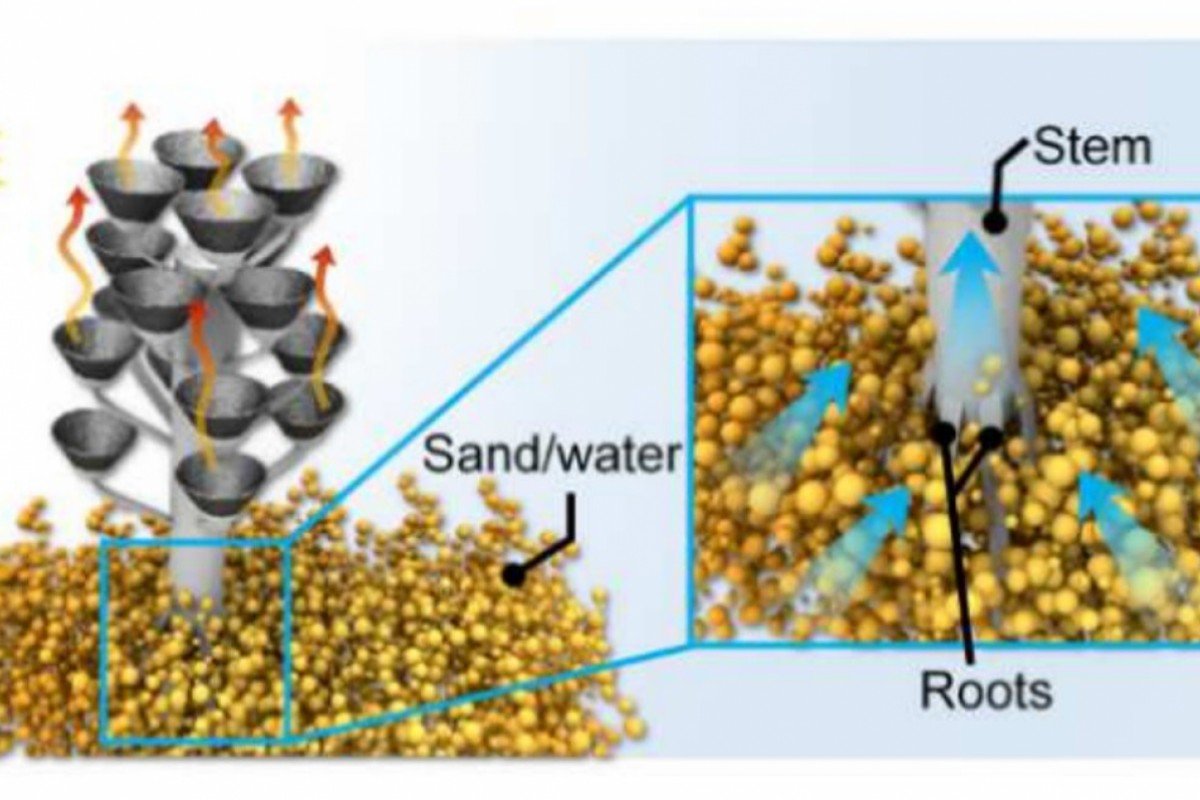
An international research team used solar power to generate a supply of drinking water / Photo credit: Chinese Academy of Sciences
Drawing its energy entirely from the sun, the “water tree” has a root made of cotton fabric that can absorb moisture from its surroundings, such as from sand on a beach.
After water moves up the stem, it is vaporized by “leaves” made of black carbon paper cones that convert light energy to heat, reaching nearly 50 degrees Celsius (122 degrees Fahrenheit). The tree sits in a glass chamber with a relatively cool surface that collects the vapor.
It uses standard cotton fabric and a new nanomaterial that can be cheaply mass-produced from charcoal. The paper cones would only cost US$2 for a surface area as large as 1 square meter, according to the researchers.
A cone that size can generate up to 3.4kg (7.5lbs) of condensed water per hour, faster than any other solar-powered desalination methods previously reported.
Even on a cloudy day, the total output in seven hours of sunlight can reach 5.4kg, or three times the amount the typical adult needs to stay hydrated.
One tree can have multiple layers of branches, each with several cones to increase the vapor-producing surface area.
The study, published this month in the journal titled Nano Energy, was led by Professor Chen Tao at the Chinese Academy of Sciences’ Ningbo Institute of Material Technology and Engineering in Zhejiang province, and also involved researchers from Singapore and Taiwan.
One of the paper’s co-authors, Dr. Ouyang Jianyong, associate professor at the National University of Singapore’s department of materials science and engineering, told the South China Morning Post that the technology could be applied in remote places such as on islands in the South China Sea.
“It is particularly useful for isles far away without a stable drinking water supply,” Ouyang said. “These trees may not be able to quench the thirst of a large city, but they can meet the critical demand of a small community, especially in emergencies.”
“We are already in contact with some companies [to commercialize the technology],” he added.
The material used to make the cone has several advantages, according to Ouyang. It can be used to absorb a wide spectrum of sunlight, maximizing the amount of energy the cones can collect, and its porous structure allows it to release vapor quickly.
When used to desalinate a supply of seawater, the trees would be self-cleaning at night – water can wash away salt residues without being vaporized as it would during the day.





Stay updated on the go with our mobile app.
Get latest insights with smoother, more personalized experience through TIA mobile app.













📅 Upcoming Events
22 October 2026
Payoneer x CSPN Summit 2026