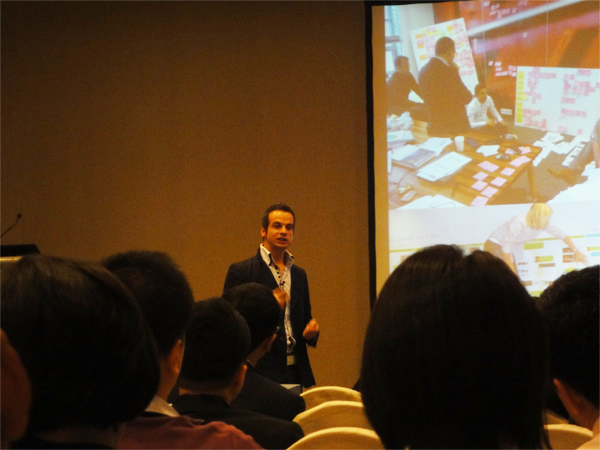
This is a summary of Thomas Marzano’s (@ThomasMarzano) speech in day 2 of the iStrategy 2010 conference. Marzano is the Global Creative Director for Philips.
 Right off the bat he posed the question: What is a brand? The standard definition one usually comes across is that a brand name, sign or symbol used to ID items or services of the seller and to differentiate them from goods of competitors.
A more succinct definition is given by Marty Neumeier, author of the Brand Gap: A brand is the consumers feeling about your product, your services or your organization.
But perhaps Thomas summarized it best: A brand is what people think it is. With people having limitless access to information via the internet, anywhere and anytime, a brand must ensure that the touch points the brand leaves with its consumers is consistent. Philips for example, Thomas said, with its 116,000 employees and 200,000 different products, faced a massive challenge to bring its brand mantra, ‘Sense and Simplicity’, across. This was not aided with its many touch points online and limited ‘human touch’ in each one.
So what Philips did was to cut down on its social media touch points, emphasizing on the fewer touch points with greater passion and greater humanization. Fewer, Bigger and Better. This allows a more concerted effort to bring across the brand message.
Thomas then described Philips Social Media 3 pillar strategy:
- Creating a cross functional social media team – where different people work on the social media aspect, not just social media ‘specialists’. This would include people from marketing, corporate communications, design, IT, customer care and even legal
- Introducing a gateway stage system process for social media – A system in place to apply for each social media activity, where insights are validated. These would include Defining Objectives, Knowing the Audience, Validating with Social Listening, Defining Strategy + KPIs and Establishing Ongoing Measure.
- Creating an Infrastructure for it to take place
An example that Thomas gave was how sold Philips sold its televisions. It could have easily banked on the technical aspects of the televisions: the Ambi-Light technology which emulates cinematic qualities. However, by using insights garnered by social media, Philips discovered that all the technical terms that were used to sell televisions were confusing. So Philips went back to its brand mantra: Sense and Simplicity.
It looked at the insights garnered from social media and uncovered that when the consumer buys a TV, design is actually important and that most people like to go to the actual store to buy the TV. Perhaps interestingly, the experience extends to even hanging the TV on the wall!
Applying Sense and Simplicity, Thomas and his team set out to design an online TV buying guide with 4 key considerations: Design, Budget, Picture Quality and Screen Size. Not surprisingly, the marketing team from Philips argued that they should be banking on the technical qualities of the TV, but Thomas and his team stuck to their guns.





Stay updated on the go with our mobile app.
Get latest insights with smoother, more personalized experience through TIA mobile app.









📅 Upcoming Events
22 October 2026
Payoneer x CSPN Summit 2026