 Rita Putatunda · · 6 min read
You will never have to queue up again if this app has its way
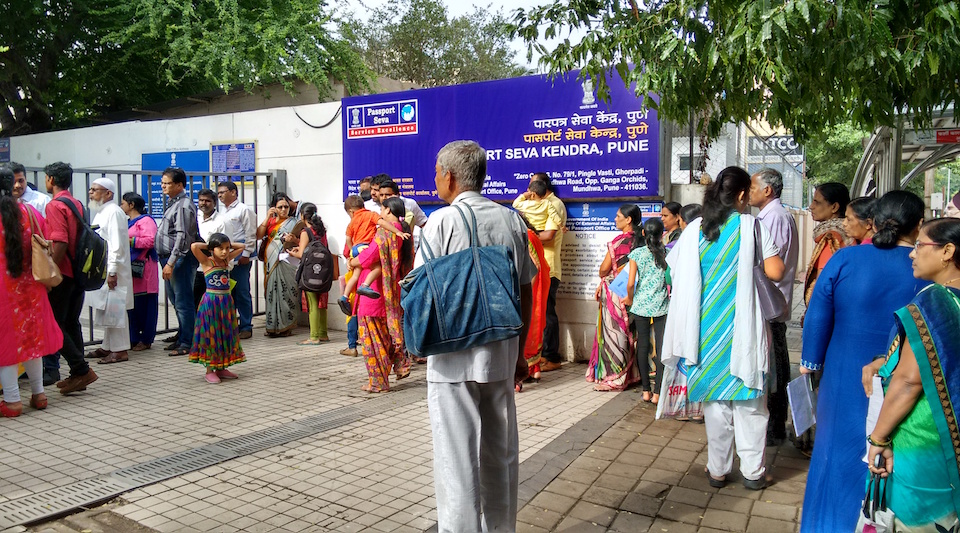
Photo credit: Tech In Asia’s Rita Putatunda.
I hate queues. I think most of us do. In fact, I just survived one a few days ago – that picture on top is of the queue I was in, just to renew my passport in Pune, India.
Daljit Singh, 72, in the same queue complained, “They don’t even have a separate line for senior citizens.” This was the second time he had to come to the passport office, merely to submit a document which was required. There is even a term for the slow aggravation one suppresses when we have to submit to such mindless waste of time and energy; it’s called “queue rage”!
Queues are an everyday reality for most citizens of India. They hark back to the pre-80s socialist era. An era epitomized by queues to get a telephone connection, or to buy a car, the years it took to get them. The gratingly detached voice intoning in your exasperated ear “aap katar mein hai (you are in the queue)” when you made a trunk call, after finally getting a phone. The brutally long lines at railway reservation counters, plodding lines through kafkaesque labyrinths of government offices, lines at banks, at cinema halls, to get a refill of your gas cylinder, you name it! And, though things have improved somewhat these days, queues to access various services continue to be a bugbear for most of us.
Of all the hated queues, the ones at the doctor’s clinic have to be the most vexatious. On top of being sick, there you are stuck in what seems an interminable wait, just to meet your doctor, often despite prior appointment.
Exasperation fathers innovation
In fact, it was the exasperation of waiting at doctors’ clinics that was the reason for Shachin Bharadwaj coming up with “See Me In No Queue”, or the Sminq app.
Shachin, who is the CEO and co-founder of Sminq, explains: “When my wife was pregnant, we had to go to the gynec for monthly check-ups. Invariably, she used to feel hungry while we waited at the clinic. So we wanted to go out and grab a bite and come back in.”
But when Shachin and his wife asked the receptionist if she would inform them when their turn was due, so that they could come back in time, the reply they got was: “Can I call 50 people when each one’s turn comes?”
To be fair, clinics and hospitals are overloaded in India because of a shortage of doctors.
It took his mind back to a similar experience while he was at his earlier startup Tastykhana, which got acquired by Foodpanda a couple of years ago. There he had met Niket Kadde, who had wanted to develop a queue system on the phone after experiencing the lines when his mother had to go to hospital.
So, about a year after selling their startup, the three Tastykhana co-founders – Shachin, Santhosh N, and Sheldon Dsouza – joined hands with Niket to start Sminq. Earlier this year, it raised a seed round of US$1 million from Saama Capital and Blume Ventures.
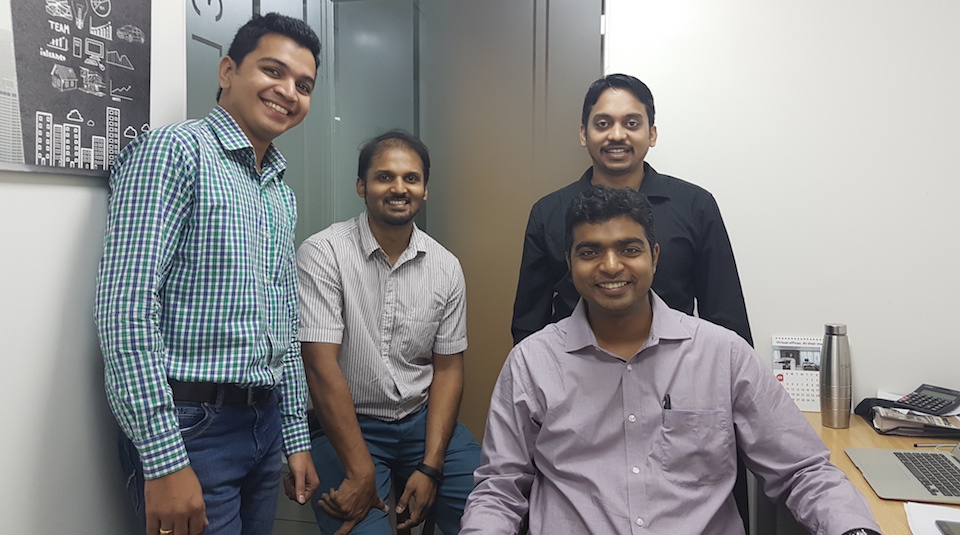
Sminq founders Shachin Bharadwaj, Niket Kadde, Santhosh N, and Sheldon Dsouza. Photo credit: Sminq.
In a nutshell, Sminq eliminates physical queues by making them virtual. You get real time information about your queue status on your mobile. Therefore, you no longer have to wait interminably at any queue just to hang on to your spot. Hence, you could do other stuff, while Sminq handles your queue status, and be just in time for your service when the app alerts you. Plus, you can join your queue from anywhere, via the app.
The one vertical that affects people the most
Queue stories





Stay updated on the go with our mobile app.
Get latest insights with smoother, more personalized experience through TIA mobile app.









📅 Upcoming Events
22 October 2026
Payoneer x CSPN Summit 2026