- Premium Content It takes our newsroom weeks - if not months - to investigate and produce stories for our premium content. You can’t find them anywhere else.
 Scott Shuey · · 3 min read
BDx reaches 1.2 GW deal to power its data centers in Indonesia
BDx Data Centers announced on Wednesday that it has secured 1.2 gigawatts of power capacity from Indonesian state utility PLN.
Access to reliable, large-scale power has become a central constraint for AI and hyperscale facilities in Southeast Asia, where operators compete for grid allocations to support GPU-heavy workloads.
The allocation is the largest held by any single data center operator in Indonesia, BDx said.
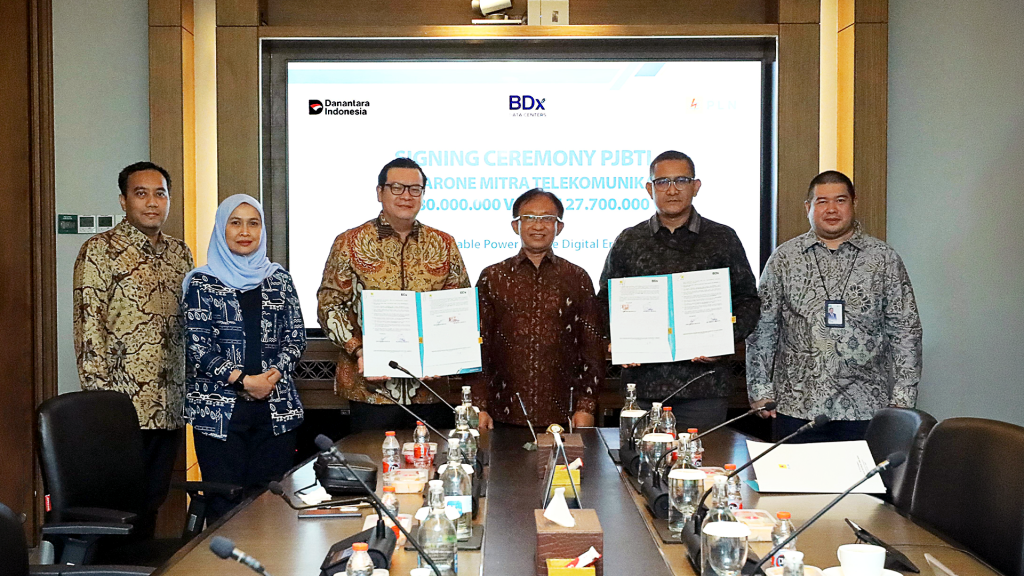
The agreements were formalized at a signing ceremony in Jakarta, with senior leaders including (third and fourth from left) Agus Hartono Wijaya, CEO of BDx Indonesia, and Adi Priyanto, retail and commercial director at PLN, in attendance. / Photo credit: DBx Data Centers
Agus Hartono Wijaya, CEO of BDx Indonesia, tells Tech in Asia that the agreement is open-ended. He did not reveal the expected value of the deal or the tariffs that BDx would pay for the electricity, but he acknowledged that the tariffs could fluctuate with international energy prices.
The agreement will provide power to three of the company’s Indonesian sites: the CGK4 campus in Jatiluhur, West Java; the upcoming CGK3A campus in Cilandak, South Jakarta; and the future CGK5 site in Suryacipta, West Java.
BDx said its Indonesian sites are used for AI training and cloud workloads. The CGK4 campus runs at up to 650 megawatts and supports Nvidia’s H-100 chipset, considered the industry standard for enterprise data centers.
Wijaya frames the speed of the deal as a competitive signal, saying it was completed in about five months, from late January to mid-May.
“We’re trying to future-proof our deployments so we can withstand new technology and higher rack densities,” he explains. “You don’t want to be trapped in a situation where you have an exciting opportunity and then don’t have enough power to serve customers.”
Meeting capacity for two to three years
The 1.2-gigawatt capacity will be brought online in stages, according to Wijaya.
“We are going to build in phases based on demand. But considering our current pipeline, we have confidence that we’ll be able to consume all of this within the next two to three years,” he says.
The CEO points out that domestic demand is a primary driver.
“One of the main objectives was digital sovereignty,” he adds. “In the last 12 months, we’ve started to see reputable enterprises deploying GPUs on a smaller scale.”
See also: The price isn’t right: Oil spike fuels risks in SEA’s tech scene
Stay ahead in Asia’s tech landscape
This is premium content. Subscribe to read the full story.
As AI facilities face energy constraints, BDx enters the ring with the largest power allocation for a single data center operator in the country.
We know this is not ideal. ⌛ Sign up in 20 seconds. Cancel anytime.
Our subscriber community includes professionals from these companies:





Stay updated on the go with our mobile app.
Get latest insights with smoother, more personalized experience through TIA mobile app.