- Premium Content It takes our newsroom weeks - if not months - to investigate and produce stories for our premium content. You can’t find them anywhere else.
 Gilang Kharisma · · 6 min read
Should Grab and Gojek drivers be considered employees, not contractors?
Drivers on super apps like Grab and Gojek are called “partners,” but the reality is that this relationship is hardly equal.
Hendry, a full-time ojek driver in Tangerang Selatan, a city 30 kilometers west of Jakarta, Indonesia’s capital, says that these platforms impose stringent demands on him and his peers. “If we reject orders more than once, especially consecutively, then incoming orders for the next few days will be much less,” he tells Tech in Asia Indonesia.
This leaves drivers with little choice but to take orders even in dangerous conditions, such as doing pick-ups in flooded areas or delivering large items like dispensers or cupboards.
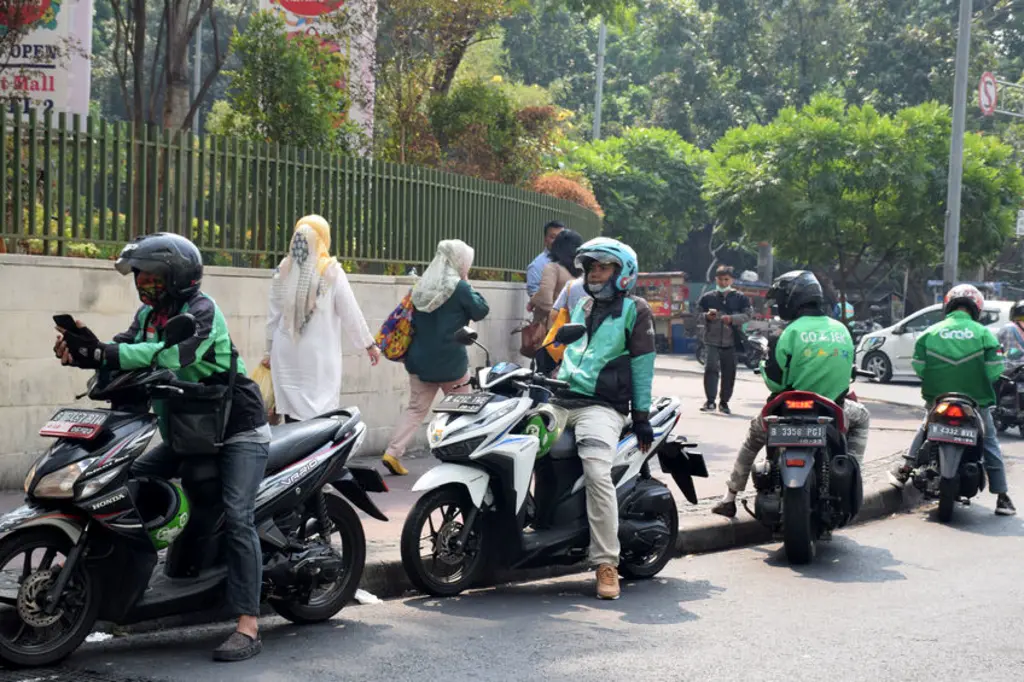
Grab and Gojek riders on the streets of Indonesia / Photo credit: 123RF
Hendry adds that the companies do not provide much protection if there’s a mishap while drivers are on the job. While he knows about the insurance that Gojek and Grab provides for partners, he doesn’t believe that it’s sufficient. Meanwhile, the costs of maintaining vehicles are still borne by the drivers.
Arief, who has been a part-time online ojek driver for the last two years, raised similar concerns, noting that this imbalance results in little loyalty between drivers and platforms. “There really isn’t much that drivers can do except look for companies that offer better benefits,” he says.
This lopsided relationship is hardly unique to Indonesia – or Southeast Asia, for that matter – but the status quo seems to be changing outside the region.
In February, the UK court ruled that Uber must classify their 70,000 driver-partners as “workers” under British law instead of self-employed. A week later, the Italian court made a similar ruling against food delivery services like Uber Eats, Foodinho-Glovo, Deliveroo, and Just Eat.
This raises a question: Should Indonesia’s driver-partners also become employees?
“Complete control” over drivers
For starters, it helps to look at the rationale behind the UK Supreme Court’s decision:
- Uber has complete control over how it evaluates drivers and how much revenue it takes from them. Drivers have no say in this matter.
- Uber demands that the drivers meet their work standards and can unilaterally end their relationships if drivers fail to comply.
- Uber regulates and determines the distribution of orders to the drivers, and drivers are penalized for refusing multiple orders.
Seeing the amount of control Uber had over its drivers, the court decided that the drivers’ should be considered employees.
“This ruling will fundamentally re-order the gig economy and bring an end to rife exploitation of workers by means of algorithmic and contract trickery,” James Farrar, the former Uber driver involved in the lawsuit, told Associated Press. He’s now the general secretary of the App Drivers and Couriers Union in the UK.
It would seem that all the elements that helped the case against Uber in the UK can also be found in Indonesia’s ride-hailing economy. That’s why the legal cases in the UK and Italy will be a point of reference for Indonesian regulators.
Should Indonesia follow suit?
Not all drivers want to be employees
Stay ahead in Asia’s tech landscape
This is premium content. Subscribe to read the full story.
Some argue that ride-hailing companies are exploiting driver-partners by not giving them sufficient rights.
We know this is not ideal. ⌛ Sign up in 20 seconds. Cancel anytime.
Our subscriber community includes professionals from these companies:





Stay updated on the go with our mobile app.
Get latest insights with smoother, more personalized experience through TIA mobile app.











📅 Upcoming Events
22 October 2026
Payoneer x CSPN Summit 2026