- Premium Content It takes our newsroom weeks - if not months - to investigate and produce stories for our premium content. You can’t find them anywhere else.
 Deepti Sri · · 5 min read
Wastewater recycling can be greener, cheaper with this Singapore firm’s solutions
The movie Mad Max: Fury Road brought to life visuals of a post-apocalyptic world with scarce freshwater resources.
Though this is a work of fiction, the fact is that today, 844 million people worldwide lack safe drinking water, of which around 110 million live in Southeast Asia, according to a 2023 United Nations report.
Indonesia’s water resources account for 21% of Asia Pacific’s, but more than half of the country’s rivers are polluted. Industrial discharge accounts for about 5% of the water pollution in the country.
While conventional wastewater technology exists, it is reliant on chemical reactions with contaminants – a process that produces additional waste and is marked by inefficiencies and high energy consumption, Mohammad Sherafatmand, co-founder Hydroleap, tells Tech in Asia.
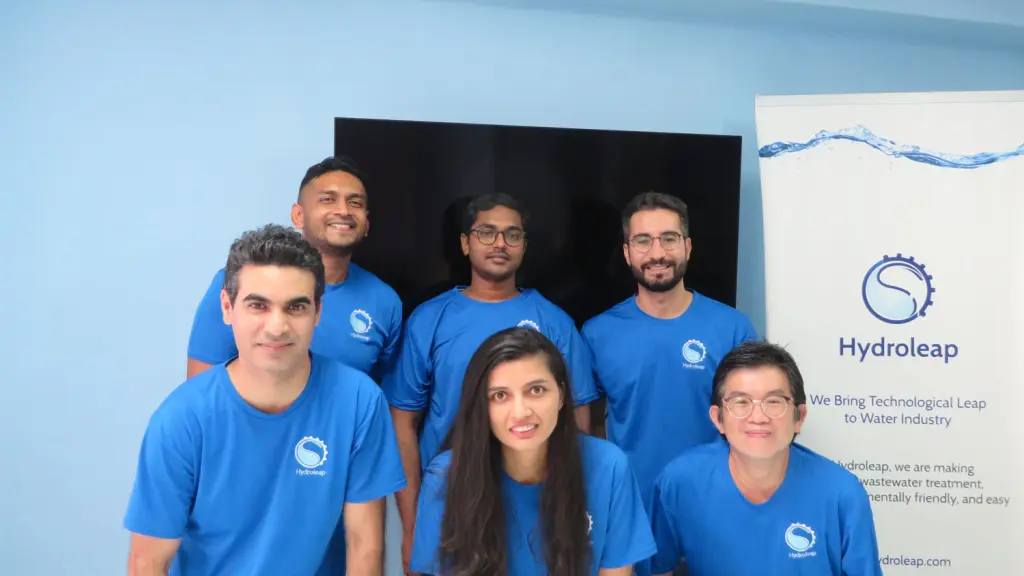
The Hydroleap team / Photo credit: Hydroleap
The Singapore-based greentech startup is looking to tackle these issues in wastewater recycling technology by focusing on providing solutions that consume less energy and don’t use chemicals.
Despite environmental, social, and governance goals gaining momentum among companies, it isn’t enough to make a business switch to a more eco-friendly system, says Sherafatmand.
But monetary benefits do help. Hydroleap says its solutions can help reduce carbon emissions as well as power and water consumption, allowing clients to save around 50% to 60% in costs.
This has helped Hydroleap pick up over 12 B2B clients across five key industries: F&B, cooling tower, desalination, palm oil, and construction.
Recently, Hydroleap partnered with Singapore-based IX Technology (IXT) to help companies in the data center industry reduce water consumption, lower chemical use, and bring down their carbon footprint. IXT designs, builds, and maintains data centers, corporate server rooms, and offices.
Traditional manufacturing industries aside, data centers consume a significant amount of water to cool supercomputers. A researcher at the University of California, Riverside found out that OpenAI’s ChatGPT consumes 500 milliliters of water for every five to 50 prompts it answers.
Singapore, which has been facing water shortages, aims to have 55% of its water demand met by recycled water by 2060, which means wastewater recycling technology is expected to see a growth in demand.
The industrial wastewater treatment market in Southeast Asia was valued at US$18.1 billion in 2022 and is expected to grow to US$33.2 billion by 2031.
With the US$4.4 million series A money raised in July from Mitsubishi Electric, Wavemaker Partners, and Seeds Capital, among others, Hydroleap aims to enter new Asia-Pacific geographies like Australia, Japan, and Indonesia over the next two years.
Battling traditional methods
Profitability in sight
Stay ahead in Asia’s tech landscape
This is premium content. Subscribe to read the full story.
Hydroleap’s industrial wastewater recycling solutions help clients reduce power and water consumption, saving them around 50% to 60% in costs.
We know this is not ideal. ⌛ Sign up in 20 seconds. Cancel anytime.
Our subscriber community includes professionals from these companies:





Stay updated on the go with our mobile app.
Get latest insights with smoother, more personalized experience through TIA mobile app.