 Jonathan Chew · · 7 min read
How Singapore is ensuring no one gets left behind in its digital future

When it comes to technology adoption, Singapore has often done well in many areas. For instance, its internet penetration rate is extremely high, with 98% of resident households having internet access. That said, not everyone in the city-state has taken to digitalization the same way.
In 2020, of the 1.4 million households in the country, 11% did not have access to a computer.
To help enrich citizens’ lives through digitalization and empower them to embrace it as a lifelong pursuit, President Halimah Yacob launched the Digital for Life movement in 2021. Supported by the Infocomm Media Development Authority (IMDA), Singapore’s governing body for the infocomm and media sectors, the movement aims to help less digitally included citizens get the necessary tools, skills, and habits they need to succeed in a tech-enabled future.
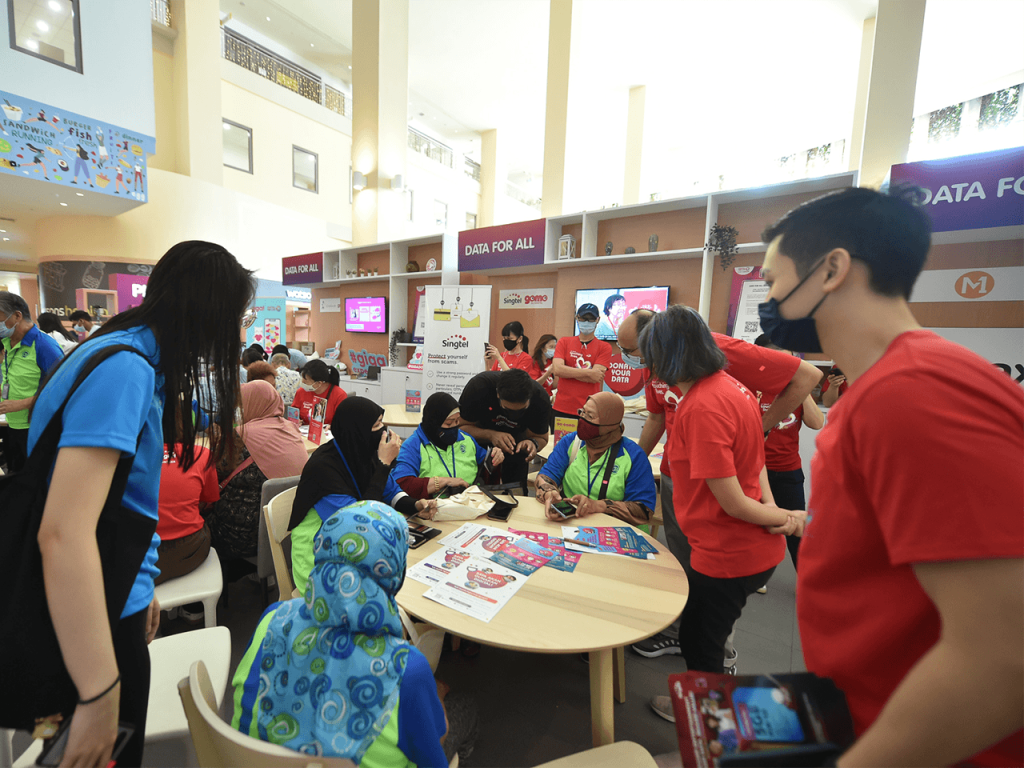
Attendees at the Data for All booth during the Digital For Life festival at Heartbeat@Bedok / Photo credit: IMDA
To that end, IMDA is working with over 100 partners from three key sectors: private corporations, public agencies, and what it calls the “people sector,” which includes social enterprises and nonprofit groups.
“There is a need to draw deeply on the diverse interests, networks, and capabilities in our community,” says Dawn Low, cluster director of IMDA’s digital readiness cluster. “Contributing to the Digital for Life movement does not always require grand ideas – everyone can play a part and help someone in the community.”
To drive further awareness of the movement, the inaugural Digital for Life Festival was held from May 21 to May 29. Close to 30,000 participants attended the festival, which featured several offline and online activities to help drive digital adoption and inclusion for groups such as the elderly, young children, and people with disabilities.
Advocating for digital wellness in the family
DigiPanion, which provides several programs to help users manage online habits, hosted a webinar called “They are watching YOU! Parents, be positive Digital Role Models!” Its objective was to teach parents how to manage family screen time and act as good influences for their children’s digital habits.
“Children are constantly watching and learning from us. The digital habits and footprints of adults go a long way in nurturing a digitally well-balanced present and future,” says Kopal Agarwal, founder and CEO of DigiPanion.
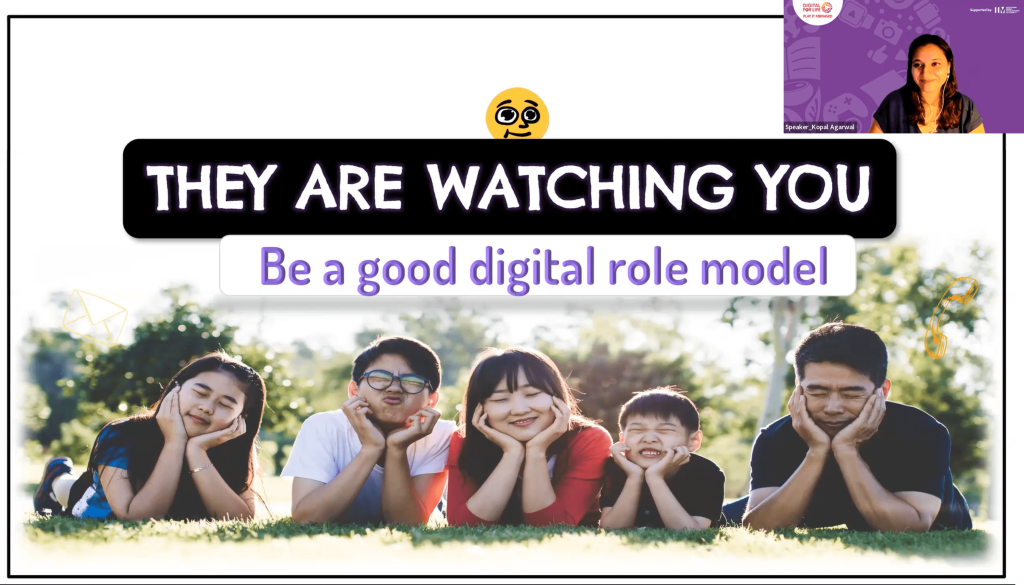
Kopal Agarwal, founder and CEO of DigiPanion, led the webinar to educate parents and children on good digital habits / Photo credit: IMDA
During the webinar, Agarwal suggested several approaches parents could take to set a good example, such as refraining from device usage during mealtimes and at least one hour before bed. She also mentioned six basic rules to help improve online etiquette: ensure the use of respectful language, be thoughtful when sharing content, refrain from spam, fact-check before forwarding content, respect privacy, and be inclusive when having online conversations.
In addition, Agarwal taught parents how to tell if their child is involved in cyberbullying. According to her, victims may show a lack of interest in online activities, have sudden changes in behavior, or display lower self-esteem. Cyberbullies, on the other hand, may display aggressive behavior while online, use multiple accounts, or even show signs of being victims themselves.
Agarwal advised that should parents find out their children are involved in cyberbullying, they should avoid banning their child’s online activity completely, as it could backfire and lead to more resentment.
Cyber safety tips
Meanwhile, financial services firm Maybank ran a booth focusing on online safety. One of its main draws was the quizzes, which taught participants about cyber safety topics such as creating secure passwords, spotting phishing and malware attempts, and managing one’s digital footprint.
“My daughter felt it was very exciting,” said attendee Soma Ravikumar. “As teenagers, they’re just starting to use mobile phones so it was a good learning [activity] for her.”
Volunteers at the Maybank booth found that cyber safety was a topic of interest for many elderly participants as well.

A volunteer from Maybank shares cyber safety tips with an attendee / Photo credit: IMDA
“Seniors tend to like something simple [for their passwords], such as ‘123’ or just numbers. So this activity helps reinforce their understanding of why it’s important to have a good, strong password,” said Jamilah Salleh, an assistant corporate social responsibility manager at Maybank who helped run the booth.
The activity also proved useful to participant Patricia Lim, who said that even though she knew the basics, visiting the Maybank booth was a helpful way to learn how to make her passwords stronger.
Equipping people with disabilities with digital work skills
Edukinect, a consulting company that helps firms carry out digital transformation strategies, organized several workshops to help people with disabilities pick up digital skills.
One of these workshops taught participants the basics of using Microsoft Excel in a business capacity, such as how to organize and visualize company data. This, in turn, helps them when looking for jobs.
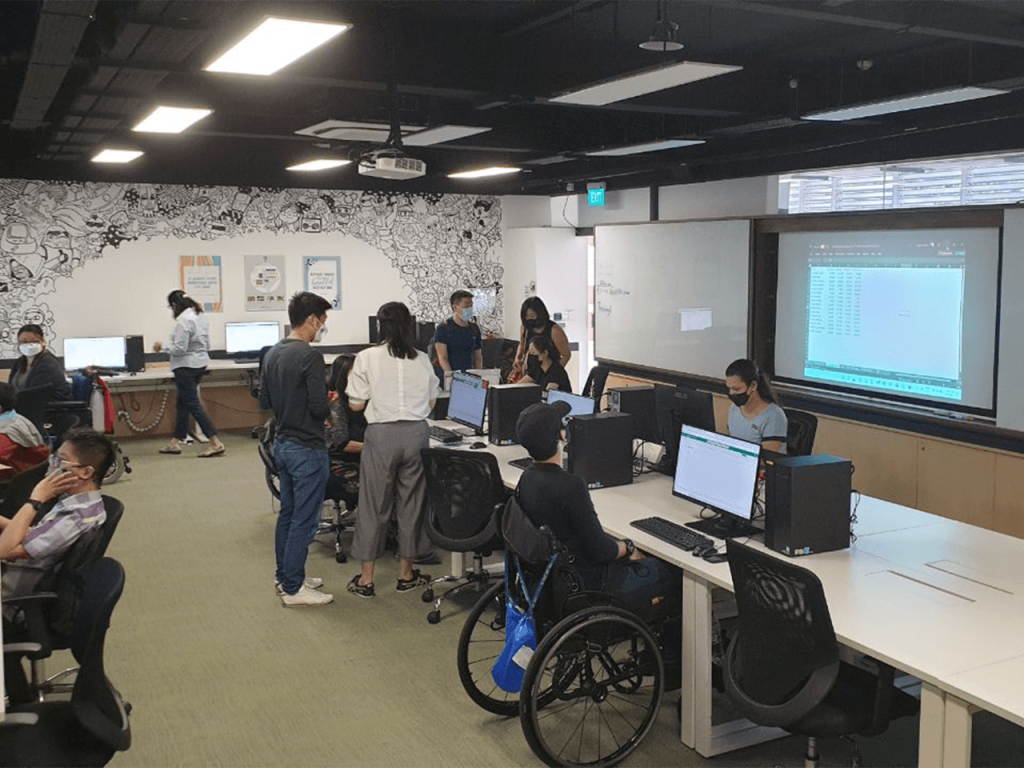
The Excel workshop, led by Edukinect founder and CEO Swapna Pawar (right), was held in a classroom in the Enabling Village / Photo credit: Tech In Asia
“Generally, if you look at the job market, almost 99% of job descriptions say Microsoft Office skills are required,” said Swapna Pawar, founder and CEO of Edukinect. “Unfortunately, not everyone knows Microsoft Office or how to use it.”
One participant, Low Zheng Yong, shared that with the skills he learned from the workshop, he plans to begin looking for part-time office jobs. Another attendee, Norharienti Abdul Gani, said the lesson was a helpful refresher as she had been unable to work for more than a year following a stroke.
“I was so lost [at that time],” she shared. “When I attended this, it kind of brought back those memories of how to use [Microsoft Excel].”
Data donation drive
As part of the Digital for Life movement’s goal to help improve digital access, IMDA launched the Data for All initiative. Under this project, three major telcos – M1, Gomo by Singtel, and Giga by StarHub – have committed to raise awareness for the movement, mobilizing their customers to pledge their support or donate unused data from their mobile plans.
Working with several organizations such as Lions Befrienders, NTUC Health, and SG Enable, each telco will use their customers’ pledges and donations to provide 10,000 mobile data lines to support up to 30,000 beneficiaries. These include youths, children and seniors from low-income families, as well as people with disabilities and their caregivers.
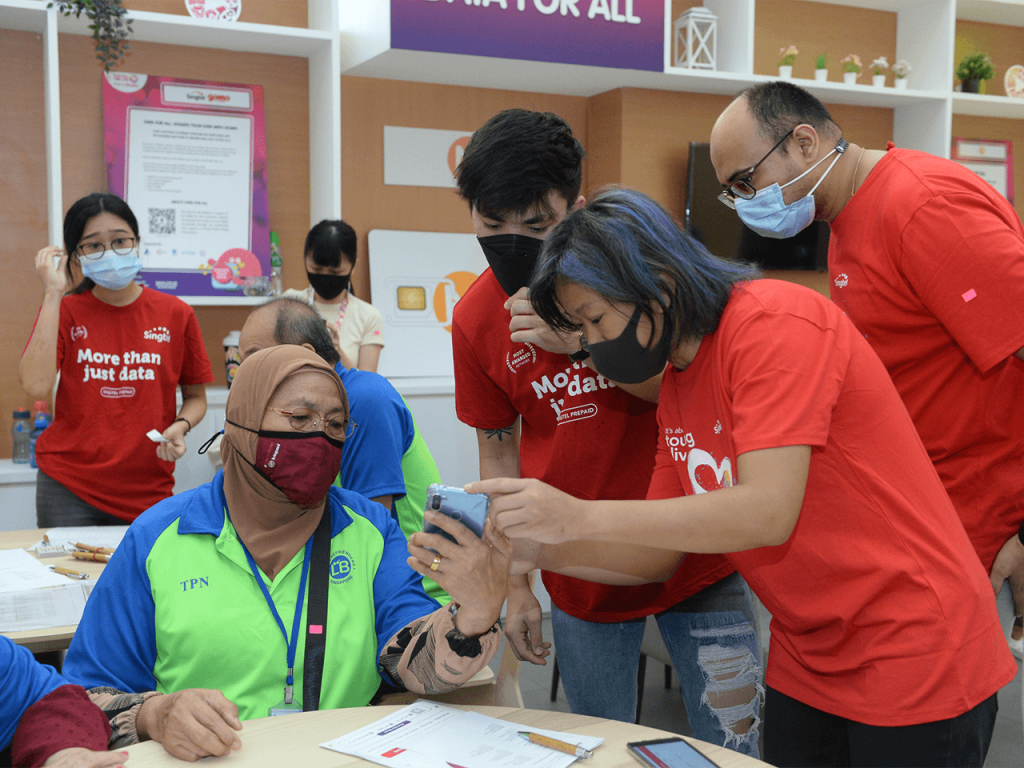
A volunteer from Singtel shares details about the Data for All initiative with an attendee during the Digital for Life festival / Photo credit: IMDA
“With digitalization rapidly changing the way we live, work, learn, and engage, persons with disabilities and their caregivers must not be left behind in this digital age,” says Ku Geok Boon, CEO of SG Enable, an agency that facilitates access to disability schemes and services.
“The Data for All initiative gives them the opportunity to access digital content and connect with others,” she adds. “Beyond the direct benefits, we also hope this will encourage communities to develop an inclusive digital ecosystem.”
For StarHub and its all-digital brand Giga, each mobile plan comes with no contract or excess charges, six gigabytes of data, 500 talktime minutes, 500 SMS texts, and free data rollover each month.
According to Aletheia Y.P. Green, head of Giga and vice president of digital at StarHub, Data for All received a positive response during the festival. Volunteers gave out more than 550 mobile data plans to beneficiaries over five days.
Customers can also play their part by using the Giga app to pledge their support and help the telco contribute to its initiative of donating up to 10,000 mobile data plans. To date, more than 70,000 customers have pledged their support, Green says.
For the other telcos, M1 will contribute additional SIM cards each time its Facebook post is liked and shared. Meanwhile, Gomo by Singtel will give out more mobile data plans each time users donate their data through the Gomo app.
A continuous effort
IMDA hopes that companies and individuals will continue to play their part in the Digital for Life movement by volunteering and developing projects that focus on building digital resilience.
It’s also encouraging Singaporeans to contribute to the Digital for Life Fund, which helps support communities through projects focusing on digital technologies, inclusion, literacy, and wellness.
“We want to harness our collective strength to equip, uplift, and engage all segments of the community. With the abled supporting the less abled, we can build a digitally inclusive society,” says IMDA’s Low.
IMDA is Singapore’s regulatory body for the infocomm and media sectors. Its mission is to support a digitally inclusive society, as well as drive Singapore’s digital transformation with infocomm and media by creating opportunities for growth through an emphasis on talent, research, innovation, and enterprise.
The Digital for Life movement was launched in 2021 by President Halimah Yacob to encourage Singaporeans from all ages and walks of life to embrace digital learning as a lifelong pursuit. To find out more about the movement and how you can contribute to it, visit its website.
This content was produced by Tech in Asia Studios, which connects brands with Asia’s tech community. Learn more about partnering with Tech in Asia Studios.
Stay updated on the go with our mobile app.
Get latest insights with smoother, more personalized experience through TIA mobile app.
Recommended reads
 Deal done: SPH Media completes Tech in Asia buyout
 SG government to support Lazada’s retrenched workforce
 ASEAN Foundation, Microsoft partner for AI upskilling project
 Did the CEO of Indonesian startup Octopus graduate from UC Berkeley?
 Ex-Temasek execs join new AI startup Resaro.ai
 Kakao’s Klaytn sets aside $20M to blockchain research in collaboration with SG, KR universities
 Google launches new AI initiatives in Singapore
 MAS to launch $3.5m grant initiative for blended finance projects
 SG comedian Mark Lee to launch NFT project
 Singapore could lose more biotech firms





Editing by Nathaniel Fetalvero, Winston Zhang, and Lorenzo Kyle Subido
(And yes, we’re serious about ethics and transparency. More information here.)




