Malavika Velayanikal · · 8 min read
No robots, please, we’re Indian – the lowdown on Amazon’s localization strategy
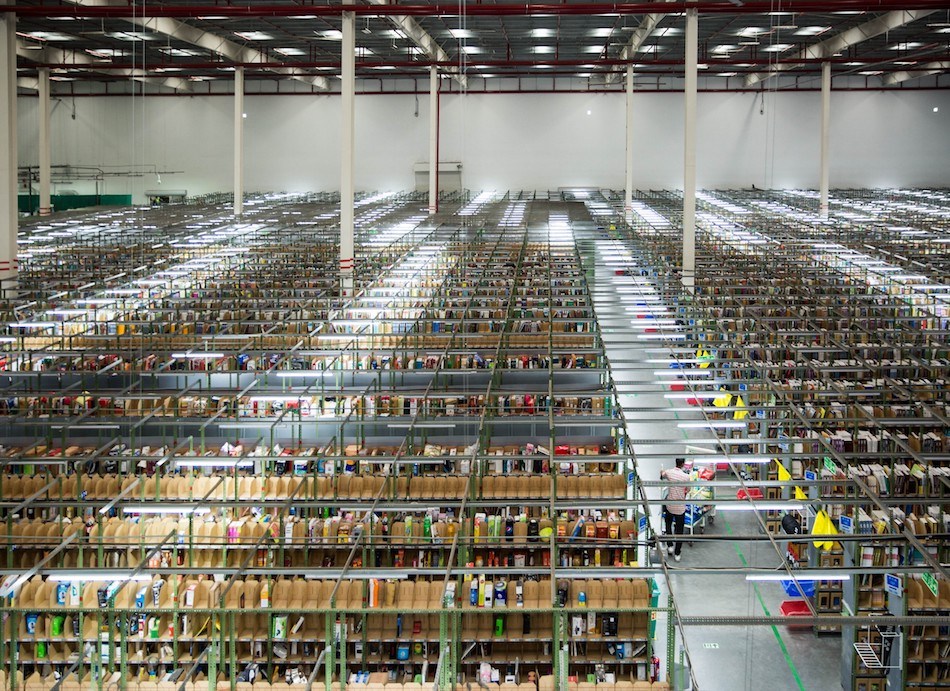
Amazon India’s largest ‘fulfilment center’ in Hyderabad. Photo credit: Amazon.
A string of docks line one end of Amazon’s 400,000-square-foot fulfilment center in Shamshabad, near Hyderabad in southern India. Trucks from sellers back into the docks, unloading boxes after boxes of goods.
I am at the start of the loop where Amazon India’s staff takes over. Boxes are unpacked, then each product is weighed, tagged, re-boxed, and sent to a coded shelf from where it’s retrieved when you or I click the buy button on our screen.
With a storage capacity of 2.1 million cubic feet, this is the largest of Amazon’s warehouses in India – the company dubs them fulfilment centers.
At what tipping point between automation and manual does it make sense to put a lot of Kiva robots here?
What strikes me is the number of hands tagging, sorting, weighing, and moving products. This is Amazon, renowned for its early push into automation right from the acquisition of Kiva Systems, a pioneer in warehouse robots, for US$775 million in 2012. We read in awe about its experiments with AI and computer vision for a fully automated offline “store of the future.”
But there are no robots here. Its biggest warehouse in the giant Indian market is human-centric.
Amazon India VP Akhil Saxena is taking me on a tour of the facility where I feel I could easily get lost among the winding conveyor belts. It is in fact less than half the size of a typical Amazon warehouse in the US, he informs me.
“We started off in India with smaller buildings, and as we scale up the buildings, we are adopting in the right level of automation,” says Saxena. “If you want to bring in all the US automation, then the buildings have to be much larger. Our US buildings are typically one million square feet. There it makes sense for the product to move rather than the person, as you’ve seen in Kiva videos I’m sure where the person is standing and the shelf moves to the person.”

Amazon India VP Akhil Saxena. Photo credit: Tech in Asia.
Jeff Bezos committed US$5 billion to Amazon India last year, determined to win the next big market after failing to make headway in China. A chunk of that goes into price wars with heavily funded rivals like Tencent-backed Flipkart and Alibaba-backed Paytm, both of which have also raised billions from Japanese giant SoftBank.
From the very outset in 2013 when Amazon entered India, it has taken the long view, spending heavily not only on discounts but also in solving India’s biggest challenge: logistics. It has built up 41 fulfilment centers around the country – twice as many as its main local rival Flipkart.
At the same time, it’s not a one-size-fits-all model for the global ecommerce giant. The Indian arm has the necessary leeway to work out its localization strategy. Part of that is to minimize costs, and the millions of dollars it is losing in the battle for India. The conspicuous absence of robots is one manifestation of being local, although, ironically enough, the local player Flipkart – flush with US$4 billion in funding this year – has already deployed warehouse robots made by Indian startup GreyOrange.
Lost and found
From CoD to PoD





Stay updated on the go with our mobile app.
Get latest insights with smoother, more personalized experience through TIA mobile app.