Jonathan Chew · · 6 min read
Shiny AI, shaky ground: why siloed data can break you

Summary:
- AI adoption is inevitable across all roles, but rushing into it without proper structure and data management can lead to high‑profile failures.
- The biggest obstacle to effective AI is siloed, poorly managed data, so organizations must align business leaders across departments and centralize information in a secure, compliant framework.
- Robust, centralized infrastructure with reliable, high‑performance and backed‑up storage is essential to support AI tools safely.
- Learn more about how Synology can support AI transformation.
Even if you dread it or run from it, AI adoption arrives all the same, whether you’re in an IT-related role or not.
Today, almost every business leader has to think about the impact of adopting AI and how to do it right. Yet, in an endeavor to keep up with the proverbial Joneses, many firms may end up rushing ahead and implementing AI without having the right structure and in ways that are less than ideal.
For instance, real estate marketplace Zillow once tried to implement an AI-powered home pricing model. However, its algorithm didn’t account for several key data points and even failed to consider market volatility during the Covid-19 pandemic. This led to huge miscalculations and more than US$500 million in losses and layoffs that affected 25% of the company’s staff.

Photo credit: Shutterstock
Issues like this are a lot more visible and highlight the problem with incorrect implementation. But there’s a much more common misstep that many companies might make: not managing and storing their data – which AI tools rely heavily on for accurate analysis – in a secure and centralized manner.
“In our perspective, data still being heavily siloed is the biggest challenge for businesses,” says Antoine Yang, head of Southeast Asia for Synology, a manufacturer of storage appliances.
Building on shaky ground
One of the main hurdles with data being so fragmented is that it becomes extremely difficult for IT teams to enforce unified governance and control.
“This can lead to gaps in data management and protection, ultimately resulting in incomplete AI coverage for analysis, along with other potential risks,” Yang explains.

Antoine Yang, head of Southeast Asia for Synology / Photo credit: Synology
For instance, picture an organization that has three different teams that handle or come into contact with customer data. Each team has its own internal definitions and policies for managing the information.
Suppose that the company now requires a unified governance structure across all three teams, so that AI models can use this data together. What will likely happen is a lot of wasted time spent arguing or discussing with each silo what data can be accessed, what each data point can be used for, and whether the definitions are consistent. All told, it can make unified governance for AI implementation highly inconsistent, not to mention increase the risk of improper data handling.
To overcome this challenge, organizations need to adopt a two-pronged approach. First, AI implementation cannot be the sole responsibility of individual departments. Along with the CTO, all other business leaders also need to align with each other on how to manage the organization’s data.
Yang says that there must be collaboration between business leaders so that everyone is aligned and can integrate their systems and files correctly, thereby providing AI tools with a single framework it can effectively work with.
“Everyone needs to sit down together to discuss what’s needed for each department and come up with things that are beneficial for all employees, not just a select few,” says Yang.
Drawing from Synology’s own experience with implementing AI transformation, he highlights how things like compliance can affect everyone, so having cross-functional alignment on AI tools is paramount.

Photo credit: Shutterstock
For instance, the European Union has the General Data Protection Regulation (GDPR) to safeguard client information and data privacy. Synology ended up adopting GDPR guidelines across the entire firm, even for teams outside Europe. This means that when the company adds new AI tools, they have to account for these protections across every single touchpoint, no matter where the user is based.
This also means that when AI tools are analyzing information, their parameters are consistent across the entire organization, ensuring that the resulting output can be used across all of Synology’s teams. In turn, reducing the walls between these silos helps get everyone on the same page and minimizes compliance risks.
Infrastructure as the cornerstone
The second part of this approach is ensuring that businesses have a consolidated, safe infrastructure to store and manage all that data.
The first step, according to Yang, might be simpler and more obvious than expected: centralize all files in a single location so that the data can be governed under a consistent data protection policy for comprehensive coverage.
Once that’s done, indexing those files accurately gives organizations the added benefit of being able to implement AI tools that can effectively capitalize on the data.
In this area, Yang shares that storage solutions with AI-integrated features, such as those offered by Synology, can come in handy. “Our solutions are integrated with commonly used large language models like ChatGPT or Gemini so that the data can be indexed quicker,” he shares.
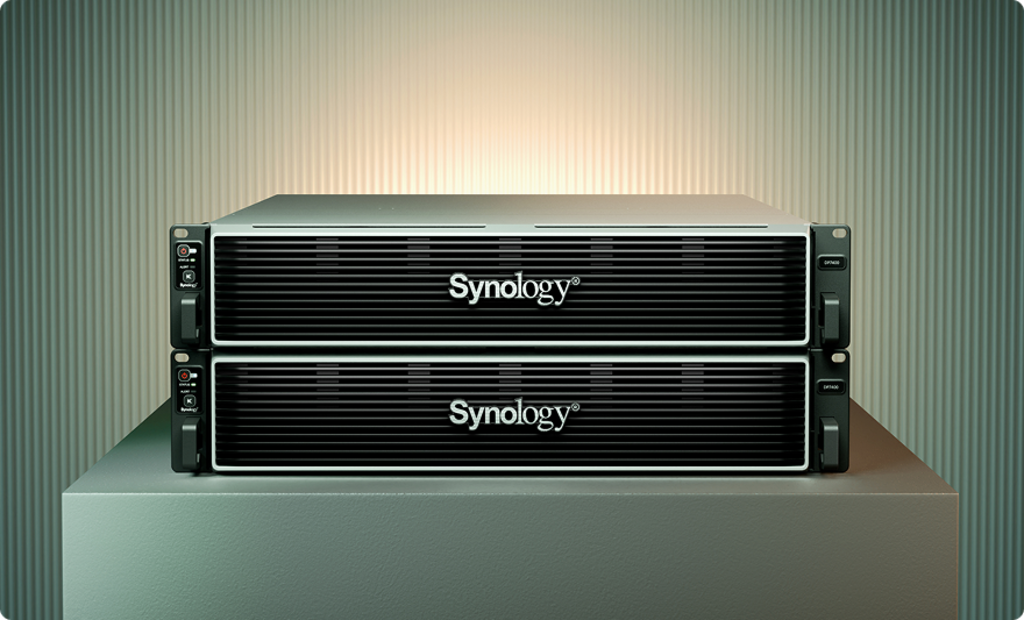
Photo credit: Synology
Additionally, some business leaders may have the misconception that just because they’re adding more accessible units of data storage, it means that they’re somehow centralizing their data at the same time. The key here isn’t just how much storage you have for centralizing data but also what kind you have.
Typically, AI solutions also require high-performance storage so that they can work more efficiently. Yang notes that this is a common scenario, which is why Synology unveiled PAS7700. This is an active-active NVMe (non-volatile memory express) all-flash storage solution, which allows the stored data to be accessed through multiple paths at the same time. In turn, the PAS7700 can deliver uninterrupted, high-performance services for enterprise mission-critical workloads.
Besides that, storage infrastructure needs to be secure and reliable as well. This is especially pertinent as ransomware attacks have been on the rise – there was a 32% uptick from 2024 to 2025, according to a report by Comparitech.
To that end, redundancy capabilities are crucial, Yang says. He advises companies to follow the 3-2-1 rule: keep three copies of your data, stored on two different types of media, with one of them stored off-site.
“With Synology, our devices are already integrated with necessary backup software. That means for IT teams, they’re able to focus entirely on managing backups correctly rather than executing backups as a response,” Yang says.
Expanding oversight
As more companies continue to implement AI across their stacks and the capabilities of AI tools advance even further, Yang notes that there’s a high likelihood that even more roles will need greater focus on how AI is used in an organization.
For example, legal departments may need to start defining what kind of data is allowed to be accessed by AI solutions, all while working with the sales team to ensure that relevant, necessary data can still be readily analyzed.
On that note, he adds that business leaders need to keep the big picture in mind: implementing these AI tools isn’t just for show, but it’s to help their organizations stay relevant and competitive, all while prioritizing data security to do right by customers and driving long-term business value. This will give them the confidence to scale much faster without compromising fundamental data protection considerations.
“Listen carefully to every employee, from your IT teams to those outside of it,” he says. “Pay attention not just to what is being used, but how your AI tools are being used.”
Synology is a corporation that specializes in network-attached storage appliances.
Visit its official website to learn more.
This content was produced by Tech in Asia Studios, which connects brands with Asia’s tech community. Learn more about partnering with Tech in Asia Studios.
Stay updated on the go with our mobile app.
Get latest insights with smoother, more personalized experience through TIA mobile app.
Recommended reads
 Indonesian AI startup goes global
 Forrest Li on scaling Sea, building smarter bots, and founder grit
 An AI assistant that joins sales calls and scores team skills
 SGX’s CEO says it doesn’t need a unicorn to win
 SMEs want AI too, but not the kind Big Tech is selling
 Oatside’s alt-milk rise hits a profitable gear
 Alibaba’s financial health in 12 charts
 Asia’s telcos bundle AI into mobile plans. Will it pay off?
 M-Daq chases bigger clients as revenue falls, losses grow
 VC tracker: Accel raises US$3.5b, including US$550m for India





Editing by Eileen C. Ang and Jaclyn Tiu
(And yes, we’re serious about ethics and transparency. More information here.)