 Malavika Velayanikal · · 5 min read
5 reasons why Google’s Android One is a game-changer in budget smartphones
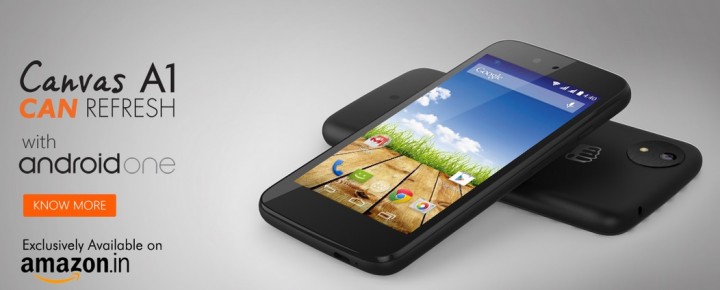
The budget smartphone market got shaken up again with the unveiling today of Google’s much-awaited Android One in India. In partnership with local phone-makers Micromax, Karbonn, and Spice, Google unveiled the Spice Android One Dream UNO Mi-498, Karbonn Sparkle V Red, and Micromax Canvas A1, with prices starting from as little as INR6,399 (US$105).
The Karbonn Sparkle V Red is available on Snapdeal, the Spice Dream Uno Mi-498 on Flipkart, and the Micromax Canvas A1 on the Amazon India site. Soon, these will be available at offline stores too.
India is the first country to get the Android One phones, which offer a relatively pure Android experience devoid of telco or OEM add-ons. Budget Android One smartphones will pop up in Indonesia, the Philippines, and other emerging Asian markets in the months to come. Google revealed today that it has signed up more phone-makers for upcoming launches, such as Asus, Xolo, HTC, and Lenovo.
The smartphone market in India appears clogged with a number of local and global players jostling for position. Samsung currently leads the smartphone race in India ahead of Micromax.
But there are at least five good reasons why the Android One looks like a game-changer in even such a crowded market. Here’s a look at what makes it stand out:
1. Redefining value for money
The price of the first set of Android One smartphones – even if it is a tad more than what was expected – will force leading players like Samsung and Motorola to rethink how much value can be delivered in a US$100 smartphone. The disruptive Chinese phone-maker Xiaomi has already raised the bar with the launch of the Redmi 1s at INR5,999 (US$99) a couple of weeks ago, but a similarly priced gadget from Google could have even more appeal. Here is what the Karbonn Sparkle V Red offers for $105 :
- Android 4.4.4 KitKat
- 4.5-inch screen, 480 x 854 pixels resolution
- 1.3 GHz quad-core Mediatek processor
- Dual-SIM
- 1GB RAM
- 4GB storage expandable up to 32GB
- 5MP front camera, 2 MP rear camera
- 1700 mAH battery
- G-Sensor, Proximity sensor, Light sensor, E-Compass, Gyro Sensor
All this for US$105. Though the Xiaomi Redmi 1S has better specs for a few dollars less, the company is unable to meet the huge demand in India. In its flash sale two weeks ago, 40,000 units of the Redmi 1S sold out in 4.2 seconds, but many prospective buyers were let down.
Google is partnering with Qualcomm for the Android One, so the next generation Android One smartphones will run on Qualcomm chipsets, which should prove more appealing to shoppers than the Mediatek ones.

2. Stock Android
The plethora of Android adaptations is a put-off even for very aggressively priced smartphones with great specs. A long delay for OS updates and concerns over security issues prompt many to opt for phones with stock Android – but Google itself, the original developer of Android, until now only provides it in the higher-end Nexus series. The other manufacturers’ Android-based skins – like Samsung’s Touchwiz, HTC’s Sense, Xiaomi’s MIUI – struggle to give users updates immediately, even when there’s a major Android security bug that needs fixing.
One reason for Motorola’s resurgence in popularity is that its no-frills Android operating system avoided all the clutter and crapware. Now Android One offers a cleaner experience direct from Google itself and at way less than half the price of a Nexus phone. That’s a big deal in markets like India which are 90 percent Android.
3. Partnerships with local players
4. Global software, local hardware
5. Global product launched first in India





Stay updated on the go with our mobile app.
Get latest insights with smoother, more personalized experience through TIA mobile app.








📅 Upcoming Events
22 October 2026
Payoneer x CSPN Summit 2026