 Bree Chan · · 5 min read
Serving new economy firms with future-focused payment solutions

Multiplier Technologies was founded in 2020 with the aim of helping businesses easily access global talent without the traditional barriers of geography or compliance.
From the outset, the team had the technical expertise to build a platform that enables companies to hire, manage, and pay employees across the world seamlessly. However, delivering this vision required a payments partner that could handle the intricacies of cross-border transactions, currency exchanges, and local compliance requirements on a global scale.
Enter HSBC, a partner with the global reach and infrastructure to manage transactions from around the world as well as an understanding of complex payment landscapes.
“HSBC recognized our potential and provided invaluable support, even when we were still an emerging player in the HR tech space. Their belief in our vision and willingness to partner with us has been instrumental in our success,” says Vamsi Krishna, co-founder and chief product officer of Multiplier.
Supporting startups has become part of HSBC’s DNA as the fintech ecosystem grows.
“Profitability, which is a usual measure for lending decisions by traditional financiers, may not always reflect a business’ potential, particularly in its early stages,” says Priya Kini, who heads the commercial banking division at HSBC Singapore. “We assess new economy businesses’ creditworthiness by using operating metrics tied to their cash flow-generative asset portfolios, rather than solely relying on traditional financial metrics.”
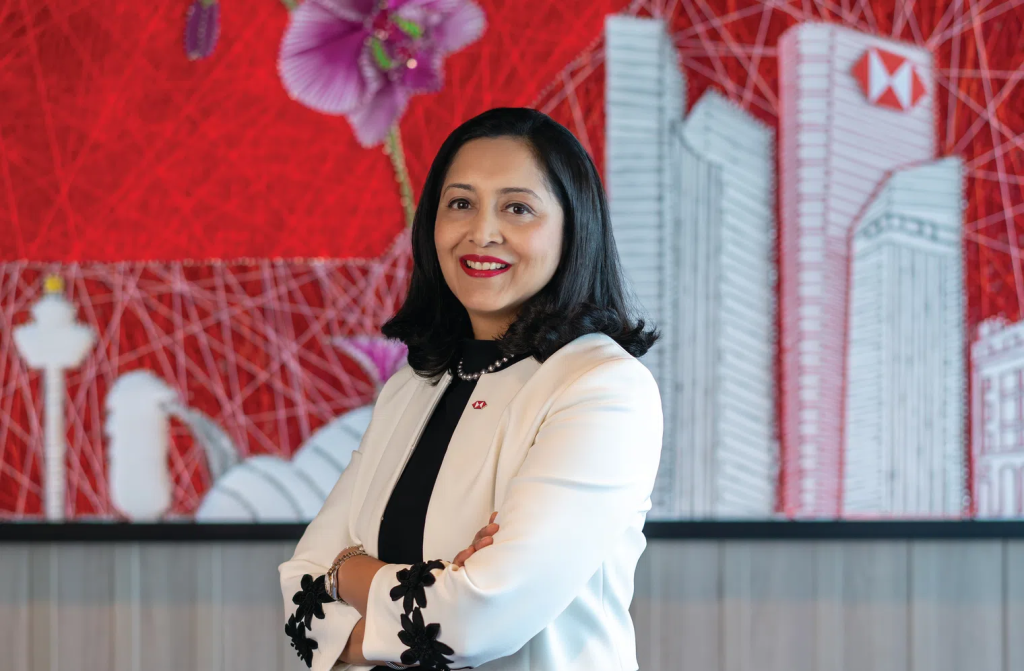
“Having experience supporting generations of entrepreneurs, we know that giving young businesses access to the right network can make the difference between a fledgling and a future unicorn,” says Priya Kini, head of commercial banking at HSBC Singapore. / Photo credit: HSBC
Kini adds that HSBC takes a long-term view of potential growth by evaluating businesses based on their past performance, key operating metrics, growth plans, and customer acquisition strategies, as it wants to accommodate new economy businesses across Southeast Asia that are looking to scale.
“Having experience supporting generations of entrepreneurs, we know that giving young businesses access to the right network can make the difference between a fledgling and a unicorn,” she says.
Beyond funding, early-stage businesses also face many challenges as they try to scale up their operations. These include access to talent, adherence to different regulations, and finding the right partners to fuel their growth.
HSBC believes it is important to understand the complexities that these early-stage businesses experience, particularly as they face macroeconomic pressures, and to support them by evolving its approach.
“The path ahead necessitates a paradigm shift in how we perceive and engage with startups within our financial ecosystem. It’s not just about surviving the present tumult but thriving in it by fostering an environment of innovation and resilience,” says Kini.
Global businesses need operational agility
Multiplier is just one of many new economy businesses that HSBC is supporting with targeted financial products, solutions, and initiatives.
In March 2024, the bank committed US$1 billion to the HSBC Asean Growth Fund. It provides financing to Southeast Asia’s digital platform businesses with international ambitions.
Online used-car marketplace Carro was the first to tap this fund, securing a S$75 million (US$56.2 million) multi-currency loan to fund its fintech arm Genie Financial Services.
Both the HSBC Asean Growth Fund and Venture Debt Fund follow the success of the New Economy Fund, which was launched in 2021 for early-stage startups in Singapore.
Most recently, logistics provider Ninja Van Group tapped the New Economy Fund to secure a US$50 million revolving credit facility to boost its regional growth and develop its ecommerce express logistics, B2B restocking, and cold chain delivery services.
These funds demonstrate HSBC’s efforts to finance high-potential new economy businesses by helping them capitalize on growth opportunities despite the global drop in venture capital funding. A report from DealStreetAsia’s Data Vantage highlighted that in the third quarter of 2024, Southeast Asia’s startups inked the fewest private funding deals in six years.
Besides incorporating flexibility into its financing solutions, HSBC is also ensuring that its services remain agile.
“We already know that technology brings down barriers and makes it easier for businesses to expand across borders,” says Kini. “We have rolled out digital offerings to support international ecommerce, and we are digitalizing our trade finance platforms to help supply chains operate more quickly and efficiently.”
For instance, HSBC has streamlined its bank account opening process in six Asean markets to enable accounts to be opened through a single point of contact within a week.
Through a solution called HSBC Omni Collect, clients can collect payments in these six markets – Singapore, Malaysia, Indonesia, Thailand, Vietnam, and the Philippines – across a wide range of alternate payment methods, which include digital wallets and QR code solutions.
“We are deploying the latest digital payments technologies to support real-time transfers across borders and across currencies,” Kini says.
Collaborative opportunities
Over the next decade, HSBC sees four key trends that will bring new opportunities for businesses.
First, organizations are going to be increasingly borderless. Successful businesses will be the ones that embrace a global outlook and an international network when it comes to talent, supply chains, and relationships.
Second, organizations will increase their emphasis on the following four attributes: a flexible workforce, lean processes, innovative business models, and tech-driven operations.
Third, automation and AI will grow more inclusive. As this happens, businesses will be more inclined to focus on the gains from adoption and will be able to train their workforce to harness the tech’s potential.
Fourth, creativity will become a defining force. Organizations that champion open-mindedness, independent thinking, and innovation will be the ones who gain the competitive edge in the market.
Against the backdrop of these four trends, HSBC is focused on ensuring it remains the right banking partner.
“Banks and financial institutions must pivot towards more agile, supportive roles, providing both capital and a stable banking relationship,” says Kini. “This approach will sustain emerging champions and foster a healthier, more vibrant financial market ecosystem.”
HSBC isn’t just supporting new economy businesses in their journeys, but also established enterprises on their digital evolution.
For instance, it has started to explore deploying blockchain technology to help Singapore-based clients phase out checks and improve payment processes.
This was carried out in collaboration with real estate developer Property Enterprises Development, a member of CK Asset Group, with whom HSBC piloted a blockchain-based platform to automate the payment process.
“We worked with the client to do a detailed mapping of their workflows and payment flows. Then we mapped all the unique workflows onto smart contracts and created automations to achieve efficiency,” Kini says. “All the claims’ submissions, negotiations, and payments now happen on a single platform, making the process more secure and more streamlined.”
This pilot has reduced payment turnaround time significantly, and HSBC hopes to roll it out beyond the real estate sector in due course.
Kini sees such efforts as core to HSBC’s offering, adding: “Collaboration, patience, and a shared vision for the future are the keystones for navigating this new landscape.”
With a supportive policy environment and a vibrant ecosystem of over 4,000 startups, 500 investors, and 200 incubators and accelerators, Singapore will continue to be a launchpad for regional new economy businesses to collaborate and secure funding support for growth. And HSBC remains committed to connect them to a world of opportunities.
Currency converted from Singapore dollar to US dollar: US$1 = S$1.33.
This story was republished with permission from The Business Times. It was moderately edited to reflect Tech in Asia’s editorial guidelines.
Stay updated on the go with our mobile app.
Get latest insights with smoother, more personalized experience through TIA mobile app.
Recommended reads
 Indonesian AI startup goes global
 Forrest Li on scaling Sea, building smarter bots, and founder grit
 An AI assistant that joins sales calls and scores team skills
 SGX’s CEO says it doesn’t need a unicorn to win
 SMEs want AI too, but not the kind Big Tech is selling
 Oatside’s alt-milk rise hits a profitable gear
 Alibaba’s financial health in 12 charts
 Asia’s telcos bundle AI into mobile plans. Will it pay off?
 M-Daq chases bigger clients as revenue falls, losses grow
 VC tracker: Accel raises US$3.5b, including US$550m for India





Editing by Lorenzo Kyle Subido
(And yes, we’re serious about ethics and transparency. More information here.)




