- Premium Content It takes our newsroom weeks - if not months - to investigate and produce stories for our premium content. You can’t find them anywhere else.
 Scott Shuey · · 8 min read
How AI-powered tools are clearing up construction’s data debris
Most people don’t think construction sites generate massive amounts of paperwork, but that’s because they’ve never seen what goes on behind the noise and dust.
There are constant updates from architects sharing blueprints, managers filing reports, and workers sending voice messages. Most of them are using basic messaging apps to send everything.
The end result is often a slew of digital detritus distributed across multiple platforms and devices.
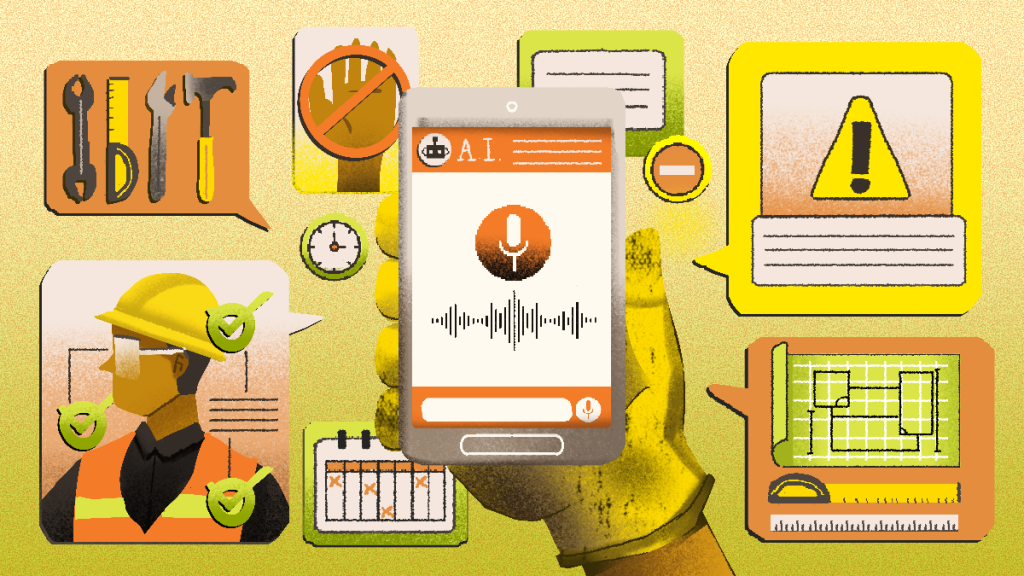
Image credit: Ulla
Liam Appelson and Yong Han Poh, who both come from families with construction businesses, are trying to rein in the chaos. They represent a growing wave of AI startups building tech for warehouses, ports, and construction sites.
But doing this means getting everyone – from the bosses in the office to the guys doing the heavy lifting – to cooperate, and that in itself presents challenges.
“If I’m drilling something with one hand, I’m not going to … take off my gloves,” Poh says. “What [I] will do is send a voice message.”
Poh and Appelson have developed OnSite, a tool that uses agentic AI to turn info – including images and documents – from everyone’s communications into a database that can be searched and utilized. The app looks like any other messaging platform: It is designed to be simple and run on the type of basic Android phones that most construction workers use on the job.
Construction in places like Singapore and Hong Kong are often multinational, so not all workers speak the same language. OnSite supports eight languages: English, Mandarin, Cantonese, Bahasa Melayu, Bahasa Indonesia, Tamil, Bengali, and Tagalog. It built its transcription engine on OpenAI’s Whisper model, which handles mixed-language speech well, according to Poh.
“A lot of the workers, including my parents, love to send very long voice messages in their own dialects or their own languages,” Poh notes. “One frustration they have is that it’s really hard to read them because the transcriptions in most standard messaging platforms are not good outside of English.”
Almost half of OnSite’s users are in Hong Kong, where the app’s support for Cantonese has driven adoption.

Yong Han Poh, CEO and co-founder of OnSite / Photo credit: OnSite
Poh, an anthropologist with a doctorate in philosophy from the University of Oxford, spent her fieldwork years studying construction in Singapore and grew up watching her parents run their small renovation company using WhatsApp. When she later joined a large enterprise and found that even billion-dollar projects operated the same way, she decided to build something better.
The invisible intern
Eyes on the site
A market still finding its shape
Stay ahead in Asia’s tech landscape
This is premium content. Subscribe to read the full story.
Communicating orders on a construction site has always been difficult. Now, a new wave of AI startups in Singapore is trying to organize the chaos.
We know this is not ideal. ⌛ Sign up in 20 seconds. Cancel anytime.
Our subscriber community includes professionals from these companies:





Stay updated on the go with our mobile app.
Get latest insights with smoother, more personalized experience through TIA mobile app.