Stefanie Yeo · · 6 min read
How product analytics helped ShopBack adapt to changing user demands amid the pandemic

One of the biggest challenges companies have faced as a result of Covid-19 has been adapting to the changes in user behavior that were caused by the pandemic.
These behaviors are still in flux and businesses are still on their toes, keeping an eye on these changes.
For cashback platform ShopBack, these shifts have meant a new challenge: Adapting to the changing demands of a growing user base across its different markets, with very little data to work on.
A state of flux
“[Covid-19] didn’t touch every market at the same time,” explains Yann AïtBachir, head of ShopBack’s data team. “We needed to adapt and react quickly depending on the situation.”
Broadly speaking, the company saw a surge in demand for home-use items and essentials once countries entered the early stages of lockdown and stuck-at-home consumers turned to online shopping in droves. Then as markets opened up, consumers started to go back to their earlier shopping habits, with traditionally popular categories such as fashion, beauty, and electronics returning to the top.

Yann AïtBachir, head of ShopBack’s data team / Photo credit: ShopBack
However, these patterns differed across the nine geographies that ShopBack is active in, as countries experienced waves of the virus at different periods and responded to them in different ways. The company currently operates in Singapore, Australia, Taiwan, Malaysia, Indonesia, the Philippines, Thailand, Vietnam and South Korea.
For example, Taiwan managed to avoid going into a full lockdown and has recently seen a rise in demand for domestic travel, says AïtBachir. In Malaysia, on the other hand, the expansion of the movement control order means consumer behavior will likely move back into the online space.
ShopBack’s local teams had to work quickly to deliver experiences that were relevant to users at particular points in time, adapting to the ever-changing circumstances of the pandemic. At the same time, the company also saw an influx of new users that were driven to join the platform as a result of a shift toward value-for-money purchasing in the face of economic uncertainty.
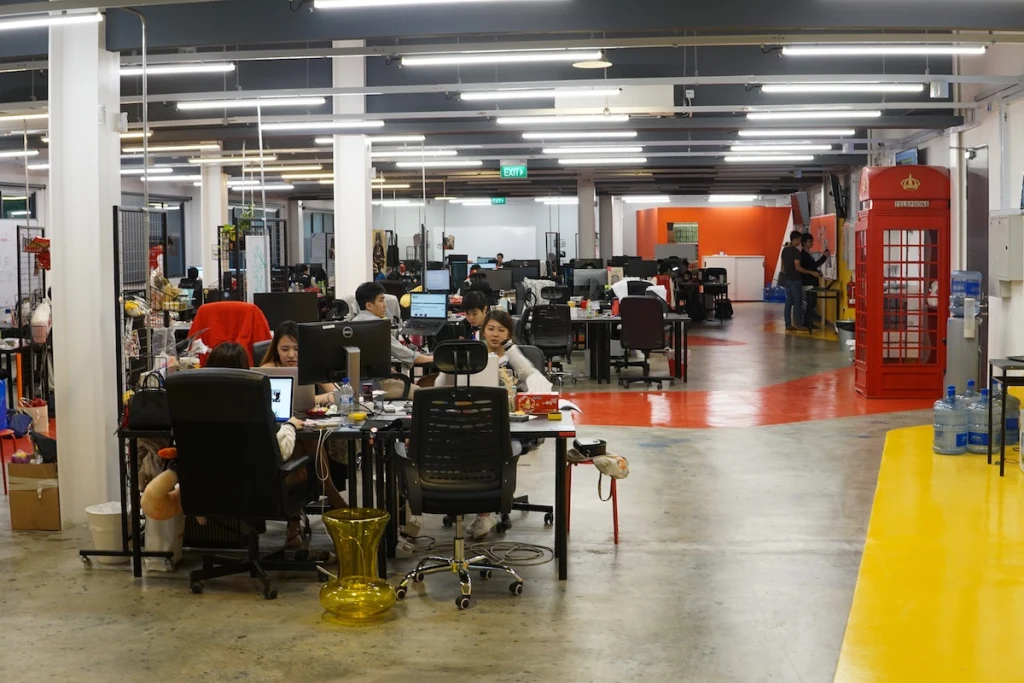
The ShopBack office, before the pandemic / Photo credit: ShopBack
“The challenge was to respond quickly in order to seize opportunities and continue to drive value for customers,” he says. “We had to identify these shifts in consumer behavior and shopping trends, and build products and features that would meet these – all while having little to no data on new customers.”
The power of product analytics
In order to adapt to the demands of its users quickly, Shopback has leveraged self-serve analytics in order to make obtaining data and insights on its markets as accessible as possible for its employees. Self-serve analytics allows users to access and interact with their data directly instead of having a technical team member like a data analyst compile data for them.
“We’ve always had a data-driven culture here at ShopBack,” says AïtBachir. This means that the company enables all employees to use and access data tools effectively without needing to rely on the data team. This accelerates the decision-making process and allows ShopBack to move swiftly in rolling out new products and features across its different markets.
Something that has been especially useful was product analytics, which is the process of gathering, analyzing, and acting on data about how people use a product. By using product analytics platform Amplitude, ShopBack is able to empower its teams to gather insights on consumer behavior and figure out the best approach in responding to the changing user demands.
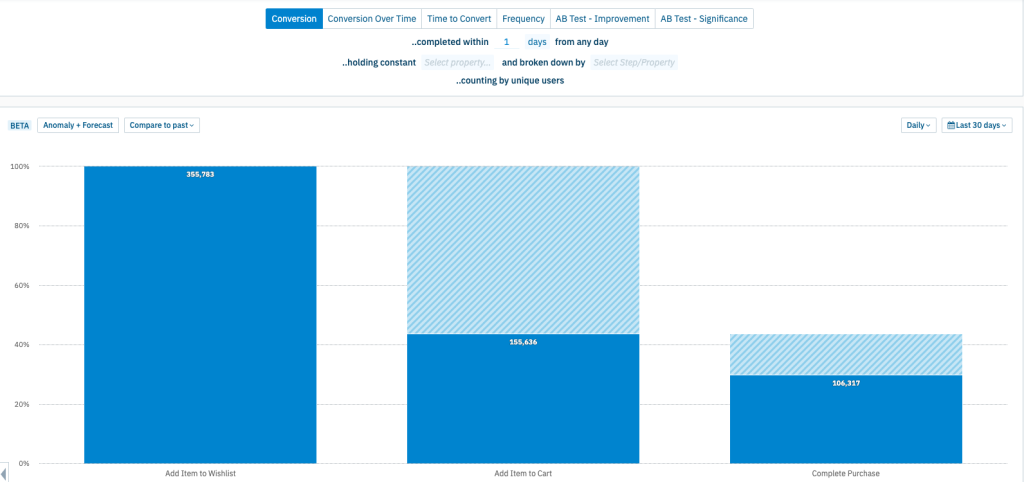
Shopback used Amplitude’s product analytics software to empower its teams / Photo credit: ShopBack
“We needed to shorten the time for experimentation and for hypothesis validation,” shares AïtBachir. “With self-serve analytics on a platform like Amplitude, our teams could be really reactive and really independent.”
With Amplitude specifically, ShopBack’s employees can test out different hypotheses, such as which product features to prioritize, and have them validated by near-real-time data about its users without requiring the data team to generate reports. The platform also enables teams to monitor on their own the validity of existing hypotheses as the situation – and user behavior – change.
Reaping the benefits
Through analyzing and understanding user behaviors, ShopBack was able to speed up the launch of two new features in order to better meet user needs: a product comparison tool and a vouchers feature.
The product comparison tool was launched in response to the friction the company had observed in the user journey when it came to making purchasing decisions. Its product aggregation service allows users to search and compare across the millions of different products from ShopBack’s merchant partners, down to the discounts and amount of cashback available. It also allows users to view price history and set price alerts. This feature, which is currently available in Singapore, Taiwan, and Indonesia, has led to an increase of more than 25% in new searches per day after it was first launched in Taiwan and Indonesia.
The second feature allows users to purchase vouchers from ShopBack’s merchants and get additional cashback on their shopping. The company had seen that users in Asia Pacific were looking for more value-for-money purchases, and that buying vouchers were a popular way of doing so. As such, ShopBack began rolling out its vouchers feature in June last year and has since seen a 10x uplift in the gross merchandise value of vouchers sold, with an over 50% month-on-month increase on average.

Photo credit: ShopBack
“We did the validations [of these new features] in a matter of days or weeks, versus months had we gone down the more traditional route,” says AïtBachir. By using product intelligence tools to streamline the process, ShopBack was able to cut down on the back and forth between the data, product, and management teams that usually slows down the process of bringing new features to the market.
Additionally, the company has been able to gain deeper insights into customer preferences. For example, ShopBack found that the top search terms in Singapore during the 11.11 sales period were “bubble tea” and “staycations,” and was able to use this information to tailor its campaigns and deals in line with these trends.
Keeping up with its customers
Ultimately, having quick access to product analytics has helped ShopBack identify the changing needs of its customers. And by utilizing self-serve analytics in the process, it was able to move swiftly to address those demands, improving and enhancing the shopping experience to help users make better decisions.
To that end, ShopBack was able to add over 1,000 new brands across nine markets in Asia Pacific in 2020 and drive over US$2 billion in sales for its merchant partners, seeing a 2x increase in total orders last year.
“We need to be as close as possible, to have the granular data and this feedback loop of data from our users in near-real-time to be able to adapt and react,” says AïtBachir. “It is crucial for companies to remain focused on creating value for users and merchants during a time when they need it most, and to keep this in mind when innovating new products or features.”
Amplitude is the leading product intelligence platform that helps digital product and growth teams rapidly build product experiences that work better for the customer and grow their business.
Learn more about Amplitude on its website.
This content was produced by Tech in Asia Studios, which connects brands with Asia’s tech community. Learn more about partnering with Tech in Asia Studios.
Stay updated on the go with our mobile app.
Get latest insights with smoother, more personalized experience through TIA mobile app.
Recommended reads
 Indonesian AI startup goes global
 Forrest Li on scaling Sea, building smarter bots, and founder grit
 An AI assistant that joins sales calls and scores team skills
 SGX’s CEO says it doesn’t need a unicorn to win
 SMEs want AI too, but not the kind Big Tech is selling
 Oatside’s alt-milk rise hits a profitable gear
 Alibaba’s financial health in 12 charts
 Asia’s telcos bundle AI into mobile plans. Will it pay off?
 M-Daq chases bigger clients as revenue falls, losses grow
 VC tracker: Accel raises US$3.5b, including US$550m for India





Editing by Nathaniel Fetalvero and September Grace Mahino
(And yes, we’re serious about ethics and transparency. More information here.)