 Harsimran Julka · · 4 min read
To sell or not to sell? Things to consider when someone offers to buy your startup
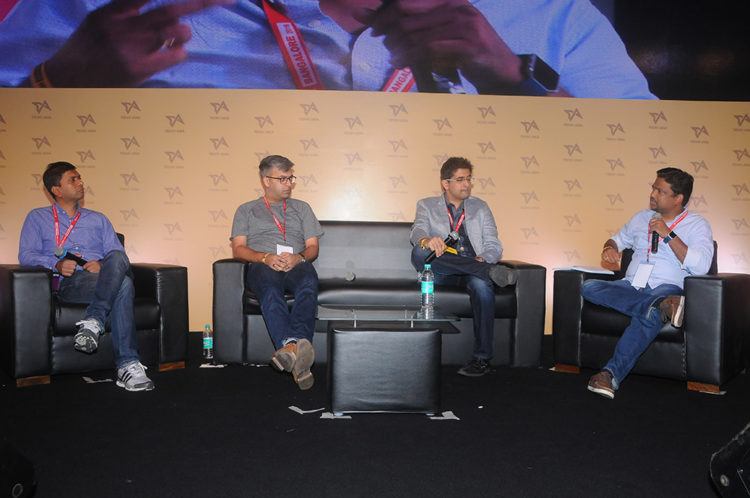
From right to left: Alok Goel, managing director at SAIF Partners, Miten Sampat, head of corporate development at Times Internet, Sanat Rao, venture partner at IDG Ventures and Abhishek Gupta, head of TLabs (moderator).
Serious entrepreneurs don’t build a company with an aim to sell it. They build it to solve a problem. But a startup may struggle or run out of cash. Or maybe the founders will get tired, have a fallout, or get an extremely attractive buyout offer on the table. This exit offer can come from a customer, partner, rival, vendor, or even another big company.
In those scenarios, exiting becomes the end goal for several entrepreneurs. But how does one navigate that curvy road? The panel on “Exits and M&As” at the Tech in Asia Bangalore 2016 conference saw Miten Sampat, head of corporate development at Times Internet, Sanat Rao, venture partner at IDG Ventures, and Alok Goel, managing director at SAIF Partners, debate on the right approach to exiting. The panel was moderated by Abhishek Gupta, head of TLabs.
Sanat and Alok agreed that you should never come across as too desperate.
“Say we’re not available for sale whenever you are approached with that topic from the other party,” says Alok.
“Then let the other party take the next step to bring up the topic.”
It often becomes a game of pursuit. And the more desperate the suitor, the bigger the price you may fetch.
The three pillars of an acquisition
There are three basic reasons why any acquisition takes place.
Sanat said that a big company such as a Google, Facebook, or Yahoo will never acquire a smaller firm for “market access.”
“Thus, technology or the team will be the things that the big company will be looking to acquire,” says Sanat, who is also a part of iSpirt, that helped in the buyout of Little Eye Labs by Facebook and Bookpad by Yahoo.
One has to really make the effort to find out what a customer or partner needs, and then start from there.
“In Little Eye Lab’s case, the founders spent their own money traveling to Silicon Valley and setting up a booth at the Google I/O event. They met the Facebook’s head of engineering there,” says Sanat.
If you’re building something which a big company lacks right now, taking too much time building it may never lead you to an exit, the panelists said. “If you take three years to build a product to fulfill that need, the whole technology stack or gap might have changed by then,” Alok said.
Acqui-hiring gains traction
There were just about 50 M&A deals for startups in India in 2014. And the number tripled to about 150 M&A deals in 2015, says Sanat. Many of the deals were acqui-hires.
Sell or not?





Stay updated on the go with our mobile app.
Get latest insights with smoother, more personalized experience through TIA mobile app.








📅 Upcoming Events
22 October 2026
Payoneer x CSPN Summit 2026