 Eva Xiao · · 6 min read
The self-driving industry has a scaling problem

Teaching cars to drive in India will come with its own set of special pain points. Photo credit: Igor Ovsyannykov / Unsplash.
Driving in a new country can be nerve-wracking. You might have to switch sides on the road, disregard right-of-way, or even detour around runaway cattle. Eventually though, you adapt.
The question of regional driving differences may sound quaint to humans, but it poses a serious challenge to autonomous vehicles. Tech and automotive firms like Tesla and General Motors are all developing their own self-driving systems with the hopes of one day scaling them across the world. But the combined barriers of regional regulations and lack of access to local data could slow their expansion – and give local competition a leg-up.
“Self-driving car technologies, like environment perception and understanding road conditions, require local data,” said Cao Xudong, CEO of self-driving startup Momenta, at an investor event in Beijing earlier this month. To design a system that works well in China, for instance, you need Chinese data.
To design a system that works well in China, you need Chinese data.
Outside of China, going 60 miles per hour on a highway might be considered normal. “In Beijing, even going [25 miles per hour] is considered pretty good,” he explained, describing the country’s traffic-plagued capital. Other special characteristics, like pollution and driver behavior, can also impact a system’s accuracy.
That’s the challenge the autonomous driving industry is now facing, as Silicon Valley tech giants break out of their California test sites and into more chaotic driving environments. It’s kind of like learning how to run and crawl at the same time – to date, no company has developed a commercially viable, fully autonomous vehicle. Moving somewhere new isn’t the same as starting over, but given artificial intelligence’s dependence on enormous volumes of data, it won’t be trivial either.
“Most of the autonomous vehicle technology being developed today is geo-specific, making it difficult to expand to new cities with new rules and new driving behaviors to account for,” says Doug Parker, chief operating officer at self-driving startup NuTonomy, which was acquired for US$450 million by automotive tech firm Delphi last week.
“The premise [of deep learning] is that if you collect large amounts of data, then whenever a car is trying to make a decision you are very likely to have encountered a similar situation before,” he explains. “While this may work for highways, the reality is that urban driving is exponentially complex, and drivers – whether human or software – continually encounter unique situations.”
Quest for local data
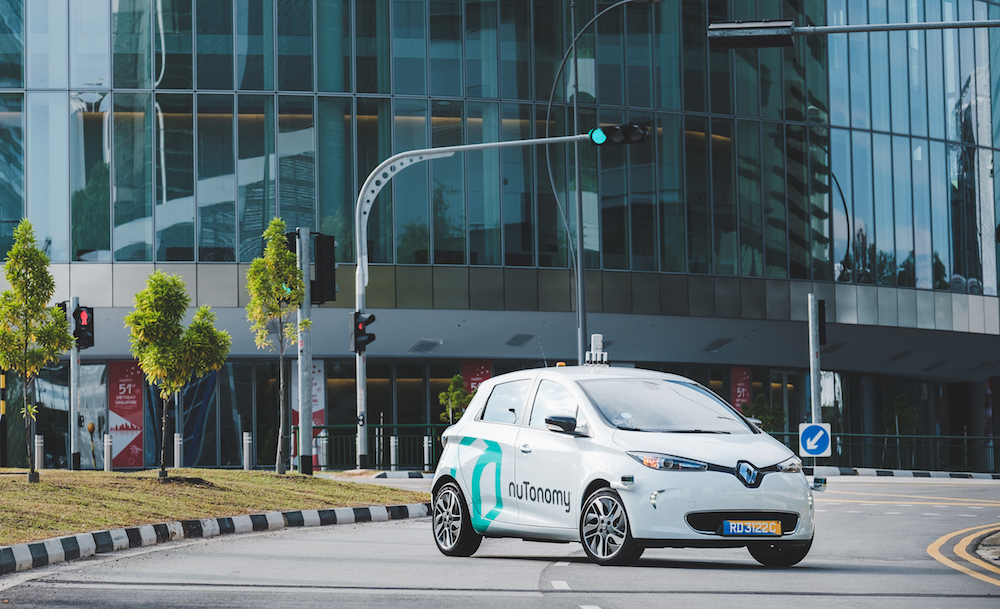
Singapore’s self-driving testbed in One North. Photo credit: NuTonomy.
The self-driving industry’s enormous appetite for data isn’t new. Indeed, it’s widely accepted that developing a safe, fully autonomous vehicle necessitates millions, if not billions, of miles in driving data. Google spin-off Waymo, which started working on self-driving technology in 2009, claims that it logs about 8 million miles per day inside its driving simulator Carcraft – in addition to real-world road tests.
However, in order to roll out self-driving vehicles across the world, the race for data will become more complex. Teaching a system to recognize trucks and cars is one thing, but what about tuk-tuks in Indonesia or daredevil scooter drivers in Vietnam? And cars won’t only have to see differently – they’ll have to adapt to different drivers and pedestrians too, whether it’s jaywalkers or aggressive New York City taxis.
Partnering across regions is one tactic. Chinese search giant Baidu, for instance, tied up with 50 different companies across the world, including Ford, Daimler, and ride-hailing firm Grab, through its open platform Apollo earlier this year. Data-sharing is a core part of the initiative.
Location, location, location





Stay updated on the go with our mobile app.
Get latest insights with smoother, more personalized experience through TIA mobile app.









📅 Upcoming Events
22 October 2026
Payoneer x CSPN Summit 2026