Miguel Cordon · · 2 min read
SEA’s digital economy to generate $100b revenue in 2023

Image credit: Made by Tech in Asia using AI
Southeast Asia’s digital economy is expected to generate US$100 billion in revenue this year despite an economic slowdown, according to a report by Google, Temasek, and Bain & Company.
Titled “Navigating the path to profitable growth,” this year’s e-Conomy SEA report also estimated that gross merchandise value (GMV) from the region is expected to cap 2023 out at around US$218 billion, a 11% growth from 2022.
Like in previous years, this growth is underpinned by Southeast Asia’s growing ecommerce industry. But travel has recovered significantly after the Covid-19 pandemic, with GMV from the sector expected to jump roughly 5.4x from its 2021 results.
However, the report also highlighted challenges and uncertainties, such as declining private funding, rising competition, and changing consumer behavior.
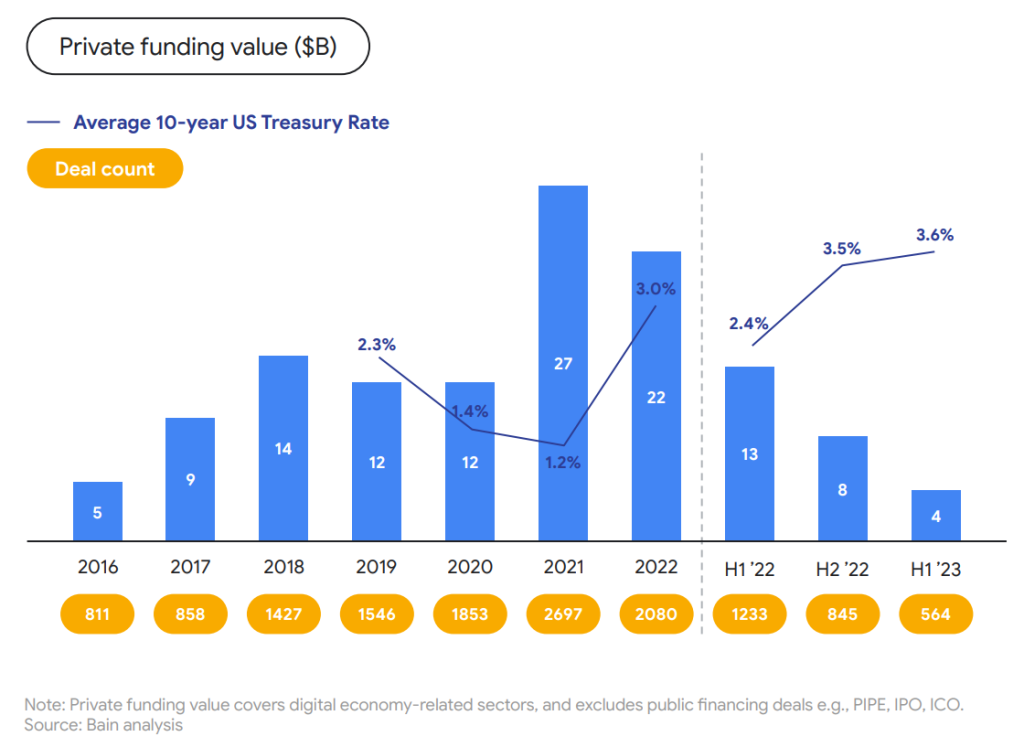
Private funding for Southeast Asian digital businesses is poised to drop to its lowest level since 2017, after reaching a record high of around US$27 billion in 2021.
According to Tech in Asia data, startups in the region have raised just US$7.4 billion so far in 2023. This is partly due to investors becoming more cautious and selective amid the ongoing downturn.
To attract more capital, digital businesses need to focus on realistic entry valuations, clear paths to profitability, proven monetization models, and clear exit options, the report said.
On the other hand, the adoption of digital financial services (DFS) remains a bright spot in Southeast Asia. Digital payments, in particular, accounted for more than 50% of the region’s total transaction value.
A Statista report estimates that there are 400 million DFS users in the region.
The top 30% of high-value users (HVU) currently account for more than 70% of digital economy transaction values in the region, and are expected to increase spending over time. But there is also huge potential to tap into the non-HVU segment, which could generate 1.9x more value than the HVUs.
The report also noted the gap between demand and supply of digital services in more rural areas, where access to infrastructure, affordability, and awareness still hinder digital participation.





Stay updated on the go with our mobile app.
Get latest insights with smoother, more personalized experience through TIA mobile app.