Stefanie Yeo · · 7 min read
Not your usual wealthtech: This startup focuses on private credit

Summary:
- While most wealthtech firms focus on retail investors, Kilde caters to accredited and institutional investors by giving them access to private credit, a stable asset class traditionally reserved for institutions.
- Kilde distinguishes itself by being a “manufacturer” rather than just a distributor – it originates, structures, and distributes its own products.
- By using proprietary AI for credit underwriting and monitoring, Kilde manages a US$180 million portfolio with a 0% default rate – all while only having a 30-person team.
- Learn more about Kilde on its website.
Singapore’s wealthtech and robo-advisory market has matured over the past few years, and consumers are spoiled for choice.
Most players in the wealthtech space focus on retail investors, making investment solutions more accessible to the average Joe. However, there remains a gap in the market for accredited investors, especially in private credit, where players often offer outdated products with unfavorable pricing.
Defined as loans provided to businesses by non-bank institutions, private credit has long been a playground exclusive to global institutional funds. Singapore-based Kilde, a platform focused on private credit investment, aims to bridge that gap, giving investors access to a US$3.5 trillion market.

Radek Jezbera, co-founder and CEO of Kilde / Photo credit: Kilde
“Kilde looks nothing like a typical wealthtech platform, and that’s by design,” says Radek Jezbera, its co-founder and CEO.
We sat down with Jezbera to learn more about what Kilde offers and how it differentiates itself in the wealthtech space.
The following interview has been edited for clarity and brevity.
What does Kilde do?
We do one thing – secured private credit – and we do it end-to-end.
My co-founder and I built Kilde to manufacture a single product class well. Our monthly-coupon, quarterly-redemption credit deals – where investors get their share of interest monthly and have the opportunity to redeem their principal investment quarterly – are originated and structured under one roof.

The founders of Kilde / Photo credit:
Being a small team with in-house software powered by AI, we can keep the costs down and pass more of the returns to our investors.
What exactly is private credit? How does private credit investment work?
Private credit takes the form of a loan made by a non-bank lender to a company. It’s a form of lending where private investors act as the bank for businesses.
It is a workhorse behind most of the fixed-income investment portfolios seen in insurance and endowments. When done right, it is steady, secure, and largely uncorrelated to public markets.
As an investment strategy, private credit is appealing as you aren’t betting on a stock price or the ups and downs of the bond market – you are simply collecting interest on a loan. As long as the company pays its debt, you get a steady, predictable return that doesn’t change just because the public market had a bad day.
Private credit takes many forms. At Kilde, we focus on senior secured loans backed by collateral – the most conservative and best-suited form for the Asian market. Other forms include mezzanine debt and venture debt.
Why did you decide to launch Kilde? What problems did you want to solve?
Both my co-founder and I did not take the usual route to private credit, which is investment banking. We came from consumer and SME credit – I had previously worked with Home Credit, one of the largest consumer finance lenders in Indonesia.
We observed that there was a large unaddressed market, focusing on borrowers who are consumers and SME lending platforms – Home Credit being one such example – with insufficient access to capital but almost insatiable demand for funding.
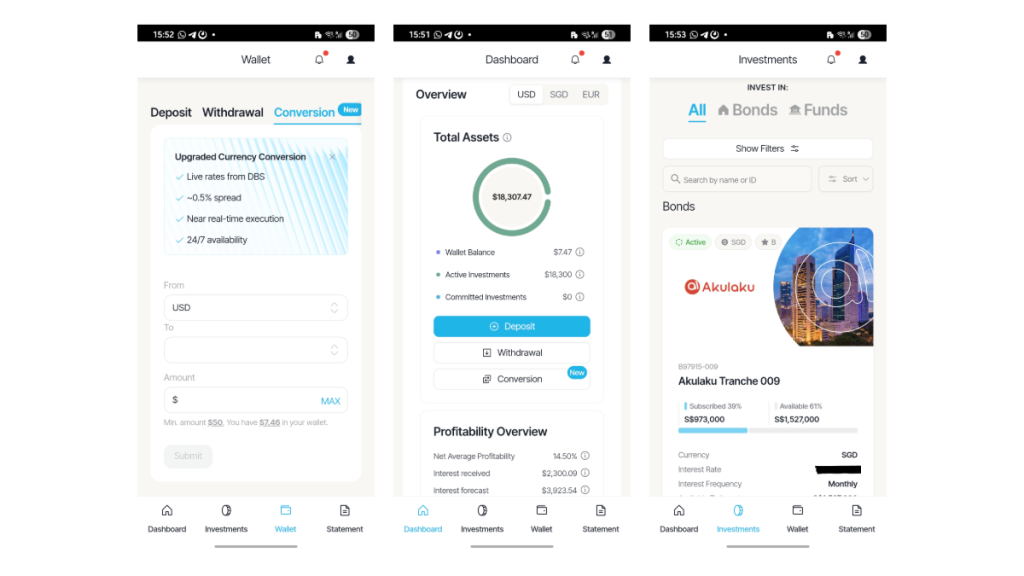
Kilde’s mobile platform / Photo credit: Kilde
At the same time, we saw that while private credit was a cornerstone of institutional portfolios, it remained largely inaccessible to individual accredited investors.
We founded Kilde to address this systematic gap between demand and supply. Established consumer and SME lending firms in emerging markets require flexible growth capital, while private investors need yields decoupled from public market volatility. By combining professional credit expertise with the regulatory rigor of an institution licensed by the Monetary Authority of Singapore, we provide the infrastructure for individuals to invest in a class of assets traditionally reserved for global funds.
In this way, we serve both sides of the same coin – borrowers who need funding and can’t access enough of it through traditional means, as well as investors interested in private credit.
What makes Kilde unique? How is it different from other investment platforms out there?
Most wealthtech platforms distribute someone else’s products. Meanwhile, every product on Kilde is built by Kilde – we originate the deals, we structure them, and we put them on our platform. That’s not a feature; it’s our entire business model.
Our products aren’t for retail investors. They’re built for high-net-worth individuals and institutions, investors with the capacity to evaluate private credit and the patience for an asset class that doesn’t trade daily.
Private credit requires a certain level of sophistication and a tolerance for illiquidity that doesn’t suit every retail investor. We offer monthly cash coupons and quarterly redemptions, which is only possible because the underlying assets have short durations, but it’s still not a savings account.
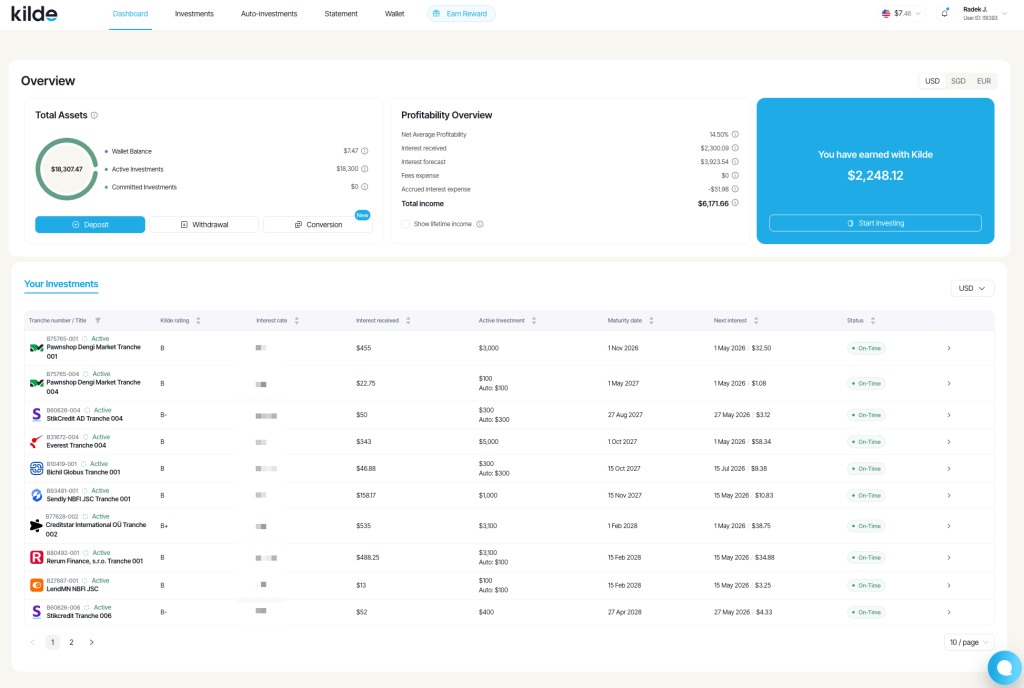
Kilde’s web platform / Photo credit: Kilde
By focusing on qualified investors, we avoid the regulatory complexity of retail distribution. And frankly, we avoid the behavioral risks that come with retail, such as the kind of panic-driven redemption spirals we’re seeing in US private credit funds right now.
What does Kilde’s revenue model look like?
Our revenue comes from brokerage – the spread on the credit products we originate – not from wealth management fees charged as a percentage of assets under management.
Since our products are unique to our platform, there’s no price comparison shopping. That gives us meaningfully higher revenue per dollar of assets than a typical robo-advisor or digital wealth manager.
What challenges has Kilde had to navigate on its journey, and how did it overcome them?
The biggest challenge we faced was timing. We entered the market in late 2020, when Covid-19 was reshaping everything and confidence in alternative investment platforms was low after years of crowdfunding disappointments.
We were building something genuinely different – an institutional private credit platform – but in that environment, the distinction didn’t land easily. Many people saw another crowdfunding operator.

Rather than chase local sentiment, we focused on institutional capital. European VC investors understood what we were building, came in early, and gave us the runway to grow the platform.
That institutional backing turned out to be the right foundation. It validated our credit discipline and gave individual investors something that retail-first platforms can’t offer: the confidence that comes from being co-invested alongside institutions.
Today, institutional and individual capital each represent roughly half our portfolio. The hard early period forced us to be more rigorous than we might otherwise have been, and I think that’s reflected in our track record.
What are some achievements you’d like to highlight from the last few years?
Across US$200 million in deployed capital and 28 borrowers, we’ve maintained a zero-default track record. That’s the number I’d point to first, because in credit, capital preservation is the key.
Due to our focus on accredited investors, the average monthly investment on Kilde is approximately US$32,300 per investor, allowing us to build at scale without needing millions of users. For context, the average monthly investment per investor on StashAway stands at about US$5,400, and on Endowus, it ranges from US$11,600 to US$15,500.

Jezbera with members of his team / Photo credit: Kilde
We’ve also been able to operate with a lean team of just 30 people, thanks to two things: technology and focus. Because we’re specialized in a single asset class, we don’t need the same breadth that a multiasset platform requires. Our technology handles the entire lifecycle, from borrower onboarding and credit assessment to investor allocation, cash flow distribution, and reporting.
We’re increasingly deploying AI across the credit underwriting and monitoring process, which lets a small team manage a growing portfolio without linear headcount growth. The cost structure is lightweight by design, and it’s getting even more efficient.
What’s next for Kilde?
More of the same, done better. We’re not following the next product trend; we’re compounding in the one we know best. That means deeper borrower relationships in Europe and Asia, more accredited and institutional capital, and continued investment in our credit AI.
The private credit market in Asia and Europe is still early compared to the US, and we think the opportunity for a vertically integrated, tech-native platform is enormous.
Kilde is an MAS-licensed private credit investment platform. It originates, structures, and distributes secured private credit deals, exclusively for accredited and institutional investors in Europe and Asia across a single asset class.
Learn more about Kilde on its website.
This content was produced by Tech in Asia Studios, which connects brands with Asia’s tech community. Learn more about partnering with Tech in Asia Studios.
Stay updated on the go with our mobile app.
Get latest insights with smoother, more personalized experience through TIA mobile app.
Recommended reads
 Indonesian AI startup goes global
 Forrest Li on scaling Sea, building smarter bots, and founder grit
 An AI assistant that joins sales calls and scores team skills
 SGX’s CEO says it doesn’t need a unicorn to win
 SMEs want AI too, but not the kind Big Tech is selling
 Oatside’s alt-milk rise hits a profitable gear
 Alibaba’s financial health in 12 charts
 Asia’s telcos bundle AI into mobile plans. Will it pay off?
 M-Daq chases bigger clients as revenue falls, losses grow
 VC tracker: Accel raises US$3.5b, including US$550m for India





Editing by Jonathan Chew and Lorenzo Kyle Subido
(And yes, we’re serious about ethics and transparency. More information here.)