 Jonathan Chew · · 6 min read
From science to public safety: turning discoveries into solutions

Summary:
- Scientific innovations, including DNA analysis, have greatly improved how we solve crimes and ensure public safety.
- Partnerships between public agencies and tech startups, enabled by programs like Hatch, drive rapid early adoption of advanced tech.
- Early collaboration and structured engagement between public safety organizations and startups help break barriers to implementing new solutions, fostering an ecosystem where forensic innovations can have a lasting impact.
- Hatch’s Dimension X program plays a key role in facilitating this collaboration. Learn more about it here.
What comes to your mind when someone mentions “futuristic tech?”
Some people might think of interesting applications like quantum computing cryptography, which is used to secure bank accounts, or a type of chip that’s implanted directly into the brain, giving the user a neural interface to control devices with just their thoughts.

Photo credit: wee dezign / Shutterstock
For most people, these sci-fi adjacent ideas typically have an obvious use case for regular, everyday consumers. On top of that, “futuristic tech” – and deeptech solutions, in general – can be implemented on a wider scale: at the national level, to improve public safety.
Tightening the net on criminals
One critical field that helps keep citizens safe – but may fly under the radar – is forensics. Nascent scientific discoveries in this domain can lead to innovations with profound positive impacts.
Aided by tech, forensics uses scientific techniques to solve legal problems. It can uncover what happened during crimes or disputes by analyzing and interpreting evidence.
“A breakthrough innovation could transform how we process evidence, providing deeper insights and greater efficiency,” says Lim Chin Chin, assistant chief executive (sciences) and director of the Forensics Centre of Expertise at HTX, also known as the Home Team Science and Technology Agency.

Lim Chin Chin, assistant chief executive (sciences) and director of the Forensics Centre of Expertise at HTX / Photo credit: Hatch
She’s also the early tech adoption ambassador for Hatch, an innovation center established by HTX in partnership with tech consultancy and solutions company Knovel Engineering and open innovation firm Sosa.
One of the key advantages that Hatch has is its expertise in linking tech from other verticals to public safety applications.
Its network and lineup of programs – such as Dimension X – have been effective in reaching out to startups in the global deep-tech ecosystem, thereby increasing the pool of potential technologies that public safety agencies can draw from.
One of the most well-known examples of a scientific innovation benefiting forensics is DNA analysis. It speeds up the process of identifying an individual, such as a suspect, using their unique DNA.
According to Lim, AI can have a huge advantage in modern forensics. In her work at HTX, she and her team are already developing AI and machine learning models to enhance forensic processes, from simulations to predictive analyses.

Lim (right) with her colleagues / Photo credit: Hatch
She notes that startups’ offerings can complement the internal, traditional research and development work carried out by HTX and other public safety agencies, as tech firms often bring “fresh, unexpected innovations.”
“For example, AI-driven solutions could redefine traditional processes like drug detection or crime scene analysis,” she points out.
Lim adds that for public safety agencies and similar government end-users, it’s critical that they work with startups through Hatch, given the organization’s ability to close critical gaps.
The early bird catches the worm
When it comes to applying scientific advancements to create usable solutions in forensics and other fields that contribute to public safety, “sooner rather than later” can be a good rule of thumb, according to Lim. It’s because the transition can take time and effort.
“Being an early adopter allows you to shape innovations from the ground up, but that alone is not sufficient to pull that technology through to implementation,” she explains. “The process is challenging and demands resources, infrastructure, and operations alignment.”
Organizations will need to overcome these hurdles and bridge scientific innovation and implementation, which is one of the key advantages Hatch offers – it’s got extensive expertise in linking tech from other verticals to public safety applications.

The Hatch team / Photo credit: Hatch
The program offers public safety agencies a structured way of engaging with tech startups, helping them turn their abstract problem statements into actionable solutions. As long as the startup in question has a working, deep-tech proof-of-concept (POC) that can solve public safety challenges, Hatch is willing to work with it to validate and explore a potential solution. Some of these companies could even be in their early stages, like Prospectral, a firm founded by four University of Cambridge researchers.
This idea of employing dual-use technologies is something Lim strongly believes in, and it’s helped Hatch consistently collaborate with HTX’s forensics team, which is under Lim’s purview.
Expecting the unexpected
When collaborating with the innovation center, her team’s problem statements usually deal with improving crime scene processing and management. This includes areas like analyzing unlikely scenarios – such as post-blast or shooting incidents – that are difficult to replicate for training purposes but are still critical for overall preparedness.
They offered this challenge statement, analyzing unlikely scenarios, during Dimension X, and worked with Flyz Robotics – which offers a cutting-edge drone solution called Drobot – to develop a working proof-of-concept. The Drobot could attach payloads to vertical surfaces, delivering cameras for live video streams from different perspectives.
“This capability not only enhances situational awareness, but also allows us to gather actionable data without interruption,” Lim shares. “This adaptability was what impressed us the most.”
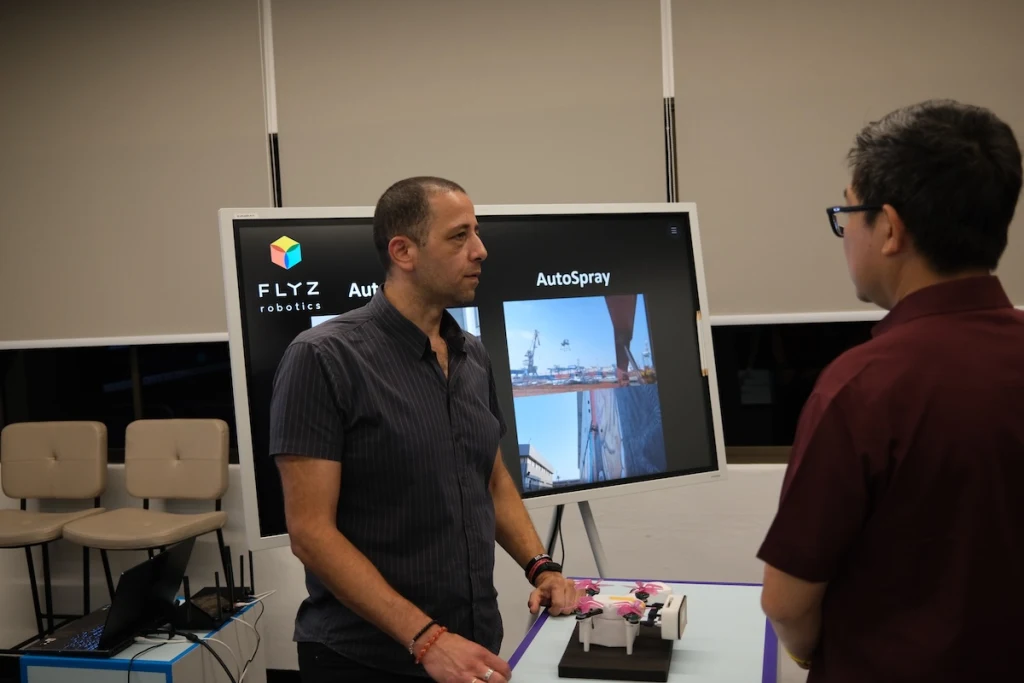
Flyz Robotics exhibiting at Hatch’s Dimension X Cohort 1 Demo Day / Photo credit: Hatch
She adds that Hatch “played a vital role in bridging this technology to our team, enabling faster and more targeted innovation.”
As part of the POC with Hatch, Flyz Robotics even reached a stage where autonomous piloting could be done. This would have eliminated the need for in-house piloting expertise, making the Drobot solution even more practical for field deployment.
All told, Lim says her team’s early involvement in Hatch’s programs has allowed it to drive rapid innovation by validating proofs-of-concept. It also lets the team identify startups that are best suited to solve their current challenges.
Hatch’s programs complement the research work her team does in-house as well, which helps them explore a wider breadth of solutions, as well as find new ways to mix and match tech to better fit the specific needs of Singapore’s public safety landscape.
“Crimes evolve, and so do the tactics of criminals,” Lim says. “For example, synthetic drugs now mimic natural substances to bypass traditional legal frameworks. We can’t afford to play catch-up; we need to anticipate these changes and adapt proactively.”
Meaningful improvements for an entire ecosystem
Lim notes that as the public safety ecosystem evolves, advancing public safety innovation remains a shared mission – one that cannot be accomplished through agencies’ efforts alone.
“It’s not just about the tools – it’s about collaborating with partners like Hatch and academia as an ecosystem to create solutions that are effective and can create meaningful impact,” she says.
Lim adds that Hatch has been “instrumental” in offering an efficient pathway for public safety agencies to tap into startups’ tech innovations through public-private partnerships.
“While public agencies lead in policy and guidelines, private sector partners are essential for their agility, creativity, and ability to address gaps,” she explains.
She also shares that by working with startups through Hatch, end users from HTX not only address specific issues but also inspire creativity and open doors for broader applications.
“Hatch facilitates this collaboration by connecting the right players in the ecosystem, accelerating innovation between startups and government agencies,” Lim says.
Hatch is an innovation center driven by the mission to curate and accelerate dual-use technologies that enhance public safety and security. To find out more and apply for its Dimension X program, click here.
This content was produced by Tech in Asia Studios, which connects brands with Asia’s tech community. Learn more about partnering with Tech in Asia Studios.
Stay updated on the go with our mobile app.
Get latest insights with smoother, more personalized experience through TIA mobile app.
Recommended reads
 Southeast Asia pulls ahead of global average on AI adoption
 The 99% AI traffic threat (and how business survives)
 From data to durians: H2O.ai’s journey to AI-led accessibility
 ‘Not how humans act’: how agentic AI is changing cyberattacks
 A middleman model makes free patient tracking possible
 Hatch’s new playbook for rapid innovation with cutting-edge tech
 Inside OpenAI’s public-first bet on medical AI
 TiDB is engineering the infrastructure for AI’s agentic future
 An AI co-pilot for scientists designing new biomaterials
 A real-time verification engine that rewards truth-finding





Editing by Stefanie Yeo, Winston Zhang, and Mina Deocareza
(And yes, we’re serious about ethics and transparency. More information here.)




📅 Upcoming Events
22 October 2026
Payoneer x CSPN Summit 2026