Deepti Sri · · 2 min read
Tide turns for green funding in SEA, but not enough to meet emission target, report says
Southeast Asia is transitioning into a green economy as the region stands to lose up to US$200 billion in gross domestic product (GDP) by 2030 because of climate shocks and a delay in timely action, said a report by Bain & Company, Microsoft, and Temasek.

Photo credit: blew1 / 123RF.
The report noted that there has been a “strong” growth in funds raised for green initiatives over the past three to five years, with 40% to 150% growth per annum across debt issuances, initial public offerings (IPOs), private equity and venture capital funds, and the assets under management of sustainable public funds.
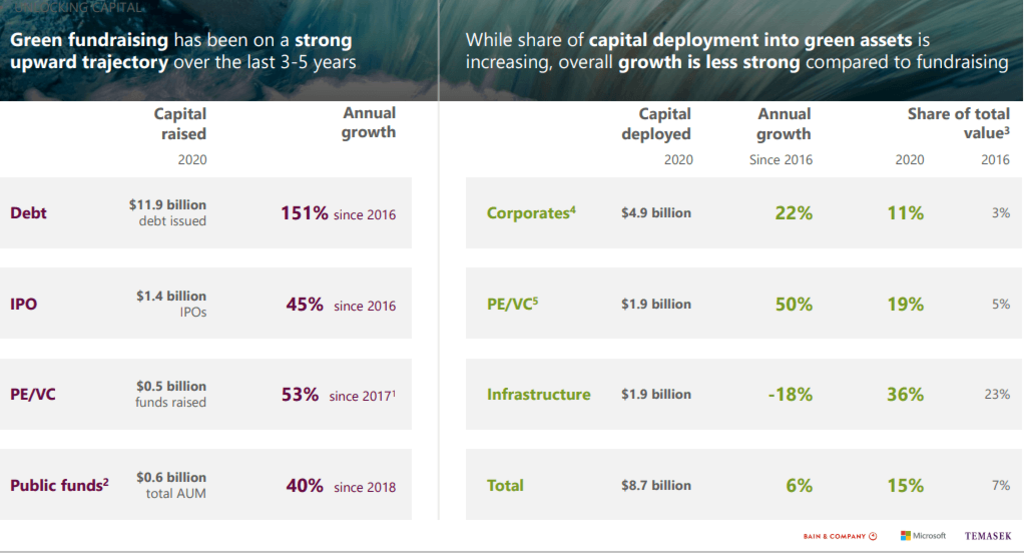
Photo credit: Bain & Company, Microsoft, and Temasek
Investors are also cheering green investments of tech startups in the region as they associate sustainability with improved tangible financial returns.
“Sustainability interest and queries reached a tipping point in the last year, especially from high-net-worth clients and investors,” an unnamed former head of a sustainable global investment management firm said in the report.
Grab, Siam Cement, and CapitaLand have also joined the race among Southeast Asian firms to go green and capitalize on financial returns due to sustainability.
While Grab has voiced out plans to run its entire fleet on clean energy by 2030, CapitaLand aims to cut its Scope 1 and 2 emissions by 28% compared to 2019 levels. Similarly, Siam Cement will increase the use of biomass and renewables in its solar photovoltaic projects and pilots.
See also: What it takes for Gojek to go entirely green
While the share of capital deployment into green initiatives has been rising, the overall growth is much less in comparison to total fundraising in the region.
The report further notes that Southeast Asia has some way to go before achieving net-zero carbon emissions by 2030.
The region’s latest commitments for reducing carbon emissions have improved by only 0.5 gigatonnes of carbon dioxide (GtCO2) to 0.6 GtCO2 compared to set targets in 2015. This leaves an estimated gap of three GtCO2 to four GtCO2 in emissions to hit promised targets in line with the Paris Agreement’s 1.5°C goals.
In a bid to meet the goals set in the Paris Agreement, Southeast Asia must accelerate the commercialization of low-carbon tech including agritech and carbon capture. The report also suggests a holistic plan for transitioning to a net-zero state and a cross-border carbon trading system. In addition, the region must reassess energy security by exploring a regional grid to efficiently connect demand to supply.





Stay updated on the go with our mobile app.
Get latest insights with smoother, more personalized experience through TIA mobile app.