 Jonathan Chew · · 4 min read
Samsung’s latest folding phone builds on years of innovation

Summary:
- Samsung’s Galaxy Z Fold series began in 2019, introducing a new form factor to produce a phone that has an immersive screen while maintaining portability.
- Continuous innovation in engineering and design led to the Galaxy Z TriFold, offering dual folds, enhanced productivity features, and a cinematic display.
- Samsung’s advanced testing, manufacturing precision, and focus on consumer needs reinforce its leadership in smartphone form-factor innovation.
- Register your interest for the Galaxy Z TriFold here.
Many people might think that creating the next big innovation requires a crazy idea or complicated concept.
But sometimes, all that’s needed is taking what’s been done one step further and putting the full weight of a company’s expertise and resources into making it a reality.
For electronics giant Samsung, this idea came to light with the Galaxy Z TriFold. Building on top of its Galaxy Z series of foldable smartphones, this latest offering sports two folding points, developed with design and engineering advancements.
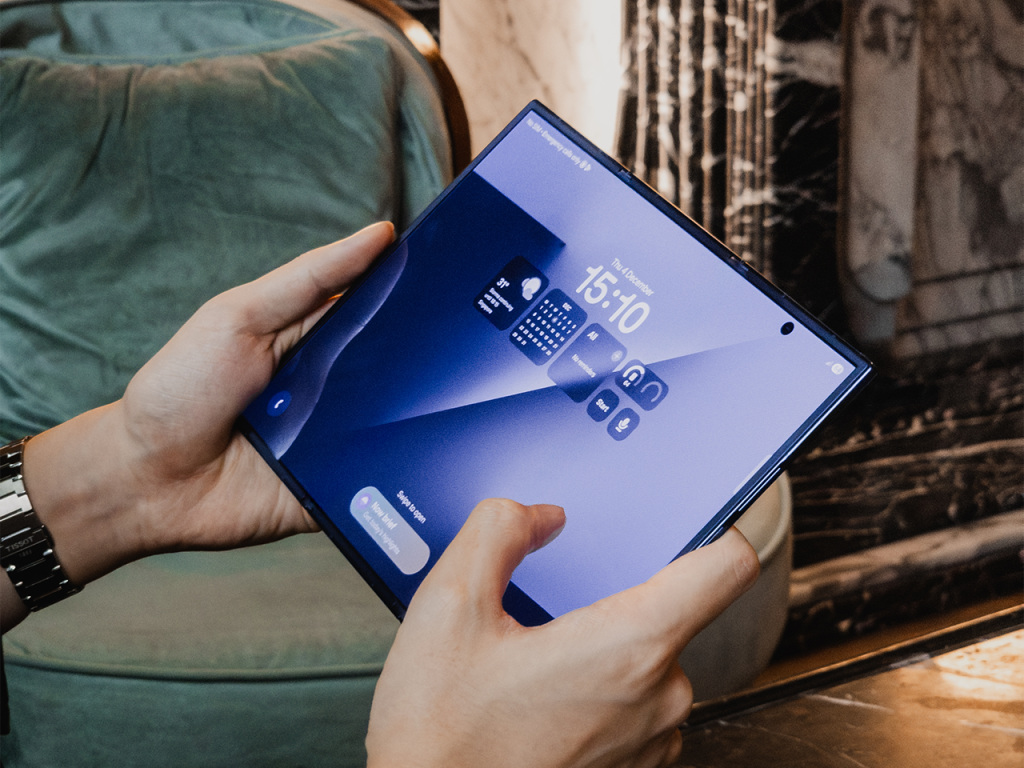
Photo credit: Samsung
“Consumers in Singapore are always on the lookout for the next big thing, and we are excited to be one of the few markets to usher in a new era of mobile possibilities with the Galaxy Z TriFold,” says Ronnie Ng, vice president and head of mobile experience at Samsung Electronics Singapore.
Folded from the bottom now we here
Samsung’s folding phone series debuted in 2019 with the launch of the Galaxy Z Fold, which marked a step forward in terms of technological advancements.
For one, the foldable screen offers an immersive, large-screen experience while maintaining the portability of regular smartphones. Its maximum folded thickness was 17.1 millimeters, which meant it still fit in pockets and handbags.
Interested in Samsung’s latest folding phone? Click here.
Since that first iteration, Samsung has innovated on the Galaxy Z Fold’s form factor, introducing improvements in both engineering and design to meet consumers’ needs.
These include a component that would protect the phone’s display from dust and debris, waterproofing technology on both the outer part of the display and the hinge, as well as a new mechanism that improved how the phone folded while reducing its weight and thickness.
These improvements helped the company build on top of previous models, which culminated in the Galaxy Z TriFold.
Top priority: consumers
What’s even better than one fold? According to Samsung: two.
The Galaxy Z TriFold has several features that cater to consumers’ needs. When fully unfolded, the 10-inch phone gives users a more cinematic viewing experience and more space for on-the-go productivity.
The phone also comes with a multiwindow function that lets users run up to three portrait-sized apps side by side, which can be resized as needed. It’s meant to suit professionals who need to work on the go – think of it as a middle ground between a standard smartphone and more bulky options like tablets or laptops.
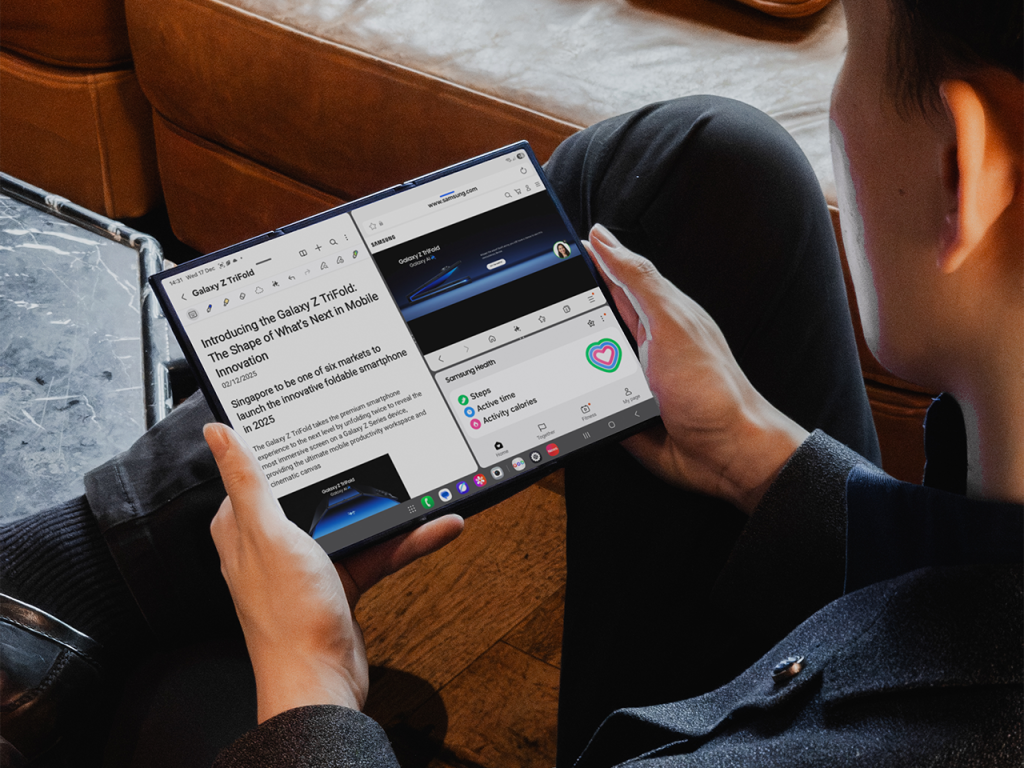
Photo credit: Samsung
For example, an architect can use it to view design plans and blueprints for a new home while simultaneously calculating measurements, all on the same combined screen. The company also notes in a press release that commonly used apps and features have been optimized for the Galaxy Z TriFold’s larger screen so that they are more intuitive to users when organizing their workspace.
In addition, the company implemented a Samsung DeX feature that can replicate a desktop-like experience from the phone itself or wirelessly cast and extend the phone’s display on another screen.
Making the dream a reality
Behind these new and upgraded features are several engineering advancements. With the screen being a focal point, Samsung used 3D laser scanning to check that every unit’s surface and display was bonded correctly.
Another potential concern is the overall thickness, given the phone’s tri-fold design. To that end, Samsung manufactured the phone to be 3.9 millimeters at its thinnest point, making it more portable.
To ensure the phone’s folding capabilities could last for the long run, the company subjected the Galaxy Z TriFold to a 200,000-cycle multifolding test, which is equivalent to folding the phone roughly 100 times a day for five years.
Maintaining the lead in form-factor innovation
Observing the trajectory of Samsung’s folding smartphone line, it becomes clear that constantly innovating on the form factor is what helps the company maintain its edge in the market.
These engineering and manufacturing advancements are packed into the Galaxy Z TriFold and allows it to deliver a “premium experience that will help users expand their canvas for work, creativity and play,” says Ng.
Despite the innovative features and technological advancements baked into its latest phone, Samsung is not about to rest on its laurels.
“We will continue to excite Galaxy fans with our cutting-edge innovation,” says Ng.
Samsung is a South Korean electronics giant that is a leading player in smartphone form factor innovation. Its latest offering, the Galaxy Z TriFold, was launched earlier this year and is available in South Korea, China, Taiwan, Singapore, the United Arab Emirates, and the US.
Register your interest for the Galaxy Z TriFold here.
This content was produced by Tech in Asia Studios, which connects brands with Asia’s tech community. Learn more about partnering with Tech in Asia Studios.
Stay updated on the go with our mobile app.
Get latest insights with smoother, more personalized experience through TIA mobile app.
Recommended reads
 Life’s a game, and AI agents are Animoca’s new play
 Indonesian AI startup goes global
 Forrest Li on scaling Sea, building smarter bots, and founder grit
 An AI assistant that joins sales calls and scores team skills
 Beyond the check: Why VCs need more than capital
 SGX’s CEO says it doesn’t need a unicorn to win
 SMEs want AI too, but not the kind Big Tech is selling
 Oatside’s alt-milk rise hits a profitable gear
 Alibaba’s financial health in 12 charts
 Asia’s telcos bundle AI into mobile plans. Will it pay off?





Editing by Winston Zhang and Lorenzo Kyle Subido
(And yes, we’re serious about ethics and transparency. More information here.)





