 Meghna Rao · · 4 min read
SaaS is the new black – and it has found a place in Chennai
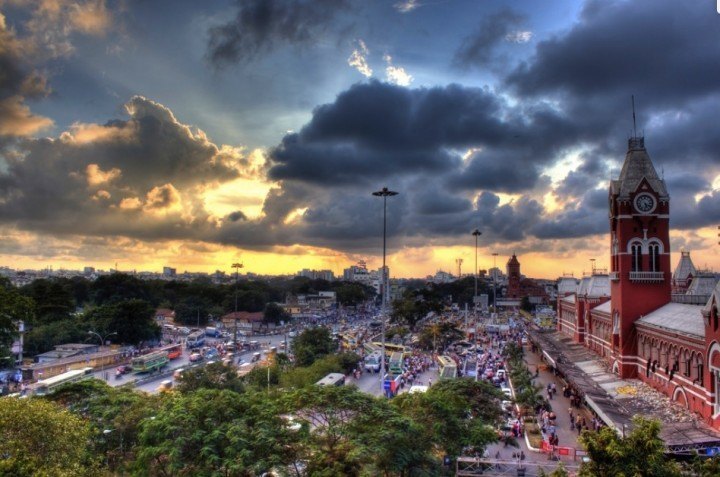
Chennai, India
At SaaSx 2015, Girish Mathrubhootham, CEO of cloud-based customer support software Freshdesk and popularly known as the Rajnikanth (think an acting, singing James Bond) of India’s Software as a Service (SaaS) scene, did the unthinkable. He revealed the entire spreadsheet of internal data-based metrics that he presented to his investors in 2011. All the media people were asked to put away their weapons and, at first, I was a little disappointed that I wouldn’t be able to share any of those numbers. Soon, however, I realized that they weren’t even important.
After Girish’s investors took a look at his numbers – and, honestly, at the time, they were not all that impressive – they decided to email his clients with a feedback survey. The response was overwhelmingly positive, with 96 percent of Freshdesk’s customers expressing approval of the product. “We didn’t even expect that,” explains Girish. “The only other feedback we got was customers expressing their desire to see us expand our product into different areas.”
The fact that customers wanted to see Freshdesk expand was important for both the company and its investors. As its progress revealed, the most dynamic feature of a SaaS product is its ability to acquire and reacquire the same customers by offering insightful new features. And, while the transient nature of software products means that differentiation can be difficult to maintain, Girish went on to explain that capturing the market was all about moving in at the right time. “Of course, best practices are easily copied and hard to retain – that’s why I’m only revealing our numbers from 2011-2012,” he joked.
SaaSx 2015, held in Chennai, Tamil Nadu, the self-proclaimed SaaS capital of India, was full of similar insights. People visited from all over the country, the furthest having traveled over 800 miles from Ahmedabad. Those in India’s startup capital, Bangalore – this includes yours truly – traveled over 6 hours and 300 miles on a bus through the winding Western Ghats to reach its neighboring state of Tamil Nadu. Despite an early start, energy was high on the road to the conference – the 34 entrepreneurs on the Microsoft Ventures-organized bus managed to conduct an ice-breaking session without falling over during the turbulent bus ride.
“My biggest virtue as an entrepreneur was patience. And, my biggest mistake… it was probably patience,” quipped one young CEO.
The SaaS leap of faith
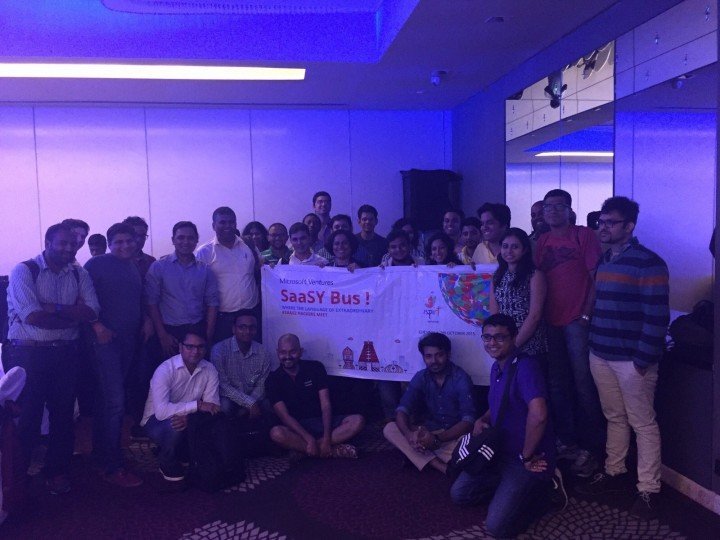
Our SaaSy Bangalore to Chennai bus group.
At the conference, Aneesh Reddy, CEO of Capillary Technologies, a software firm that helps companies manage their customers, explained to the audience that the leap from software to SaaS was the same as that of computer to mobile – an increasing number of people were going straight to the latter. Furthermore, he explained, SaaS was a product that did not need to be specifically customized for different cultures. It worked across all boundaries. “We wouldn’t have raised any money if we were only working on India,” he explains. And, in some ways, SaaSx proved that this was true. The concept of SaaS removes the need for bulky software or physical hardware, creates access to information across borders, and helps organize, manage, and enhance businesses through the use of technology. Best of all, a SaaS startup can be based out of anywhere in the world – perhaps the reason why the comparatively sleepy city of Chennai, India is now considered its new hub.
A particularly successful SaaS startup is US-based Salesforce, a cloud computing company that specializes in customer relationship management. It has a market capitalization of around US$50 billion. In India, Chennai-based Zoho is a suite of business apps that was founded in 1996. It recently broke 10 million users.
At SaaSx, it was interesting to see that startups were beginning to focus on solutions outside of the usual selection of management software. Vijay Sharma, co-founder of Bangalore-based talent sourcing startup BelongCo, explained that they used SaaS to help other startups hire better employees. “There’s a lot of data that’s currently being left out,” Vijay explained during a short one-minute feature session. “We take all the stuff that people aren’t looking at and help streamline them with a company’s vision.”
Indix, a startup that is using SaaS to aggregate the world’s ecommerce inventory into a giant catalog for brands, was represented by co-founder Sridhar Venkatesh, who explained that it would finally allow for the conjunction of geolocation and products. Bangalore-based Shieldsquare uses its software to prevent “web scraping” and stop malicious robots stealing content from sites. And CanvasFlip allows people to create working prototypes of their application or website.
SaaS circles are all about community
Throughout the event, the one thing that stood out most was the sense of community it provided. Girish Mathrubhootham spent 20 minutes at an “unconference” session patiently discussing the meaning of “inside sales” with other entrepreneurs while Shekhar Kirani of Accel Partners suggested the best resources for improving onboarding processes for SaaS startups (User Onboard, by the way. It’s really cool!).
When I boarded the bus from Chennai back to Bangalore, I was well fed, satiated, and really interested in the world of SaaS. If there was one thing that SaaSx did best, it was creating a sense of inclusion around a technology and a set of entrepreneurs that had seemed unapproachable when I set out. The Chennai SaaS cult had successfully indoctrinated its newest fan!





Stay updated on the go with our mobile app.
Get latest insights with smoother, more personalized experience through TIA mobile app.











📅 Upcoming Events
22 October 2026
Payoneer x CSPN Summit 2026