 Adinda Pryanka · · 3 min read
A rural village upbringing inspired this cloud computing startup
This article is a part of Startup Spotlight, a series that features young, up-and-coming startups.

Photo credit: Rounak Adhikary
Rounak Adhikary grew up using his family’s underpowered PC in rural Bengal, and later met a student from an even more remote village who was self-taught in astrophysics on a low-cost phone. That encounter made the problem personal, and he launched ProjectX during his first year of college.
The platform eliminates local hardware limitations. It allows anyone to access high-performance computing capabilities directly from a standard web browser.
😟 Problem
Robotics and engineering teams currently manage tools scattered across disparate servers and local laptops. A typical customer employs 10 to 45 engineers who waste hours configuring complex machine setups.
This fragmentation forces engineers to constantly transfer large files and recreate one another’s work environments. As a result, product development stalls and expensive computing hardware remains underutilized.
💡 Solution
ProjectX provides technical teams with a high-performance cloud computer called Infinity. Users can access this centralized environment instantly from anywhere.
The platform offers several core capabilities, including:
- Persistent workspaces allow engineers to run a simulation, edit code, and share the exact digital state seamlessly with remote teammates.
- Unified resources keep full desktop applications, large files, and terminals housed securely in one accessible place.
- AI integration ensures human developers and AI agents share the exact same applications and computing power.
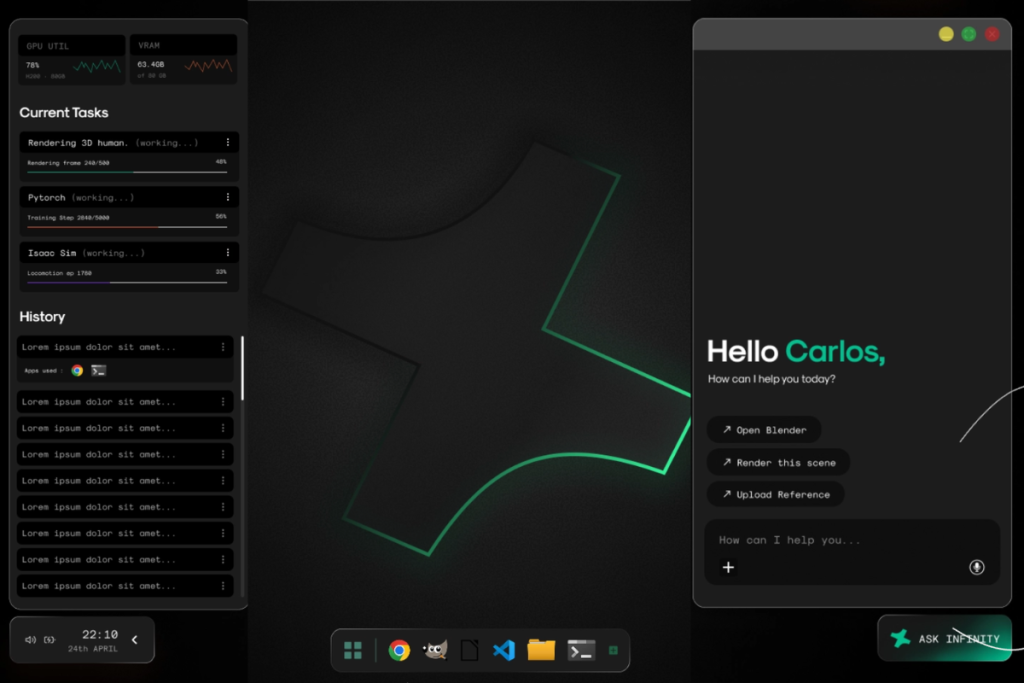
Image credit: ProjectX
📊 Market size
Enterprise AI workflows grew 19 times over in 2025. This rapid shift requires unified digital environments where AI agents can operate software alongside human workers.
The startup projects that capturing 10,000 technical teams would generate US$480 million in annual subscription revenue. Securing 250,000 engineering teams would unlock a US$12 billion annual market.
🤝 Team
- Rounak Adhikary. Founder and CEO. Adhikary taught himself design and coding, eventually using his freelance income to fund the startup’s early operations.
🚀 Traction
- Secured over 40,000 sign-ups for its first product launch without relying on paid marketing campaigns.
- Established strategic product partnerships with OpenAI and Microsoft Azure.
- Built an active pipeline of enterprise companies representing over US$5 million in potential upcoming contracts.
🏆 Competition
Existing solutions range from virtual desktops like Amazon WorkSpaces to raw GPU clouds like Runpod. Other alternatives include cloud coding environments such as Gitpod and agent sandboxes like E2B.
ProjectX differentiates itself by combining these disparate layers into one persistent workspace. Users can continue their engineering projects seamlessly without migrating files across separate cloud systems.
💰 Financials
Companies pay an estimated US$100 per user per month alongside additional computing usage fees. A standard team of 40 users yields around US$48,000 annually in baseline recurring revenue.
The startup recently raised US$4.6 million from Y Combinator, OpenAI, Pontaq VC, and Eight Capital. The company plans to raise a series A funding round in May 2027.
🚩 Risks
- ProjectX’s 40,000 sign-ups and enterprise pipeline show interest, but they do not prove paid adoption. Free-to-paid SaaS conversion data shows why signup volume can overstate revenue potential if activation and team-level conversion lag the assumed US$100 per user per month model.
- ProjectX’s all-in-one workspace depends on teams moving daily work, files, and shared states into one persistent environment. Forrester’s guidance on cloud development environment adoption supports the caution that these tools fit some workflows better than others, which could cap adoption outside teams with acute collaboration pain.
This piece was written with the help of AI and edited by our staff based on information provided by the startup.
Want to get your startup featured? Fill in the survey here.
Stay updated on the go with our mobile app.
Get latest insights with smoother, more personalized experience through TIA mobile app.
Recommended reads
 Tracking AI hiring in Singapore: OpenAI, Anthropic, and more
 Why ‘cheaper’ no longer wins dev deals for Vietnam
 Alibaba’s capex isn’t the full story
 Forget startups. Buy the business running on Excel
 Life’s a game, and AI agents are Animoca’s new play
 Indonesian AI startup goes global
 Forrest Li on scaling Sea, building smarter bots, and founder grit
 An AI assistant that joins sales calls and scores team skills
 Beyond the check: Why VCs need more than capital
 SGX’s CEO says it doesn’t need a unicorn to win





Editing by Adinda Pryanka
(And yes, we’re serious about ethics and transparency. More information here.)







📅 Upcoming Events
22 October 2026
Payoneer x CSPN Summit 2026