 Terence Lee · · 3 min read
With OnOnPay, topping up your prepaid card could take just 10 seconds

Topping up a prepaid mobile card is a mundane experience. It’s unnecessarily long too: doing it at a store takes minutes. But Vietnamese startup OnOnPay has a plan to streamline the drudgery and even make it fun.
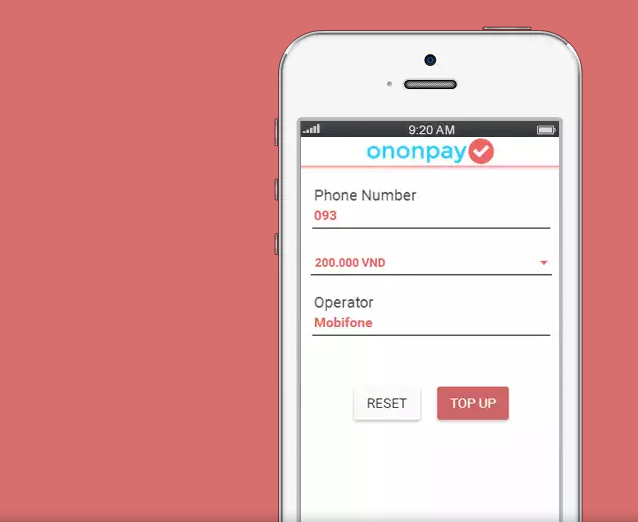
It plans to do so with an app – set for a June launch – that lets users top up their cards right from the app, in exchange for guaranteed rewards like extra credits, coupons, and gift certificates.
“To do a top-up at a retail store in Vietnam, subscribers spend at least six minutes – travel time included. With OnOnPay, it’s one minute for the first time and 10 seconds for the next few times,” says founder Sỹ Phong Bùi.
The app will notify users when their balances are low or when there’s a promotion. It allows top-ups for several phone numbers as well as scheduled top-ups. It will eventually enable credit transfer between accounts. “The more it’s convenient, the more it’s addictive,” he adds. Telcos stand to gain too. By increasing the convenience to consumers, telcos could see lower churn rates and better average revenue per user, which have been declining worldwide.
Bùi believes the time is ripe for OnOnPay. A legion of smartphone users is rising in Asia. He estimates an audience of 3.5 million students, executives, and shopaholics in Vietnam who are “online-transaction-capable.” Eventually he hopes to reach out to the 25 million people in the country making up the startup’s total addressable market. “It’s an intersection of people owning smartphones, having 3G connections, and capable of doing online payments.”
Talking money
How does this translate to revenues? At the initial stages, he estimates making US$28.80 out of every customer over their lifetime. OnOnPay takes a six percent cut of every top-up (which averages around US$8), and he foresees the typical customer topping up once a month for five years, which is the average lifespan of each Vietnamese phone number. It will also get money from merchants to offer rewards to customers.
He expects a higher customer lifetime value (up to US$38.40) in the future after working out deals with telcos to get better margins. If that works out, in a few years he could make US$7 to US$10 million in annual revenue, assuming he can get to a million users. It’s tiny in a dominate-the-world sense, but that’s just the Vietnamese market.
Vietnam sounds like a great initial market for an idea like this, given its language and cultural barrier and the lack of direct competitors. The same can’t be said for other countries though, with well-funded jugganauts like FreeCharge (recently acquired by Snapdeal) and PayTM expanding rapidly in India. Rapid regional expansion will be an outsized factor in OnOnPay’s volume game if it wants to become big.
Interestingly, Bùi is pursuing a bottom-up marketing strategy by getting mobile users first. He plans to use booths in high-traffic spots, a referral program, and Google Adwords.
It’ll also go by the other route though: OnOnPay has begun talks with one Vietnamese telco on a partnership, and it hopes to speak to more of them this year. He plans to keep customer acquisition cost at about US$1.60, which is pretty ambitious.





Stay updated on the go with our mobile app.
Get latest insights with smoother, more personalized experience through TIA mobile app.








📅 Upcoming Events
22 October 2026
Payoneer x CSPN Summit 2026