Annie Teh · · 8 min read
Here are some good, bad, and ugly examples of sponsored content
Publishers are jumping head-first into sponsored content, but the rules aren’t always spelled out. As publishers and brands figure out the dos and don’ts of sponsored content, many stumble and make mistakes. Thank goodness for outspoken and critical internet users who aren’t afraid to point out when paid articles aren’t up to par. The bigger the publisher, the louder the criticism.
As with any other new venture, trial and error is integral to learning. While some, like Edelman, have tried to create ethical guidelines, the best way to learn what makes good sponsored content is to understand the successes and failures of past campaigns. We look at five well-known publishers to understand where they went wrong, and how they have, or could have, learned from them.
It pays to be transparent
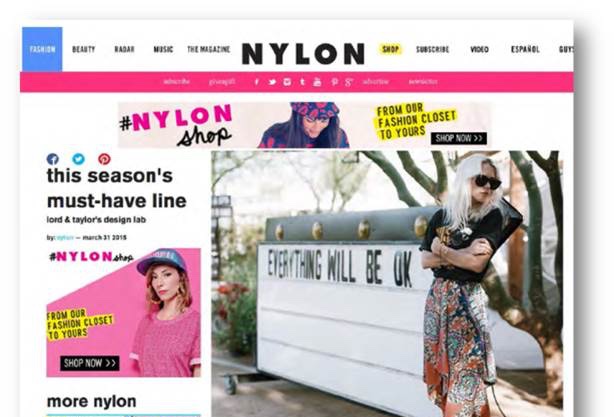
If we’re going to talk about bad examples of sponsored content, a lack of disclaimers is a good place to start. This article and photo gallery declaring Lord & Taylor’s new clothing line as “the season’s must-have line” was published on the Nylon website as an editorial piece, but neglected to state that it was sponsored by that very brand.
The article was accompanied by a successful Instagram campaign involving several fashion influencers, all wearing the same paisley dress, leading to that dress being sold out. None of the influencers disclosed they were each paid a few thousand dollars for the brand’s promotion.
The article and Instagram campaign led to Lord & Taylor having to settle a complaint from the Federal Trade Commission for “misrepresenting that paid commercial advertising is from an independent or objective source.” The article has since been removed.
That’s not to say that fashion magazines can’t create meaningful content featuring brands. In 2012, Refinery29 worked with Levi’s to produce a series of interviews featuring innovative entrepreneurs, including Instagram’s Kevin Systrom and the two founders of Warby Parker, all clad in Levi’s clothing.
The success of this piece was telling in the comments, where many complimented the publisher on creating great branded content. One comment read: “Kudos on a sponsored post with great content while avoiding the feeling that the company dictated it.”
What we learned: Always disclose if it is a paid article; it won’t necessarily blow up in your face. In fact, good sponsored content is so few and far between that producing quality ones can be a win in your favor.
Know what your readers want
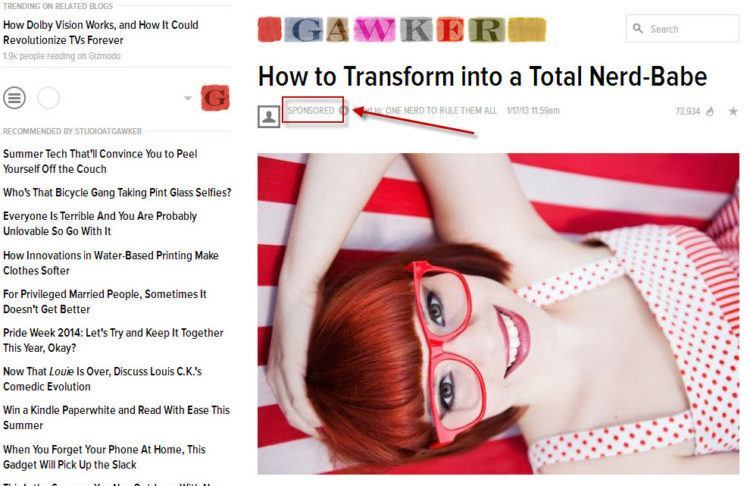
When Gawker published this article promoting TBS’s new TV show King of Nerds, the media company had just begun dipping its toes into sponsored content.
Their inexperience was evident, as the article turned out to be cringe-worthy. The most glaring problem was that the angle was so far removed from Gawker’s usual stream of American cultural topics that it seems absurd. After all, Gawker’s kind of fashion advice is more in-line with strange animal T-shirts and the Duggars. Providing advice on how to attract men with nerd-chic fashion isn’t part of Gawker’s expertise.
On top of that, the article was peppered with grammatical errors, and the only hint that the article was sponsored was the barely-visible label below the title, and a very awkward mention at the end of the article.
These days, sponsored articles on the site are published under Studio@Gawker, the company’s new branded content arm. All branded content are now published under the Studio@Gawker brand, and thankfully, the content has gone through spellcheck.
In September of the same year, Studio@Gawker worked with Jarritos to create a three-part series about Mexican food and culture. The three articles, which included an insightful interview with Mexican street artist Federico Archuleta, tapped into Jarritos’ roots to showcase Mexican culture in an entertaining and informative way. The campaign was a huge success, gathering 58,000 cumulative page views and 366 likes for Jarritos.
What we learned: It’s paramount for all written branded content to follow the basic rules of all editorial pieces like grammar and maintaining a consistent voice. Also, don’t attempt to comment on something that you (brand or publisher) are clearly not an expert in — the inexperience will show. Try interviewing actual experts instead.
Avoid BS
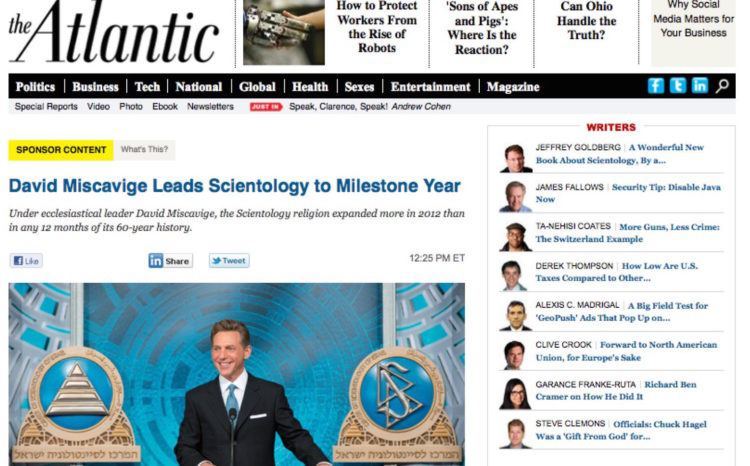
An article titled “David Miscavige Leads Scientology to Milestone Year” would have been right at home on Scientology Weekly, but not on The Atlantic. The news site received massive backlash from its readers, with words like “advertorial” and “propaganda” being thrown about.
The criticisms had nothing to do with a lack of a disclaimer, as the article was labelled in bright yellow as “Sponsor Content.” Rather, it was the fact that it did a very terrible job fitting The Atlantic’s voice. While the publication is known for its strong journalism and high-quality editorial pieces, this article bordered on propaganda, exalting David Miscavige’s many accolades and success as the leader of the church and passing it off as relevant news.
In response to critics, The Atlantic took down the article and issued a sincere apology.
“We screwed up. It shouldn’t have taken a wave of constructive criticism — but it has — to alert us that we’ve made a mistake, possibly several mistakes. We now realize that as we explored new forms of digital advertising, we failed to update the policies that must govern the decisions we make along the way. It’s safe to say that we are thinking a lot more about these policies after running this ad than we did beforehand. In the meantime, we have decided to withdraw the ad until we figure all of this out. We remain committed to and enthusiastic about innovation in digital advertising but acknowledge—sheepishly—that we got ahead of ourselves. We are sorry, and we’re working very hard to put things right.”
Since publishing the Scientology article in 2013, The Atlantic has followed up on their promise to revise their branded content strategy, with a very prominent disclaimer and link to their Advertising Guidelines appearing on all their articles.
One of their native advertisement even mentioned the collaboration between Atlantic Re:think, their branded content arm and Porsche. The article, “Art of the Thrill”, created compelling visualizations about the thrill of being in a Porsche car, using artistic renderings of biometric data. It was so innovative and shareable that readers were willing to overlook the fact that it was sponsored by Porsche.
This article went on to win “Best Advertiser/Program Partnership” at the Best of the Web & Digital Awards, 2015.
What we learned: Readers can see through the bullshit, so don’t feed them any. Instead, focus on creating original and entertaining content that people will remember.
Also remember that it can also take a village to create quality pieces — Cramer-Krasselt was the creative agency, Omnicom Media Group was the media agency, TRAQS was the analytics firm that collected the biometric data, and Sosolimited was the design firm that turned that data into art.
Sponsored content isn’t just an ad
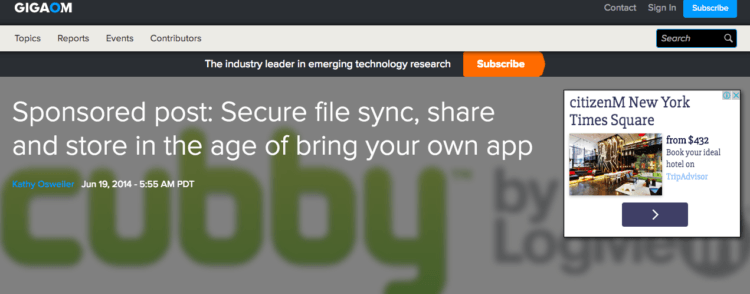
This article by Gigaom is a classic example of sponsored content being written by the brands without any editorial input. The article, which consists of a threadbare promotional pitch, shows how little both brands and publishers cared. In fact, it’s hard to call this an article — 121 words of self-promotion does not a branded article make.
Gigaom has gone through a lot of changes in the past few years, having been bought over, shut down, and relaunched in August 2015. The new Gigaom site is peppered with sponsored content that are distinctly different from the usual editorial feed, like Dell’s “The driverless economy: what our city streets might be like in 2020.” Despite bearing Dell’s logo on the Gigaom front page, it still gathered a series of reader comments chiming in with thoughts on the driverless economy, which is a sign that people are engaged by the article.
What we learned: Branded content shouldn’t be treated as just another advertising outlet — it can be a great tool to establish thought leadership, generate conversations, and interact with prospects.
Experiment with caution
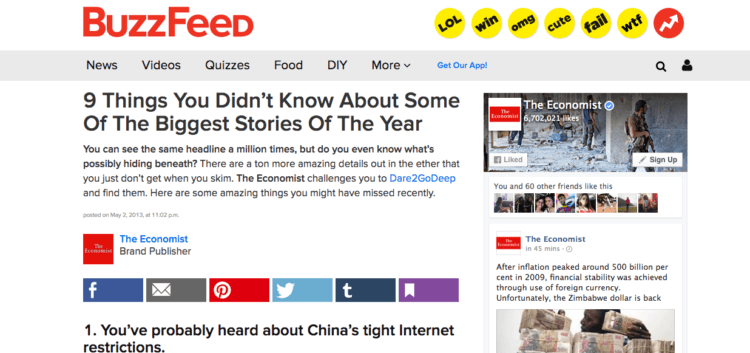
You’d think that an established publisher like The Economist would know a thing or two about how to reach out to their audience, but their Dare2GoDeep campaign created in collaboration with Buzzfeed failed to hit its mark. Amongst giggles about “going deep,” the awkward attempt to appeal to college-goers reached its pinnacle in “9 Things You Didn’t Know About Some Of The Biggest Stories Of The Year”, where they paired hard-hitting news pieces with gifs and memes.
Some perplexed Twitter users singled out this cringe-worthy article, with one asking if The Economist got a receipt for the paid content. Editorial Director of Mic Stefan Becket even tweeted the article with this caption: “At some point when trying to appear to be digitally native you become a caricature of yourself.” Ouch.
The collaboration with The Economist may have missed the mark, but Buzzfeed is still the resident expert at creating highly shareability (if superficial) articles. In a branded post for Mini USA,” Buzzfeed taps into the age-old formula of showcasing photographs of beautiful places around the world.
Unlike the Economist article, the photo spread garnered 439 reactions and 108 comments, with many other people contributing to the conversation with gorgeous travel images of their own.
What we learned: Sometimes the oldest trick in the book works wonders, and experiments will blow up in your face. It’s okay to have both in your repertoire, as long as you think through your ideas thoroughly from all angles.
Get clued in
Itching to learn more about content marketing? Fill in the very simple form below, and we’ll drop you an update the next time we share new insights. Let us know what you want to learn next in the comments below!
Brand Pulse is Tech in Asia’s very own take on sponsored content. Our Brand Pulse team works closely with reputable brands to create educational, insightful, and credible content for our audience. To find out more, visit us at brandpulse.techinasia.com, or drop us an email at brandpulse@techinasia.com.
Stay updated on the go with our mobile app.
Get latest insights with smoother, more personalized experience through TIA mobile app.
Recommended reads
 Animoca co-leads $1.75m round of IreneDAO creator
 Will virtual humans replace ‘real’ influencers, models, and more?
 IDN Media launches $3m fund for livestreamers
 The important and unseen role that content delivery networks play in our daily lives
 Can Carousell crack Google-Facebook duopoly with big ad bet?
 High-voltage drama in the world’s fastest-growing video-streaming market
 Engaging Gen Z through interactive gaming
 Breaking down WhatsApp and Facebook’s super-app ambitions
 Line to launch NFT marketplace in Japan next month
 CEO of Byju’s-owned WhiteHat Jr files $2.7m defamation suit against critic